
Key Takeaways:
- 1. Rarity needs demand to mean anything. A prototype can exist in just a handful of known examples and still underperform at auction if collector interest in that category is weak. Scarcity sets the ceiling; demand determines whether you ever reach it.
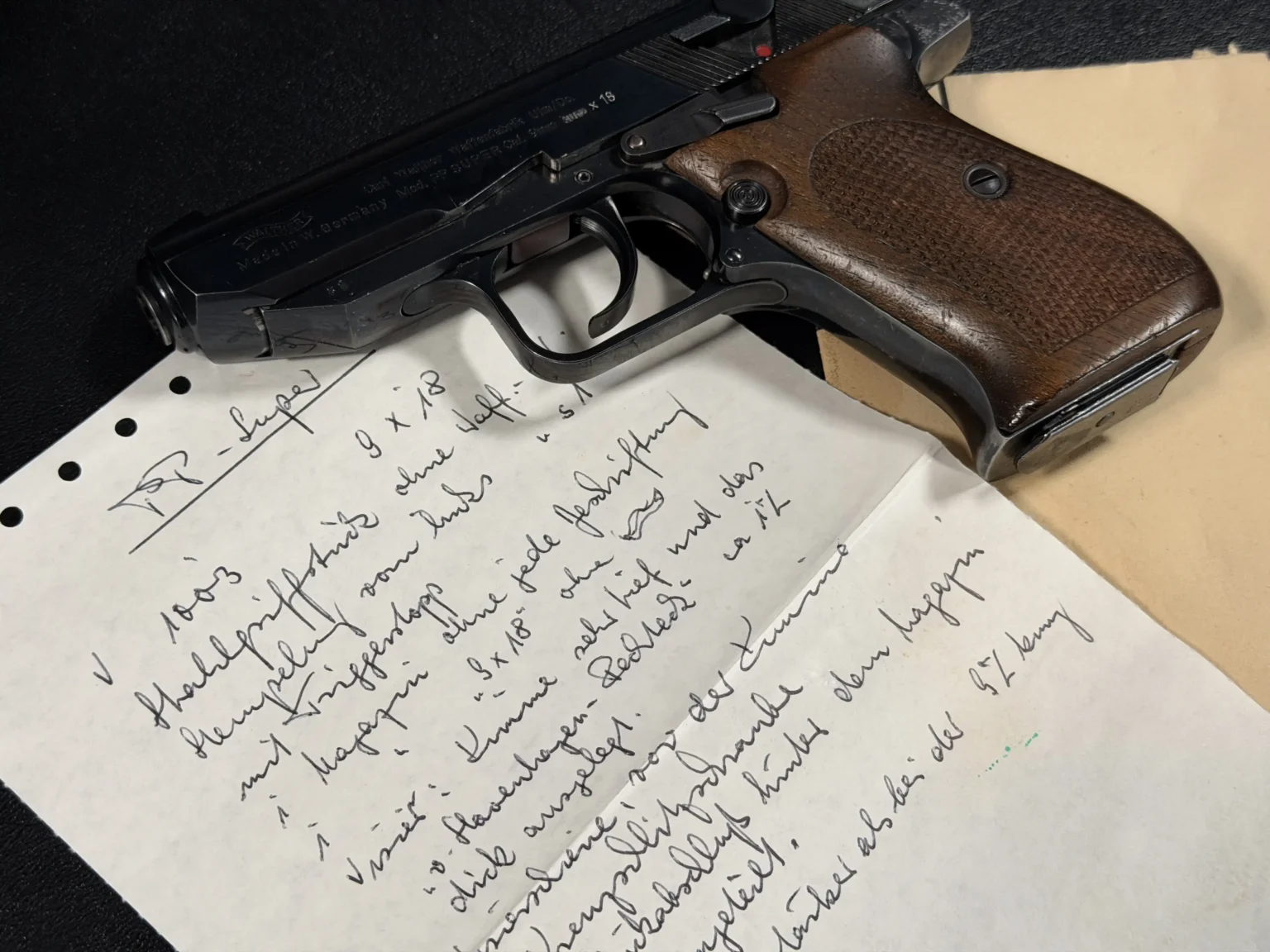
- 2. Documentation isn’t optional; it’s everything. Factory letters, military trial records, and a clean provenance chain are what separate a genuinely valuable prototype from an expensive question mark. Without paperwork, even the most historically interesting piece can sell for less than a standard production model.
- 3. Volatility cuts both ways. The same market that produces record-breaking auction results can just as easily deliver disappointing ones. Prototype collectors who rely on research and careful authentication tend to learn the lesson the hard way. Buyers who skip that homework do, too.
There’s something almost mythological about a prototype firearm. It’s a gun that almost was, a mechanical idea frozen between concept and reality, captured at the exact moment when a designer was still working things out. Most collectors understand intuitively that prototypes are special. But “special” doesn’t quite capture what happens when one hits the auction block.
The numbers can be staggering. Even shocking. Especially when you put them next to the standard production versions of the same gun.
So how much more valuable is a prototype, really? And what drives that gap? Let’s work through it.
Rarity Matters More Than Almost Anything
Here’s what collectors learn pretty quickly: condition matters, originality matters, provenance matters, but rarity sits above all of them. A gun that exists in only a handful of known examples will almost always outperform a gun that exists in ten thousand. Even if that ten-thousand-unit gun is in pristine, unfired condition.
Prototype firearms are among the rarest objects in the firearms market. A production model like the Ruger 10/22 has been manufactured in over seven million units, according to Ruger’s own production figures. A factory prototype, by contrast, might survive in only a handful of examples. Pre-production runs sometimes number in the dozens. True developmental prototypes, the guns made to test ideas before tooling was finalized, are often far scarcer than that.
When supply drops that low while demand stays strong, prices behave in ways that can feel almost irrational. But they’re not irrational. They’re just following a different economic logic.
Here’s the important caveat, though: rarity alone doesn’t guarantee high prices. NRA curator Jim Supica has pointed out that a firearm can be genuinely rare yet undervalued if few collectors are interested in it. The demand side matters just as much as the supply side. A prototype from Colt or Winchester draws from a deep, well-established collector base. A prototype from a lesser-known manufacturer might sit in relative obscurity despite being equally scarce. Rarity creates potential. Demand is what turns that potential into price.
The numbers bear this out. A standard production Colt M1911 in excellent condition fetches around $5,700 on today’s market, according to Rock Island Auction’s price data. A first-production-year M1911 sold for $152,750 at auction, roughly 26 times the average production price. That multiplier came from meaningful scarcity within the production run itself, before you even get into true developmental prototypes.
What “Prototype” Actually Means
It’s worth pausing to define terms. The word “prototype” gets used loosely in collector circles, and that vagueness can create real problems when money is involved.
A true factory prototype is a firearm produced by the original manufacturer during the design process, before production tooling was finalized. These guns often differ from the eventual production model in clear ways, such as different tolerances, components, markings, or even operating mechanisms. They were made to test ideas, not to sell to customers.
Pre-production guns are sometimes confused with prototypes, but sit closer to the start of a production run. They typically match the final design but carry special markings or predate the normal serial number sequence. Valuable? Yes. But usually not as extreme as true developmental pieces.
Then there are “project guns” or “one-offs”, custom modifications or experimental builds that originated outside the factory. These can be fascinating, but they live in a completely different valuation tier. An undocumented one-off that can’t be authenticated might actually be worth less than a standard production model. Buyers can’t be certain what they’re getting, and uncertainty drives prices down.
The line between these categories matters enormously when money is on the table.
Documentation: The Factor That Makes or Breaks Value
You know what separates a $5,000 firearm from a $75,000 firearm in this niche? Paperwork.
That sounds anticlimactic. But it’s true, and it’s worth being specific about which types of paperwork actually move the needle, because not all documentation carries equal weight.
Factory letters are among the most powerful documents a prototype can have. Major manufacturers like Colt and Winchester have historically issued letters confirming a firearm’s origin, production date, and special characteristics. These letters aren’t just interesting historical artifacts. They’re authentication anchors that give buyers solid ground to stand on. Factory letter services still exist for certain manufacturers today.
Military trial records are even more valuable. The National Archives holds significant documentation related to U.S. military weapons evaluations. Connecting a specific firearm to a specific documented test record is the kind of discovery that transforms a moderately interesting piece into something historically verifiable. That’s hard to dispute, and impossible to fake convincingly.
Provenance documents round out the picture. This means the full ownership chain, from the original manufacturer or military custody through to the present day. Photos of the firearm in a testing context, contemporary correspondence referencing the specific gun, and expert authentication from recognized authorities like the NRA Museums or established auction houses, all add credibility that sophisticated buyers factor directly into their bids.
Without documentation, the situation reverses quickly. An undocumented piece sits in uncomfortable limbo. It might be a genuine experimental gun. Or it might be a customized production model with an invented story. In a market where authenticity is everything, that uncertainty translates directly into lower prices. Sometimes much lower. The documentation needs to exist before the purchase, not be promised afterward.
Why Historical Significance Commands a Premium
Collectors aren’t just buying objects. They’re buying stories and connections to moments in history when decisions were made that affected armies, wars, and millions of people. A prototype often sits at the center of one of those stories in a way no production model can.
Think about it this way. When you own a standard-production M1 Garand in excellent condition, you own a piece of World War II history. That’s genuinely meaningful. But when you own a prototype from the military competition that the Garand eventually won, you own the decision point itself. That’s a qualitatively different experience, and collectors with the resources to pursue it will pay accordingly.
The Pedersen rifle makes this point clearly. John Pedersen’s semi-automatic rifle competed in U.S. military trials during the interwar period and lost out to what became the M1 Garand. Documented Pedersen rifle prototypes from those 1929 trials have reached $74,750 at auction, according to Rock Island Auction. Their commercial counterparts sell for far less. The documentation connecting those prototypes to the actual military evaluation is a large part of why.
Worth noting: the Pedersen lost. Its trial outcome didn’t diminish the value. The association with the trial itself is what matters, not the result.
How Prototype Markets Differ From Production Markets
Standard production firearms, particularly those with established collector bases, tend to appreciate in stable and predictable ways. A pre-64 Winchester Model 70, a Colt Python in excellent shape, and a matching-numbers Luger; these guns have known markets, published price histories, and a reasonably predictable trajectory. Collectors can research comparables, understand condition grades, and make informed purchases without taking enormous risks.
Prototype markets work differently.
They’re volatile in both directions. When the right prototype hits the right auction at the right moment, the results can be extraordinary. Multiple serious collectors competing for a single documented example with strong provenance and clear historical importance, that creates the conditions for record prices. The premiums involved vary widely. There’s no reliable formula. What’s consistent is that exceptional circumstances produce exceptional results.
The first-year M1911 example is instructive here. A 26-times premium over the average production price is dramatic, but it came from a combination of factors: chronological rarity, documented provenance, and strong collector interest in Colt 1911s specifically. Remove any one of those factors, and the number would likely be lower.
The downside is equally real. A prototype that comes to market without adequate documentation, or during a period of reduced collector interest in that category, can underperform badly. Unlike a production Colt or Winchester, there’s no established comparable to anchor expectations. One auction result becomes the reference point, for better or worse.
This volatility excites some collectors. It makes others nervous. Both reactions are reasonable.
What Actually Drives a Prototype’s Price
Not all prototypes are equal. Here’s a practical breakdown of what separates a $10,000 piece from a $100,000 piece.
Manufacturer reputation is foundational. A prototype from Colt, Winchester, Remington, or Springfield Armory carries a built-in interest premium. The collector bases for these makers are large, auction interest is broad, and the historical context is well understood. A prototype from a lesser-known maker simply doesn’t have the same following.
Military trial connection is probably the single most powerful driver after basic rarity. A gun that was submitted and evaluated in official military trials has documented, verifiable significance. The paper trail from those evaluations, when it survives, creates an authenticity foundation that’s hard to replicate. This is exactly what drives the Pedersen rifle’s auction results.
Physical differences from production matter more than casual observers expect. A prototype that looks nearly identical to a production model creates authenticity challenges and generates less excitement. One with clear engineering differences, experimental components, or unique markings tells a more compelling story, and stories sell.
The collector demand for the category shapes everything else. Rarity is only valuable when buyers want what’s rare. A prototype from a historically significant category with an active collector base will consistently outperform an equally scarce example from a niche with limited following. Jim Supica’s observation about rare guns being undervalued when interest is low applies directly here.
Condition still matters, even for prototypes. An experimental firearm in excellent shape will outperform the same gun in poor condition. The gap is smaller than in the production market, but it exists.
Is Prototype Collecting Right for You?
Honestly, no, not for everyone. And that’s not a dismissive answer. It’s a practical one.
Prototype collecting demands a serious commitment to research. You need to understand documentation, authentication, and the history of specific manufacturers and military programs. You need risk tolerance for a volatile market. And you need to be comfortable making decisions with limited comparable data.
That’s a high bar. Not every collector wants to clear it.
For those who want to participate in the excitement without fully committing to acquiring a prototype, there are adjacent options. Pre-production examples with documented serial numbers at the beginning of production runs offer meaningful rarity at lower price points. Limited-run military contractor variants with clear government documentation can show similar appreciation patterns at more accessible entry prices.
For those who do pursue true prototypes: engage with recognized experts, use auction houses with genuine authentication expertise, and treat documentation as non-negotiable. Rock Island Auction maintains a research team and publishes price history that serious collectors treat as reliable reference material. That kind of institutional knowledge is worth leaning on.
Standard Production Models Still Hold Their Own
It would be wrong to leave the impression that production firearms are somehow worth less. They’re not.
The market for high-condition, original-configuration production firearms from major manufacturers is deep, liquid, and well understood. Pre-64 Winchester Model 70s have appreciated consistently for decades. Matching-numbers Lugers continue to command strong prices. First-year Colt Pythons in original factory boxes represent serious money.
Production models offer something prototypes generally can’t: predictability. You can research what comparable pieces have sold for, clearly see how condition grades affect pricing, and then make an informed decision supported by real market data.
The appreciation of production models tends to be slower and more measured than the dramatic swings possible in the prototype market. For collectors who prefer stability, or who are building collections over long time horizons, that’s not a drawback. It’s a feature.
Prototype vs. Production: The Key Differences at a Glance
| Factor | Standard Production Model | Prototype / Experimental Model |
|---|---|---|
| Availability | Mass-produced (thousands to millions) | Often only a handful of known survivors |
| Primary value driver | Condition and originality | Rarity, demand, and historical significance |
| Documentation needs | Original box and manual help | Factory letters, trial records, and provenance are essential |
| Price behavior | Stable, predictable appreciation | High volatility; premiums vary widely |
| Comparables | Readily available auction data | Often single data points or none |
| Authentication risk | Low for known production variants | Often, single data points or none |
What It All Comes Down To
Prototype firearms occupy a unique corner of the collector market. They carry real risks alongside extraordinary potential. But for collectors with the patience to research deeply, the resources to pursue documentation, and the risk tolerance to navigate a volatile market, they offer something no production model can: a direct physical connection to the decision points of firearms history.
The value gap between a documented prototype and its production equivalent isn’t arbitrary. It reflects real scarcity, real historical importance, and real collector demand that outpaces available supply. But rarity without demand is just obscurity. Historical significance without documentation is just a story. The most valuable prototypes are those in which all three forces, scarcity, desirability, and verifiable authenticity, align at once.
Understanding why that alignment matters, and what it takes to find it, makes you a more informed buyer. In this hobby, that knowledge is worth as much as the firearms themselves.
Frequently Asked Questions
Prototypes combine extreme scarcity with direct historical significance, factors that standard production guns simply can’t match. When strong collector demand meets limited supply, auction prices can climb well beyond what most people expect.
Not necessarily, a prototype without solid documentation or collector interest can actually sell for less than a standard production equivalent. Rarity only drives value when buyers actively want what’s rare.
Factory letters, military trial records, and a clear ownership chain from manufacture to the present day are the most important pieces. Without at least one of these, even a genuinely interesting piece carries serious authentication risk.
Absolutely, production models offer stable appreciation, reliable comparables, and a well-understood market that prototypes simply can’t provide. For many collectors, that predictability is worth more than chasing volatile auction results.
Start with the documentation, not the gun itself. If the paperwork trail isn’t solid before you buy, walk away. Engaging a recognized expert or a reputable auction house like Rock Island Auction before committing