
Key takeaways
- Hilton Yam founded 10-8 Performance in 2006 to develop 1911 components.[1]
- The company’s rear sight received coverage in the July 2006 issue of S.W.A.T.[2]
- The Nighthawk Custom 10-8 was developed in collaboration with 10-8 Consulting.[4]
Let’s get going…
Hilton Yam founded 10-8 Performance in 2006 to develop components for the 1911 pistol. Its first product was a rear sight combining a U-shaped notch, a serrated rear face, and a ledge profile. The company’s name came from the police radio code “10-8,” which Yam explained as meaning “on duty” or “in service.”[1]
The sight brought the company into the specialist firearms press early in its history. The July 2006 issue of S.W.A.T. included “10-8 Performance Rear Sight: A Different Way to Look at Things.”[2]
In January 2008, Scott Smith’s “Lights, Lasers, and Tactical Sights” in POLICE examined the sight as equipment for a working handgun. Smith identified Yam as its designer and described his own use of a 10-8 rear sight paired with a TRUGLO TFO front sight. His account emphasized the U-shaped notch and serrated blade, describing the serrations as a means of reducing glare. He also reported that versions were offered for Smith & Wesson M&P pistols, Kimber applications, and Novak rear-sight cuts.[3]
That coverage presented 10-8 Performance to a law-enforcement readership through an individual component. Its sight could be encountered on a pistol made by another manufacturer, independently of Yam’s custom gunsmithing.[3]
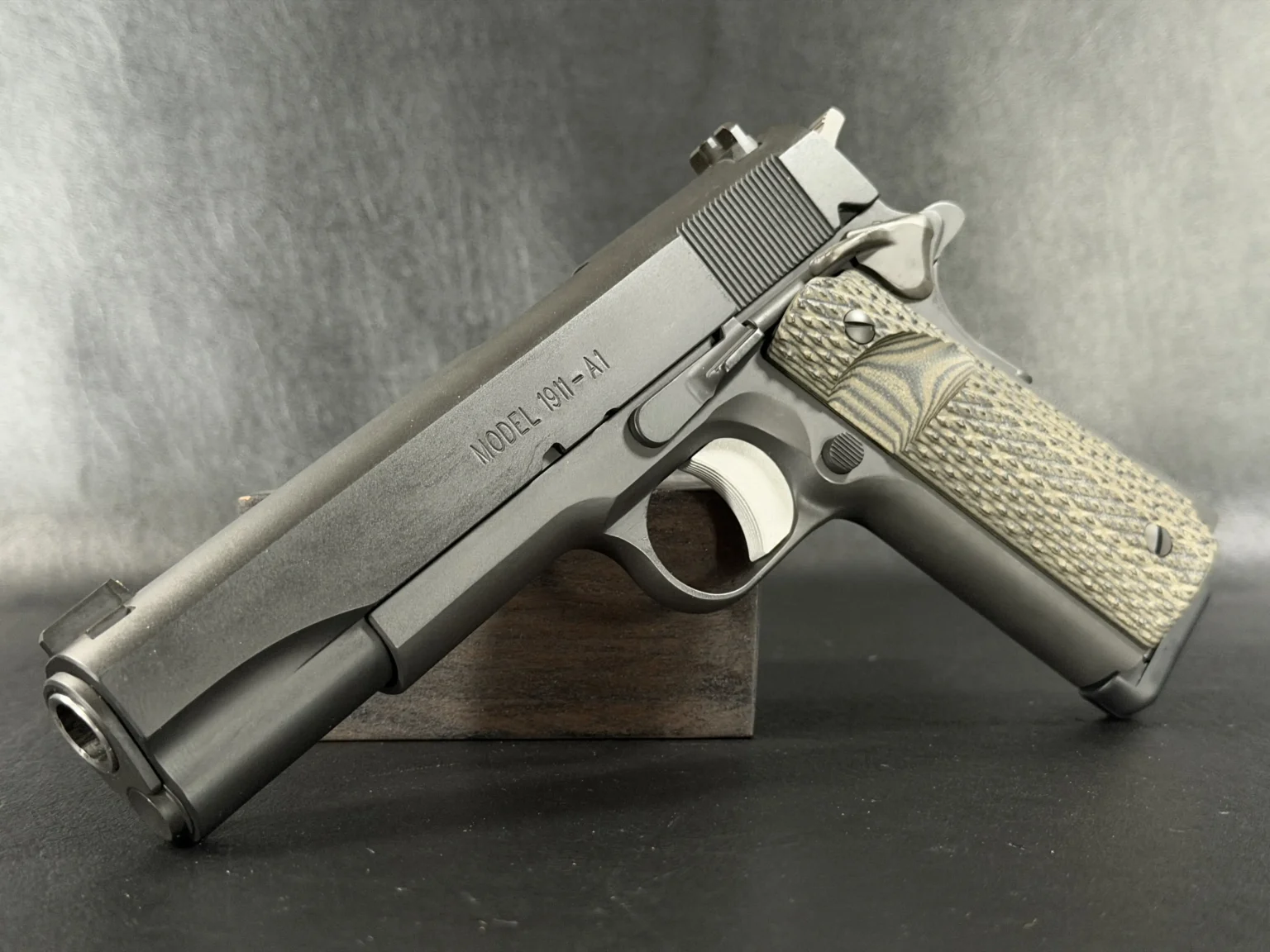
The Nighthawk Custom 10-8 carried the name onto a complete pistol. In his Handguns review, Paul Scarlata identified the model as a collaboration between Nighthawk Custom and 10-8 Consulting. He separately credited Yam with designing its 10-8 Performance rear sight. The reviewed pistol was a .45 ACP 1911 with a 5-inch barrel, a Trijicon front night sight, a Dawson Light Speed rail, and VZ Diamondback grips bearing the 10-8 logo.[4]
For collectors, those distinctions matter. A Nighthawk Custom 10-8, a pistol fitted with a 10-8 Performance component, and a custom pistol built by Yam represent different descriptions of manufacture and workmanship. The shared name should not substitute for identifying who built the firearm and which parts it carries.[1][3][4]
Training formed another part of the published identity. In S.W.A.T., Ed Lawrence described attending a 10-8 Consulting 1911 Diagnostics & Operation Course led by Tim Lau, with Erick Gelhaus, Joe Reidy, and Yam participating. Lawrence identified 10-8 Performance as Yam’s product business and described Yam inspecting and correcting students’ pistols during the course. The account connected the parts with practical instruction in inspection, maintenance, and reliable operation.[2]
Yam’s custom work also had its own naming system. In his published interview with Rob Garrett, he recalled building a series of pistols named after the phonetic alphabet, including Alpha, Bravo, and Charlie. He later shifted his attention from complete custom 1911s to component development.[1]
Frequently Asked Questions
Hilton Yam founded 10-8 Performance in 2006 to develop components for the 1911 pistol.
Its first product was a rear sight with a U-shaped notch, a serrated rear face, and a ledge profile.
The July 2006 issue of S.W.A.T. included a feature titled “10-8 Performance Rear Sight: A Different Way to Look at Things.”
It was a .45 ACP 1911 developed by Nighthawk Custom in collaboration with 10-8 Consulting. The pistol incorporated a 10-8 Performance rear sight designed by Hilton Yam.
No. A 10-8 Performance sight identifies a component and does not, by itself, establish that Yam built the complete pistol.
Sources
[1] Yam, Hilton. “The Armory Life Interviews: Hilton Yam.” Interview by Rob Garrett, The Armory Life, vol. 4, no. 2, Summer 2024, p. 22.
[2] Lawrence, Ed. “10-8 Consulting Diagnostics & Operation Course.” S.W.A.T., n.d.
[3] Smith, Scott. “Lights, Lasers, and Tactical Sights.” POLICE, January 1, 2008.
[4] Scarlata, Paul. “Nighthawk Custom 10-8.” Handguns, September 24, 2010.