
Key Takeaways
- Original and current-production Colt Pythons are mechanically different and belong to separate collecting categories.
- The Smith & Wesson 686 Plus holds seven cartridges, compared with the Python’s six.
- Configuration, condition, originality and documented provenance are critical when evaluating a collectible Python.
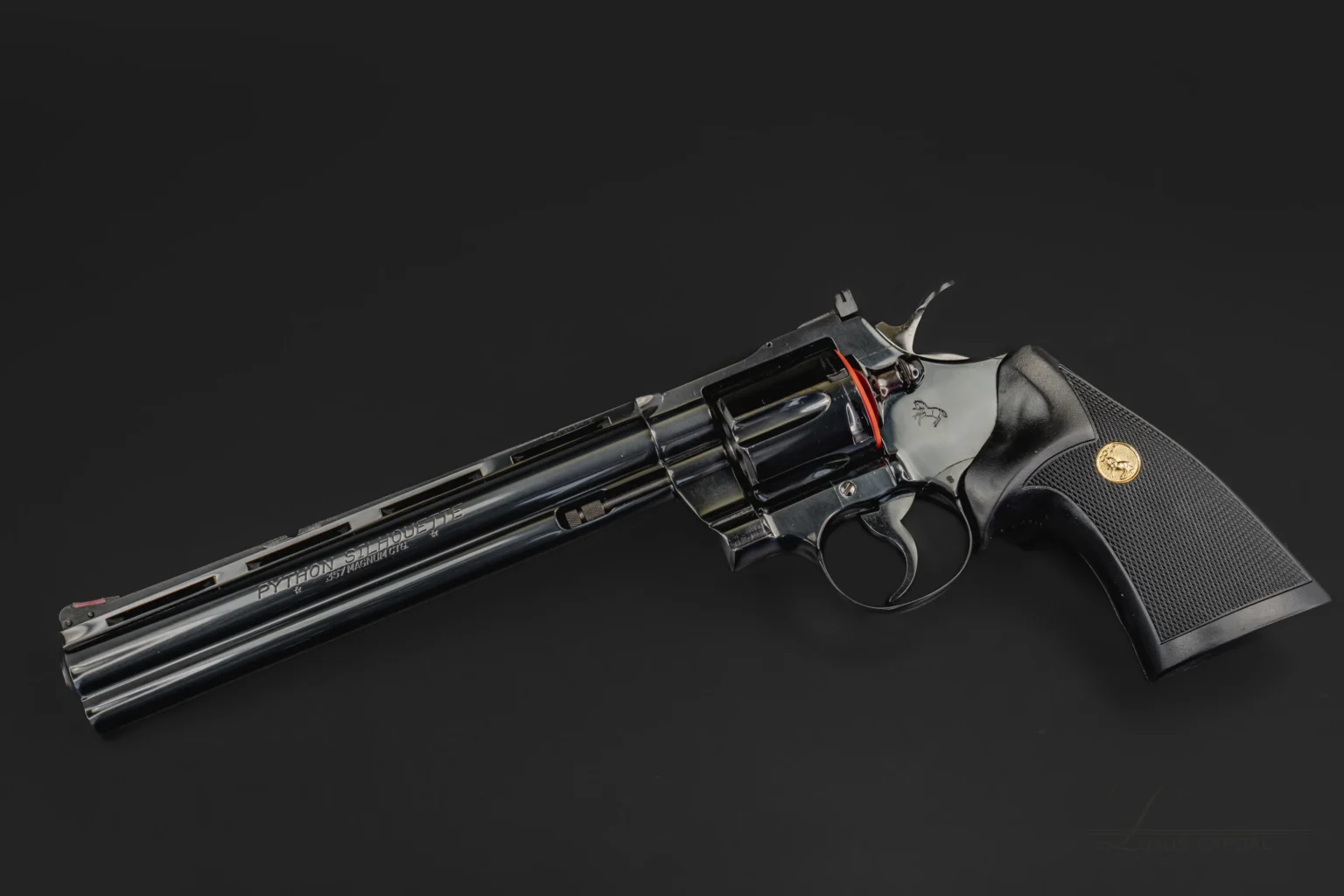
Few American revolvers are as immediately recognizable as the Colt Python. Its ventilated barrel rib, full-length ejector-rod shroud and high-polish finish established a distinctive profile when Colt introduced the model in 1955. The Python subsequently developed a reputation for careful fitting, a refined action and premium construction.[1]
That history matters, but “Colt Python” now describes two materially different revolver generations. Original-production Pythons were assembled and finished with substantial skilled handwork. Regular production ended in 1996, followed by limited Custom Shop availability through 2005. Colt introduced a redesigned, commercially manufactured Python in 2020.[1][2]
Original and Current-Production Pythons
The original Python was a six-shot, double-action revolver built primarily for .357 Magnum and .38 Special ammunition. Colt offered multiple barrel lengths and finishes over its production life, including Royal Blue, nickel and stainless steel. Less-common configurations, special editions and documented factory engraving now occupy distinct collecting categories.[2][3]
The current Python retains the earlier revolver’s visual identity but is not a mechanical reproduction. Colt revised the action, strengthened internal components and increased the amount of steel in the topstrap. Modern machining replaced much of the hand-fitting associated with original production.[1]
Colt’s manual identifies the current Python as a six-shot, single- and double-action .357 Magnum revolver that can also fire .38 Special and .38 Special +P ammunition. The 6-inch stainless model weighs 46 ounces unloaded and measures 11.5 inches overall. It has adjustable rear sights, an interchangeable front sight and 1:14-inch left-hand rifling.[4]
Colt has since expanded the current Python family beyond the 4.25- and 6-inch stainless models introduced in 2020. Its 2026 commercial catalog lists .357 Magnum Pythons with barrel lengths from 2.5 to 8 inches, including stainless, blued and specialized configurations.[5]
Trigger and Accuracy
The original Python’s trigger is central to its reputation. Its lockwork was fitted and polished by experienced workers, producing a double-action pull widely regarded as unusually smooth for a factory revolver. That refinement came with complexity: servicing the older Colt action correctly requires specialized knowledge, and improper adjustment can affect cylinder timing.[1]
The current action was engineered to provide a similarly smooth pull with fewer components and stronger engagement surfaces. In a 2020 evaluation for American Rifleman, Wiley Clapp reported clean single-action pulls and smooth, consistent double-action operation in two test revolvers. His accuracy testing also found the redesigned guns comparable to the original Pythons used in the same evaluation.[1]
Those results establish that the current Python can be an accurate revolver; they do not prove that every Python will outperform every competing model. Ammunition, barrel length, individual manufacturing tolerances and the shooter all influence practical accuracy.
Python vs. Smith & Wesson Model 686 Plus
The Smith & Wesson Model 686 Plus is one of the Python’s most direct current-production competitors. Both are stainless steel, double-action .357 Magnum revolvers with adjustable sights and full-length barrel underlugs. Both can also use .38 Special ammunition.[4][6]
The clearest functional difference is capacity. The Python holds six cartridges, while the 686 Plus holds seven. Smith & Wesson also emphasizes the 686 Plus’s interchangeable grips and offers it in configurations intended for sporting, field and defensive use.[6]
Trigger characteristics differ because the two manufacturers use different lockwork. Descriptions such as “smoother” or “better” remain subjective unless the specific revolvers are measured and fired under identical conditions. For a buyer comparing current-production examples, the meaningful questions are grip fit, trigger preference, barrel configuration, capacity and price—not the reputation of the model name alone.
From a collecting standpoint, an ordinary current-production 686 Plus and a current Python are both modern commercial firearms. An original, documented Python belongs to a different market because age, configuration, originality and provenance materially affect collector interest.
Python vs. Ruger GP100
The Ruger GP100 provides another useful comparison. Ruger’s standard 6-inch stainless GP100, model 1707, is a six-shot .357 Magnum revolver with adjustable rear sights and a full barrel underlug. It weighs 45 ounces and measures 11.5 inches overall—one ounce lighter but otherwise the same published overall length as Colt’s 6-inch stainless Python.[4][7]
Ruger uses a triple-locking cylinder and a modular grip frame that accommodates numerous grip styles. Its published specifications also list a 1:18.75-inch right-hand rifling twist, compared with the Python’s 1:14-inch left-hand twist.[4][7] Rifling specifications alone do not establish which revolver will be more accurate with a particular load.
The GP100 is positioned as a practical, serviceable revolver, while the Python carries a higher level of finish and a historically significant name. Ruger’s published suggested retail price for model 1707 is also below the Python’s cataloged price.[5][7] For regular range or field use, the GP100 may therefore offer the more economical route to a full-size stainless .357 Magnum. It does not, however, duplicate the Python’s design, finish or collector history.
Engraved and Collectible Pythons
Engraving adds value only when its origin and quality are established. Colt offered factory-engraved and gold-inlaid Pythons through its Custom Shop, but aftermarket engraving also exists. An engraved revolver should not be described as factory engraved without supporting documentation.[3]
Colt Archive Services can research an individual firearm by model and serial number. Depending on the surviving records, an archive letter may confirm the original configuration, shipment details, engraving or special features.[8] Such documentation is particularly important for unusual barrel lengths, finishes, special editions and engraved examples.
Condition must also be evaluated carefully. Rebluing, polishing, replacement stocks, altered sights and non-factory engraving can materially change collector desirability even when the work is attractive. Boxes and accessories are useful only when they are correct for the revolver and credibly associated with it.
Which Revolver Makes Sense?
For a shooter choosing among current-production revolvers, the Python offers distinctive styling, a refined action and a broad range of barrel lengths. The Smith & Wesson 686 Plus provides an additional cartridge, while the Ruger GP100 offers closely comparable size and weight at a lower published price.
For a collector, the analysis is different. Original and current Pythons should not be treated as interchangeable. The strongest collectible examples are those whose serial number, configuration, finish, condition and provenance can be documented. An engraved or otherwise unusual Python deserves especially close examination and, where records are available, a Colt archive letter.
The Python’s historical reputation is deserved, but it does not make the model universally superior. The right choice depends on whether the objective is regular use, mechanical preference, aesthetic appeal or the acquisition of a documented collectible.
Frequently Asked Questions
What makes the Colt Python collectible?
Original Pythons attract collectors because of their construction, finish and place in Colt’s history. Configuration, condition, originality and provenance materially affect desirability.
Is the current Colt Python identical to the original?
No. The version introduced in 2020 retains the original’s appearance but uses a redesigned action, strengthened components and modern manufacturing methods.
Can the current Colt Python fire .38 Special ammunition?
Yes. Colt specifies that the current .357 Magnum Python can also fire .38 Special and .38 Special +P ammunition.
Is the Colt Python better than the Smith & Wesson 686 Plus or Ruger GP100?
Not in every respect. The 686 Plus offers seven-round capacity, while the GP100 provides similar published size and weight at a lower suggested retail price than the Python.
How can factory engraving on a Colt Python be authenticated?
A Colt archive letter may confirm engraving, original configuration, and shipment information when records survive. The revolver should also be examined for refinishing, replaced components and later alterations.
Sources
- Wiley Clapp, “Colt Python Review,” American Rifleman, March 23, 2020.
- Rick Hacker, “A Look Back at the Colt Python,” American Rifleman, September 15, 2016.
- Philip Schreier, “A Colt’s Python Primer,” American Rifleman, June 18, 2018.
- Colt’s Manufacturing Company, “Operator’s Manual for the Colt Python Revolver,” 2020.
- Colt’s Manufacturing Company, “2026 Commercial Catalog,” 2026.
- Smith & Wesson, “The Most Versatile Revolver, the S&W Model 686 Plus,” accessed August 7, 2026.
- Sturm, Ruger & Co., “GP100 Standard Double-Action Revolver, Model 1707,” accessed August 7, 2026.
- Colt’s Manufacturing Company, “Archive Services,” accessed August 7, 2026.