
Key Takeaways:
- HK developed the USP for the American market and introduced the .40 S&W model in 1993.
- Its defining features include a polymer frame, configurable lockwork and a patented mechanical recoil-buffering system.
- Early pistols and original Match, Tactical, Expert and other specialized configurations offer the strongest collector distinctions.
Introduced in 1993, the Heckler & Koch USP combined a polymer frame, conventional hammer-fired operation, a modified Browning locking system and an unusually adaptable fire-control system. Those features allowed HK to offer the pistol in multiple calibers and operating configurations without abandoning a common underlying design.
USP stands for “Universal Self-loading Pistol,” the English name used by Heckler & Koch.[1] Although the pistol incorporated modern materials and manufacturing methods, its operating principles were deliberately conventional. Its historical significance lies less in a single revolutionary feature than in the careful integration of established mechanics, polymer construction and modular controls.
Developed for the American Market
Heckler & Koch began the USP program after completing a survey of American military, law-enforcement and civilian shooters in July 1989. Formal design work started that September under Helmut Weldle, who had previously led development of the P7 series. The pistol was designed initially around the then-new .40 S&W cartridge rather than adapted from an existing 9mm platform.[2]
The first prototype was completed in 1991, followed by two additional prototypes during 1992. HK finalized the basic design in December 1992 and introduced the USP40 at the SHOT Show in January 1993. Production began the following month, and American commercial sales commenced in April. The 9×19mm USP followed in September 1993, while the enlarged USP45 entered production in 1995.[2]
Development of the USP overlapped with HK’s work on the Offensive Handgun Weapon System that became the Mark 23. The projects shared engineering knowledge, but the USP was already under development before the US Special Operations Command program began. Describing the USP simply as a commercial derivative of the Mark 23 reverses the documented chronology.[2]
Conventional Mechanics, Modern Execution
The full-size USP is a short-recoil-operated, locked-breech pistol using a modified Browning system. Rather than employing separate locking lugs and corresponding recesses, the barrel locks against the slide at the ejection port. Metal guide rails are incorporated into its fiber-reinforced polymer frame.[2]
One of the pistol’s defining mechanical features is its recoil-reduction assembly. A secondary buffer spring works with the main recoil spring to moderate the forces generated during barrel unlocking and the slide’s rearward movement. The associated HK patent describes a spring-loaded system that transmits recoil progressively instead of allowing the barrel and slide to strike fixed stops abruptly.[3]
The system should not be confused with a “pre-cocked” hammer mechanism. In a conventional double-action/single-action USP, decocking the hammer leaves the pistol with a full double-action first trigger pull. Cycling the slide cocks the hammer completely for subsequent single-action fire.[2]
The principal full-size chamberings were 9×19mm, .40 S&W and .45 ACP. Period specifications list standard magazine capacities of 15, 13 and 12 rounds, respectively, although reduced-capacity magazines were supplied for markets subject to capacity restrictions. The larger USP45 used a steel magazine, while the original 9mm and .40 S&W pistols employed polymer-bodied magazines with metal reinforcement.[2]
HK fitted the USP with cold-hammer-forged barrels. Early USP9 and USP40 pistols had conventional lands-and-grooves rifling; production changed to polygonal rifling in November 1994. The USP45, introduced later, was manufactured with polygonal rifling from the outset. Conventional rifling in an early 9mm or .40-caliber example may therefore be entirely correct and should not automatically be treated as evidence of a replacement barrel.[2]
Modular Controls
The USP’s adaptable lockwork was central to its “universal” concept. HK offered multiple operating variants, including double-action/single-action and double-action-only arrangements, with different combinations of manual safety and decocking functions. Depending on the configuration, the operating lever could also be positioned for right- or left-handed use.[2][4]
In the familiar safety-and-decocker configuration, the frame-mounted lever can place the pistol on safe or lower the cocked hammer. This arrangement permits a decocked double-action first shot or cocked-and-locked carry. Other factory variants omitted either the safety, the decocking function or the external control lever entirely.[2]
The magazine release is a bilateral paddle at the rear of the trigger guard. It is pressed downward rather than inward and can be reached from either side of the pistol. The enlarged trigger guard helps protect the release from inadvertent operation.[4]
The frame also incorporates molded accessory grooves forward of the trigger guard. This interface predates the widespread adoption of standardized Picatinny pistol rails. Consequently, many contemporary lights and lasers require a USP-specific mount or adapter.[2][4]
Tactical, Match and Competition Models
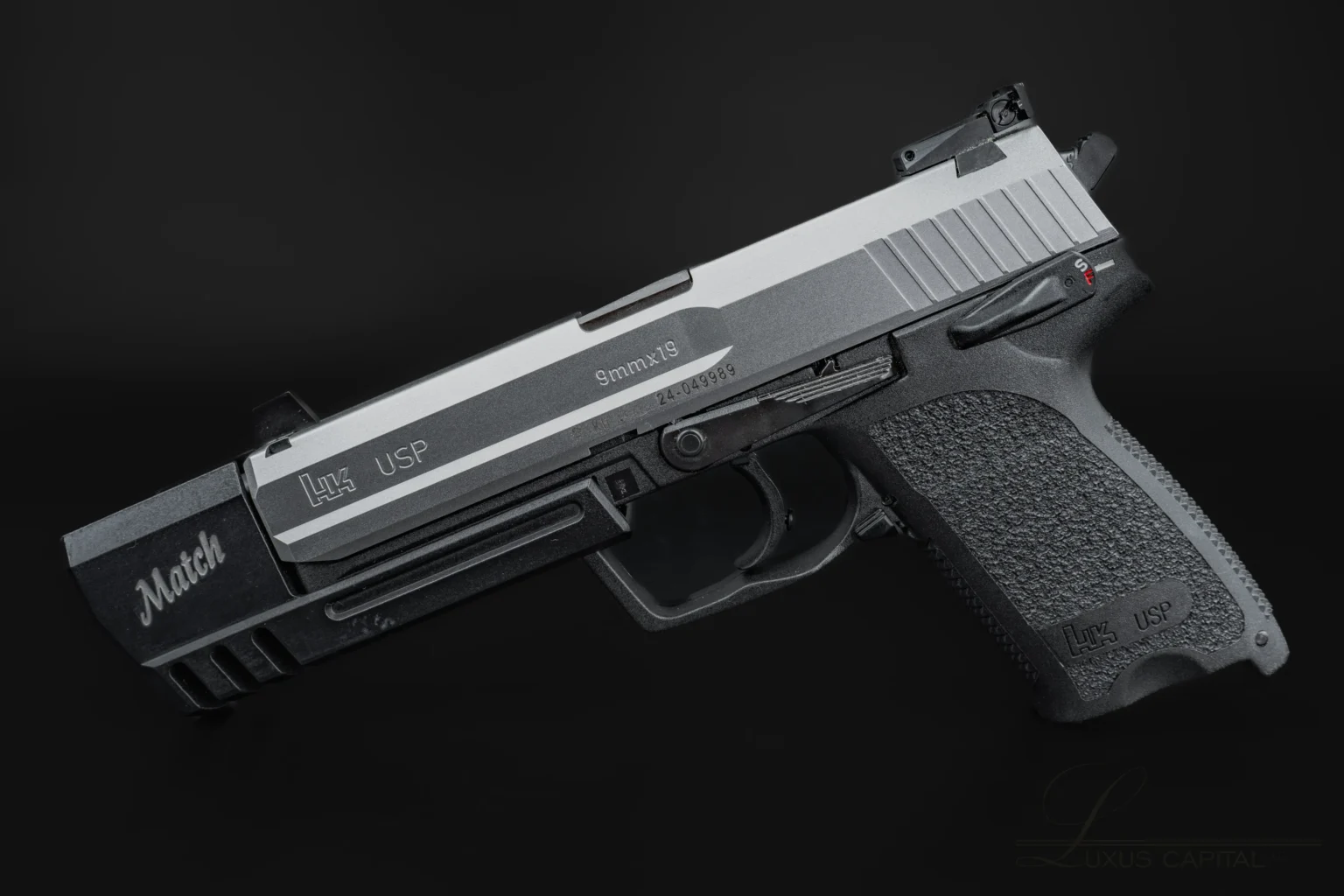
Heckler & Koch expanded the USP into a broad family that included compact, tactical and competition-oriented versions. The USP Compact appeared in 1997, while specialized full-size models addressed suppressed and precision shooting.[1][2]
The USP Tactical combined a threaded barrel with adjustable elevated sights and an improved trigger incorporating an adjustable stop. On the .45-caliber Tactical, an O-ring near the muzzle helped promote consistent barrel-to-slide positioning. These were functional changes intended to accommodate a suppressor and improve practical precision, not merely cosmetic additions.[2][4]
The USP Expert used a lengthened slide and barrel, adjustable sights, a match trigger and a barrel O-ring. Heckler & Koch’s current sporting literature groups the Expert with the Custom Sport and Elite, all of which feature adjustable match sights and match triggers with adjustable stops. The Expert and Elite also receive additional fitting between the barrel and locking component.[5]
These pistols should not be confused with the historical USP45 Match. The Match is readily identified by its large, removable barrel weight, described in period coverage as a barrel weight or compensator. References to a generic “USP45 Compensated” can therefore be misleading: the recognizable factory configuration is the USP45 Match, not an ordinary USP45 equipped only with the internal recoil buffer.[2]
The USP as a Collectible
The USP is a modern pistol family, so its collector interest depends on configuration, originality and documented context rather than age alone. Early USP40 and USP9 pistols, less-common factory operating variants, original Tactical and Match configurations, and examples retaining their factory cases, manuals, magazines and accessories present the clearest distinctions.
Collectors should examine caliber-correct components, date and proof markings, barrel type, control configuration and period accessories. A scarce variant can lose historical integrity when later alterations obscure its original form. Conversely, features that now appear obsolete—such as the proprietary accessory grooves or conventional rifling in an early barrel—may be correct for the production period.
The USP’s enduring importance is straightforward. It combined polymer construction, hammer-fired operation, a patented recoil-buffering system and configurable controls at a time when the service-pistol market had not settled on a single formula. More than three decades later, the platform remains recognizable and is still represented in Heckler & Koch’s product range. That continuity, supported by the survival of numerous specialized configurations, provides a sound basis for collector interest without resorting to exaggerated claims of rarity or indestructibility.
Frequently Asked Questions
USP stands for “Universal Self-loading Pistol,” the English name used by Heckler & Koch.
HK introduced the USP40 at the SHOT Show in January 1993. Production began the following month.
No. USP development began before the US Special Operations Command program that produced the Mark 23, although the two projects later shared engineering knowledge.
The principal full-size chamberings were 9×19mm, .40 S&W and .45 ACP.
Collector interest generally centers on originality, condition, early production features and uncommon factory configurations. Original cases, manuals, magazines and period accessories can further distinguish an example.
Sources
- Heckler & Koch Defense Inc., “Heckler & Koch: A Company History,” corporate history.
- Charles Q. Cutshaw, “HK USP: Past, Present & Future, Part I,” Small Arms Review, Vol. 1, No. 12, September 1998.
- Tilo Moller, Rudolf Brandl and Helmut Weldle, “US Patent 5,309,815: Firearm, Particularly Handgun,” assigned to Heckler & Koch GmbH, issued May 10, 1994.
- Wiley Clapp, “H&K’s USP Tactical Pistol Trio,” American Rifleman, October 24, 2016.
- Heckler & Koch, “USP,” official product and technical information.