
Key Takeaways:
- Kimber began as an Oregon rifle manufacturer in 1979 and entered the 1911 market after its reorganization in the 1990s.
- Model names alone do not establish rarity; collectors should verify configurations against dated catalogs or factory documentation.
- Original components, documented provenance, proper maintenance, and careful storage can materially affect collector interest.
Kimber’s place in the modern 1911 market grew from a company originally devoted to sporting rifles. Jack Warne and his son Greg established Kimber of Oregon in Clackamas, Oregon, in 1979. The firm initially concentrated on high-quality rimfire rifles built around Jack Warne’s Model 82 action before expanding into centerfire models.[1][2]
The original company’s ambitions eventually exceeded its financial resources. Kimber of Oregon changed ownership in 1989, closed, and had its assets liquidated. Greg Warne returned in 1993 with businessman Leslie Edelman and firearms-industry figure Boyd Metz to establish Kimber of America. Manufacturing was subsequently consolidated in Yonkers, New York, and the company became Kimber Manufacturing.[1][2]
Kimber entered the 1911 market during this reorganization. Working with competitive shooter and firearms designer Chip McCormick, the company developed a production pistol incorporating features then more commonly associated with customized 1911s.[2] By 1997, Kimber had closed its remaining Oregon operations and transferred production to New York.[1]
Understanding the Kimber 1911
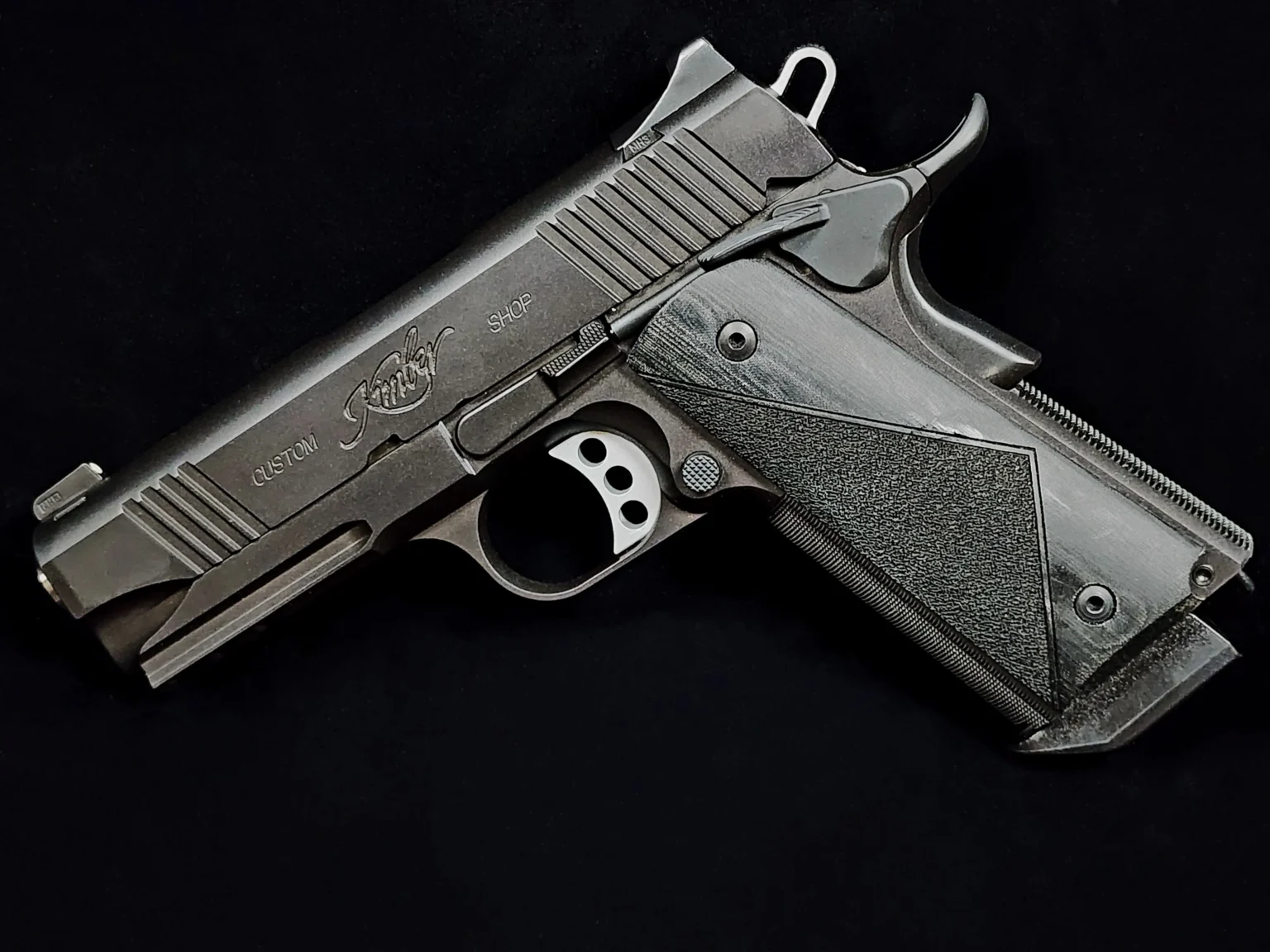
Kimber’s catalog has encompassed full-size, intermediate, and compact interpretations of the single-action 1911. Traditional full-size examples use a five-inch barrel, while Pro models generally use a four-inch barrel and Ultra models a three-inch barrel. Frame materials, sight arrangements, finishes, chamberings, and control configurations vary by model.[3]
The Custom II became one of the company’s foundational production pistols. Kimber’s 2020 catalog listed the standard Custom II with a five-inch, match-grade barrel, steel frame and slide, fixed sights, a seven-round magazine, and .45 ACP chambering.[3] Other full-size pistols in that catalog were available in 9 mm, 10 mm Auto, and .38 Super, but those chamberings applied to specific models rather than every Custom-series configuration.[3]
Across the wider line, Kimber has offered features such as extended beavertail grip safeties, lowered and flared ejection ports, frontstrap checkering, ambidextrous thumb safeties, accessory rails, night sights, fiber-optic sights, and specialized slide finishes.[3][4] These features are not universal. Kimber has revised individual model families over time, and pistols carrying similar names may differ substantially by production period.
Models of Collector Interest
The Royal II and Sapphire Ultra II illustrate two different approaches to visually distinctive Kimber 1911s. Kimber’s 2020 catalog described the Royal II as a full-size pistol with a polished blue finish and rosewood grips. The compact Sapphire Ultra II featured a blue-finished slide and frame, contrasting controls, and decorative grips.[3]
These models may attract collectors because of their distinctive configurations and subsequent discontinuation. However, the available sources do not establish a definitive production total for either model. Their rarity should therefore be evaluated from documented production information and market availability rather than advertising language or unsupported seller claims.
Kimber has also produced regional, commemorative, and special-configuration pistols. Such firearms require careful examination because similar names can encompass different engraving patterns, finishes, grips, distributors, or production periods. A seller’s description of a pistol as “rare,” “limited,” or “collector grade” does not establish how many examples were manufactured.
For collectors, the firearm itself is the starting point. The serial number, frame and slide markings, chambering, sights, controls, grips, and finish should be compared with a dated Kimber catalog or factory documentation. An original box, manual, test target, sales receipt, and factory correspondence can strengthen provenance, provided the identifying information matches the pistol.
Condition requires equally disciplined evaluation. Polished finishes readily reveal handling marks, while refinishing can soften edges, markings, or engraving. Replacement sights, grips, safeties, triggers, and other parts may affect collector interest even when they improve the pistol’s usefulness as a shooter. “Original” should describe a documented configuration, not simply a pistol that appears correct.
Maintenance and Preservation
Kimber’s current 1911 manual instructs owners to confirm that the pistol is unloaded before cleaning, wear eye protection during disassembly, and insert the cleaning rod from the chamber end of the barrel. The prescribed procedure includes cleaning the bore, breech face, and bearing surfaces, followed by lubrication of specified areas such as the slide and frame rails, barrel hood, locking lugs, barrel link, slide-stop pin, and exterior of the barrel.[5]
The manual recommends a premium firearm lubricant and advises against grease. It also warns that ultrasonic cleaning may damage finishes or components and specifically directs owners not to expose night sights to an ultrasonic-cleaning environment.[5] These instructions provide a sounder maintenance standard than generalized claims that every Kimber requires unusually heavy lubrication or cleaning after each firing session.
Collector-grade examples also benefit from secure, dry, and environmentally stable storage. Regular inspections can identify corrosion, displaced lubricant, or deterioration of grips and accessories before permanent damage occurs. Maintenance involving potentially original components should be documented, and replaced parts should ordinarily remain with the firearm.
Springs, magazines, and extractors are service components, but replacement requirements depend on the particular pistol, ammunition, use, and observed condition. Kimber advises owners to obtain qualified assistance when a firearm is damaged, functions improperly, or requires work beyond the procedures covered in its manual.[5]
Collecting Kimber 1911s with Discipline
Kimber’s historical importance rests partly on its role in bringing feature-rich 1911 pistols into regular production during the 1990s and on the breadth of configurations it subsequently offered. That history does not make every Kimber scarce, nor does an elaborate finish automatically create lasting collector value.
The strongest collector examples combine a desirable configuration with high condition, correct components, and persuasive documentation. Before purchasing, collectors should identify the exact model and likely production period, compare its features with contemporary records, and distinguish factory work from later modification. In a field crowded with commemorative language and unsupported rarity claims, documentation remains more valuable than adjectives.
Frequently Asked Questions
Jack and Greg Warne established Kimber of Oregon in Clackamas, Oregon, in 1979.
Kimber developed its production 1911 line during the company’s reorganization in the mid-1990s.
Traditional Custom models generally have five-inch barrels, Pro models four-inch barrels, and Ultra models three-inch barrels. Features and chamberings vary by model and production period.
No. Discontinued status alone does not prove scarcity, and rarity should be supported by reliable production records or other documentation.
Collectors should verify the serial number, markings, configuration, condition, and originality against contemporary catalogs or factory records. Matching boxes, manuals, receipts, and factory correspondence can strengthen provenance.
Sources
- Guy J. Sagi, “Kimber America: From Rifles to 1911s & More,” American Rifleman, March 16, 2022.
- Jeff Johnston, “The Kimber Rifle Story,” American Rifleman, February 22, 2018.
- Kimber Manufacturing, “2020 Product Catalog,” 2020.
- Kimber Manufacturing, “Kimber Announces Updates to Current In-Line 1911-Style Handguns,” company announcement.
- Kimber Manufacturing, “1911 Pistol Models: Owner’s Manual,” revised 2023.