
Key Takeaways:
- The art still has to work. On a best gun, engraving sits on parts that get hardened and fitted afterward, and a double rifle must print both barrels to the same mark no matter what covers the action.
- You’re buying hours. Holland & Holland’s standard Royal Scroll pattern takes 150 hours to cut, and Fracassi bulino work has reached 2,000 hours on a single shotgun action, which is why six-figure prices aren’t padding.
- Paper beats stories. Auction records reward history and condition first, so factory letters, ledger searches, and signed engraving separate provenance from rumor, and an undocumented claim is worth nothing at resale.
Why collectors treat certain guns like paintings, and why the guns still have to work
Walk into Gallery 372 at the Metropolitan Museum of Art, and you’ll find revolvers. Not wheellocks from some distant court. Smith & Wesson, the same frames your great-great-grandfather could have ordered from a catalog, except these are set with sterling silver, carved ivory, turquoise, lapis, and enamel applied by Tiffany & Co. Most of them were built for one job: stopping foot traffic at the 1893 World’s Columbian Exposition in Chicago.
Here’s the detail I keep coming back to. The Met’s own catalog entry for one of them admits, politely, that the silverwork did nothing for the gun’s handling. It still fired. It just fired fancy.
That tension is the whole genre. A painting doesn’t have to do anything. A best-quality gun has to lock up tight, hit where it looks, survive proof loads, and then, on top of all that, somebody spends 500 hours cutting pictures into it with a sharpened sliver of steel. What follows is a tour of the overlap between mechanism and ornament: the history, the houses doing it now (Holland & Holland in London, Mueller Murgenthal in Switzerland, Peter Hofer in Austria), the engravers whose signatures move prices, and what a buyer should know before the bidding starts.
What functional art means when the thing recoils
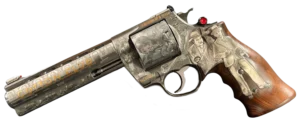
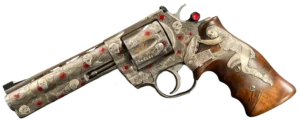
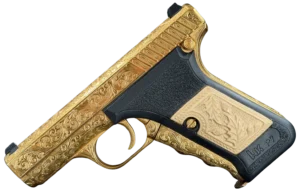
Let’s define the term before the auctioneers do it for us. Functional art, in this corner of the world, means a real firearm, mechanically correct and safe to fire, that has been finished far past any practical need. Not a sculpture shaped like a gun. A gun that happens to be a sculpture.
That distinction imposes discipline you won’t find in most decorative arts. An engraver working on a sidelock plate is cutting metal that still has to be hardened, fitted, and filed to the action. A double rifle’s two barrels must be soldered and regulated so both print to the same spot with the client’s chosen load, and no amount of gold on top excuses a rifle that crosses its shots at forty yards. The self-opening mechanism inside a London best doesn’t know about the acanthus scrolls above it, and it isn’t allowed to care.
None of this is new. Decoration on weapons is older than decoration on almost anything else, because for most of history a weapon was the most valuable machine a person would ever own. European courts commissioned wheellocks carved in ivory and chiseled steel while most of the continent ate off wood. Nicolas-Noel Boutet, who ran Napoleon’s arms manufactory at Versailles, built presentation pieces that worked as diplomacy you could hold. The closest modern cousin isn’t painting at all. It’s the minute repeater in watchmaking: a machine judged as art that still has to chime on demand.
Tiffany, Colt, and the great American show-off era
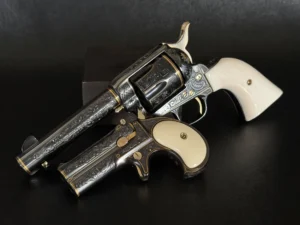
Samuel Colt understood spectacle before most of his customers understood revolvers. Engraved presentation Colts went to newspaper editors, army officers, and heads of state as rolling advertisements, and the men who cut them, Gustave Young and the independent New York master L.D. Nimschke, among them, became a name within the name.
Tiffany & Co. saw the same opening from the jewelry side. By the Met’s account, the firm was America’s leading supplier of presentation swords through the Mexican War and Civil War years, then moved into partnerships with Colt, Deringer, and Smith & Wesson starting in the early 1860s. The high-water mark came at the 1893 fair in Chicago, where Tiffany’s display included two Winchester rifles and nine Smith & Wesson revolvers, each decorated differently: embossed silver, enamel in graded tones, niello, carved ivory, stones set into the grip. The firm’s Blue Book catalog listed pistol decoration at fifty to three hundred dollars, serious money when a workman earned about a dollar a day. Guns from the exhibition carry a small stamped cartouche, a globe over the letter T, and collectors have been hunting that mark ever since.
My favorite footnote from that fair: soon after it closed, Smith & Wesson gave the wildest revolver of the group, a .44 Frontier sheathed in silver, to Walter Winans, the Olympic marksman and author. It hung around in private hands for a century and now sits at the Met, a gift of the Robert M. Lee Foundation. The company that built it clearly believed the thing belonged to the shooting world. The museum that owns it believes it belongs to art history. They’re both right, which is the point.
The house on Harrow Road
If you want the purest expression of the built-from-scratch approach, you go to London, and in London the name that anchors the conversation is Holland & Holland.
Harris Holland wasn’t born to the trade. He was a London tobacco wholesaler, good enough at competitive pigeon shooting to be known for it, who opened a gun retail business in 1835. He had no children, so in 1861 he apprenticed his nephew Henry, and by 1876 Henry was a full partner with his name on the door. It was Henry who pushed the firm from retail into manufacture, spending the profits on a purpose-built factory at 527 Harrow Road, finished in the spring of 1893, tall and full of windows to pour daylight onto the benches. Demand outgrew it in about five years. The replacement at 906 Harrow Road opened in 1898, and the company still builds there. The builders, in a coincidence no novelist would dare, were a firm called Holland & Hannen. No relation.
The gun that carries the house is the Royal, a sidelock side-by-side whose design settled into final form when the firm patented its assisted-opening mechanism in 1922. The Royal became the template for the “London best,” copied by makers on several continents; Shooting Sportsman noted that even Beretta’s own Imperiale Montecarlo side-by-side drew on it. The firm’s other great legacy fits in your palm. The .375 Holland & Holland Magnum cartridge, introduced in 1912, has been in serious hunting camps on every continent since, and the house added the enormous .700 Nitro Express in 1988 because a client asked for it.
The craft numbers deserve their own paragraph, because they’re the honest answer to “why does it cost that much.” Kirsty Swan, an engraver with the firm for eighteen years, told interviewers in 2022 that the standard Royal Scroll pattern takes 150 hours per gun, and the Classic Acanthus, with detailed game scenes and gold inlay, runs up to 500 hours. Stock blanks of figured walnut dry for as long as two years before shaping, and the oil finish alone takes about two weeks of repeated coats. A 2022 profile counted 42 craftsmen and women in the building. A bespoke gun takes roughly two and a half to three years from fitting to delivery, and the fitting itself is done like tailoring, with a try-gun adjusted to your build.
Ownership has wandered. The Wertheimer family’s Chanel bought the remaining shares in 1989 and spent heavily on modernizing the factory, along with a less convincing detour into luxury clothing. Beretta Holding, the family group behind Benelli, Sako, Tikka, and about thirty other companies, acquired 100 percent of Holland & Holland, including the shooting grounds, effective February 1, 2021, and reopened the London gunroom on St James’s Street the following year. The firm holds royal warrants, currently by appointment to the King. On price, nobody publishes a full list; press coverage at the time of the sale noted top guns above $170,000, and that’s before you start talking to the engraving room. Plan on six figures as the door charge.
Ferlach, and a two-pound double rifle
Austria answers London with a town rather than a single house. Ferlach, on the Slovenian border, has made guns for roughly five centuries, long enough that Safari Club’s magazine reported UNESCO adding the town’s craft to its intangible cultural heritage listings in 2010. The Ferlach method is a guild ecosystem: barrel makers, actioners, stockers, and engravers passing work between small shops.
The best-known name to come out of that system lately is Peter Hofer. He finished Ferlach’s five-year gunsmithing course in 1979 and opened his own shop in 1986, building only top-end bespoke pieces. His calling card is the Hummingbird, which holds the record as the smallest and lightest true double rifle ever made: 2.2 pounds, chambered in .17 HMR or .22 Hornet, built on a side-lever action designed from scratch for this one model, every part made for it. The engraved hummingbirds that cover it get their feather colors from metal itself, the result of what Gray’s Sporting Journal described as hundreds of hours of experiments with titanium and zirconium. His shop inlays gold wire of 99.99 percent purity, and keeps bulino specialists on staff for the pictorial work.
The rest of Hofer’s catalog reads like a dare. Four-barrel Vierlings. Five-barrel combination guns. A claimed 300 chamberings and 42 barrel configurations. Who needs a five-barrel gun? Nobody. That has never been the question this trade answers.
The quiet Swiss house working in silver
Ask ten collectors about Mueller Murgenthal and expect blank looks from eight. That’s partly by design, and it makes the house worth explaining carefully.
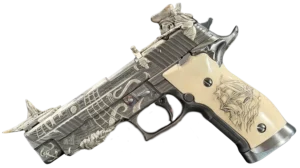
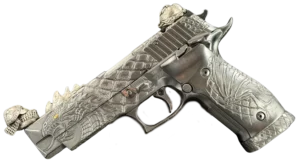
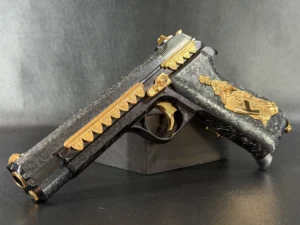
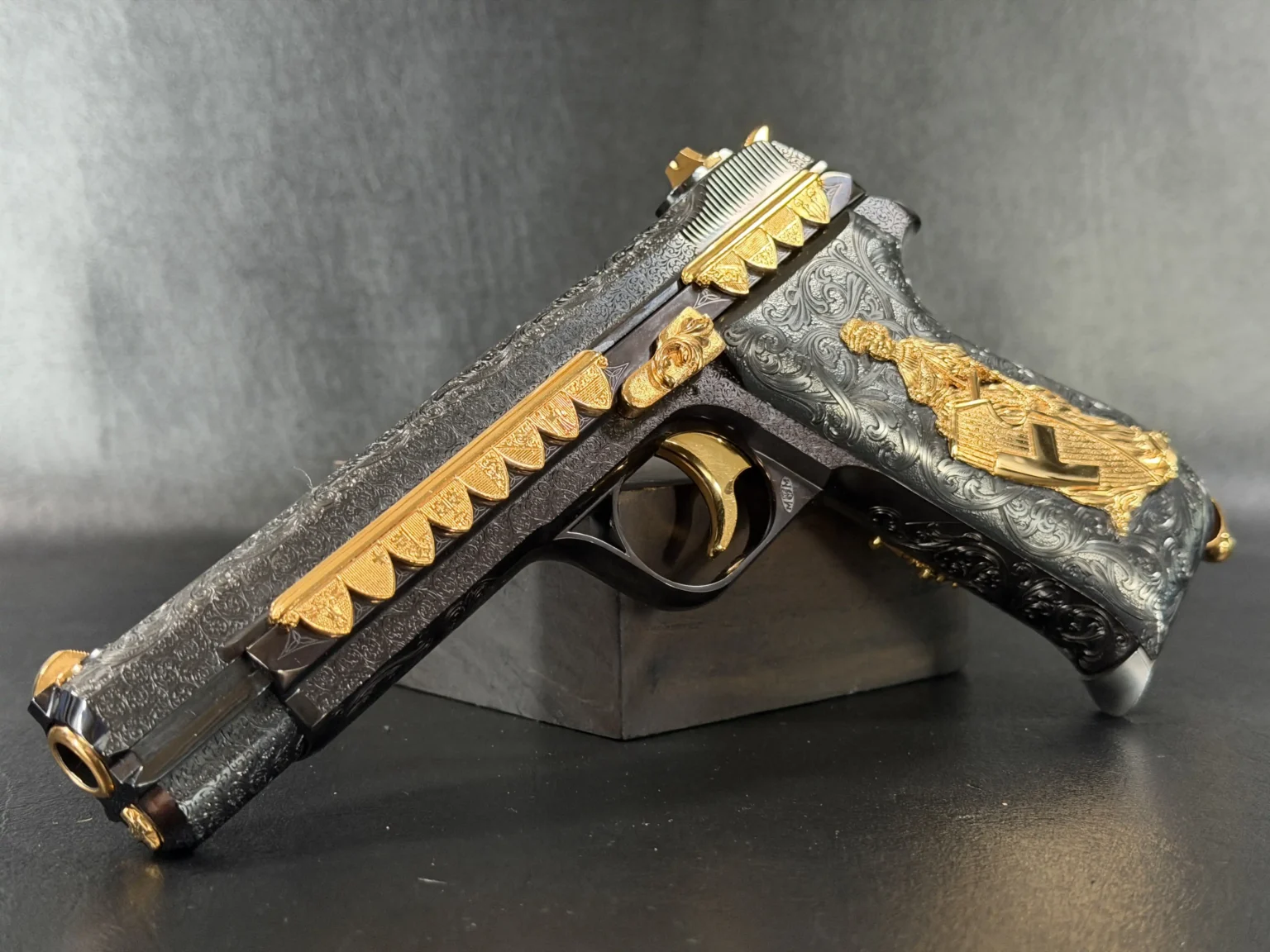
The facts on the ground: Mueller Murgenthal AG is a Swiss firm named for the small Aargau town of Murgenthal, and the craftsman at its center is Vivian Mueller, trained as both silversmith and gunsmith, with the company tracing its lineage to the silversmithing tradition around Lucerne. The method is the mirror image of London’s. Holland & Holland builds the whole machine from bar stock. Mueller starts with a machine already famous for precision, the SIG P210 service pistol (the P210-6 variant, per the company), and treats it the way a goldsmith treats a plain case: hand engraving, relief chasing, sculpted sterling-silver furniture, precious-metal coatings, and set stones. The house also makes daggers and jeweled eggs, which tells you plainly which tradition it thinks it belongs to. This is the Faberge lane, entered through a gun shop.
Named pieces include the Noir, the Bandeline, and the Royal Love, along with two mechanical oddities: the Duplex, which the company says fires two rounds at once, and the Skeleton Z, a pistol opened up so the working parts show. The firm lists collaborations with SIG Sauer, Korth, Blaser, and, back in 1978, the watchmaker IWC Schaffhausen.
There’s at least one solid independent record of the work. In October 2008, the German auction house Hermann Historica sold a Vivian Mueller P210 called La Gazza Ladra, themed on Rossini’s opera, with the maid Ninetta hand-cut on one grip panel and the magpie on the other, gilding burnished with a diamond tool, and a deep blue surface created by depositing titanium and gold vapor onto the steel in a vacuum, so the pistol never needs oil. It began life as first prize in Deutsches Waffen Journal’s 35th-anniversary competition in 2000.
Now the honest caveat, because you deserve it. Beyond that auction record, most published material on the house comes from the house itself. The claims of royal clients, the collaboration histories, the founding story: all company-sourced. I could not confirm founding dates, production totals, or prices anywhere independent, and the firm doesn’t publish a price list. None of that makes the silverwork less real. It does mean that anyone considering a piece should ask for documentation the way they would with any unsigned painting attributed to a name.
The hands that cut the steel
Collectors learn quickly that on the best work there are two signatures that matter: the maker’s and the engraver’s. Sometimes the second one moves the price more.
The technique that changed the modern market is bulino, named for the hand graver itself. Instead of deep scroll cuts, the engraver builds an image out of thousands of dots and hairlines, the way a banknote portrait is built, controlling how light lands on the steel to create tone. The school grew up around Brescia, in the same valleys that produce Italy’s finest guns, and its towering figure was Firmo Fracassi. Born in 1939 in the village of Tavernole above Brescia, Fracassi pushed the bulino toward photographic realism that no one had seen on metal before. He died in 2022; his daughter Francesca trained at his side for decades and carries the studio on. Rock Island Auction Company has cataloged Fracassi work at up to 2,000 hours for a single shotgun action. Read that number again, then divide a price by it, and the economics of this trade start looking almost reasonable.
Britain runs on house styles instead, which is why patterns have names. Royal Scroll is a standard the way a typeface is a standard, executed by an in-house team so a Holland gun reads as a Holland gun across decades. Belgian masters work the top end too; Philippe Grifnee has cut game scenes on Holland & Holland Royals that circulate through the London auction rooms. And America keeps its own bench alive, with a working guild of hand engravers (FEGA) and factory custom shops that still cut steel rather than laser it.
The practical takeaway for a buyer is short: signed work, and paperwork naming the engraver, changes value. An unsigned “Italian-style” game scene is a different object from a documented Fracassi, even when they look similar from across the room.
Walnut, gold, and bone charcoal
The materials list on a best gun hasn’t changed much in a century, and that’s a feature.
Wood first. The blanks that matter come from the root ball of old-growth Turkish walnut, where stress puts figure into the grain. The trick is getting drama through the buttstock while keeping straight, strong grain through the wrist, because a gorgeous stock that cracks at the grip is firewood with a sad story. Blanks air-dry for years, and the classic London finish is nothing but oil, coat after thin coat, rubbed in over weeks.
The metal finishes are chemistry you can date by eye. Case-hardening colors come from packing an action in bone and charcoal, bringing it to heat, and quenching it, which leaves those swirled blues and straw yellows no two guns share. Gold inlay is jeweler’s work: a channel cut and undercut into the steel, pure gold wire or sheet hammered until it locks into place, then carved. Hofer’s shop takes it further, pulling color from titanium and zirconium oxides instead of paint. Tiffany’s nineteenth-century toolkit went further still: niello, fired enamel, and mokume, a laminated metal borrowed from Japanese sword furniture.
One caution belongs here. Antique pattern-welded “damascus” barrels are beautiful, and plenty survive in fine condition, but they were proofed for the ammunition of their day. A vintage gun deserves a qualified gunsmith’s inspection before anyone thinks about shooting it, and many of these pieces have earned their retirement on a wall.
What the auction results actually say
The record book is blunt about what buyers reward, and craft alone isn’t at the top.
The most expensive firearm ever sold at auction is a plain, honest Colt Single Action Army: the revolver Pat Garrett used to kill Billy the Kid in 1881. Bonhams sold it for $6.03 million in August 2021. No engraving. All story. The Henry rifle with serial number 1 brought $5.875 million at Rock Island in June 2026. Rarity and the origin story did the lifting there. The sweet spot for this article sits one rung down: the pair of Remington revolvers presented to Ulysses S. Grant after Vicksburg, engraved by Nimschke, with Grant’s likeness in the ivory grips. They brought more than $5 million in May 2022, history and artistry in a single cased lot. And the Winchester Model 1886 with serial number 1, presented to the officer who took Geronimo’s surrender, held the single-gun record for a while at $1.265 million back in 2016.
A footnote that says a lot about this market’s speed: Guinness World Records has listed Al Capone’s Colt pistol, sold for about $1.04 million in October 2021, as the record holder, even though the Garrett revolver had already brought almost six times that figure two months earlier. Even the record books lag.
So the hierarchy runs story first, condition second, craft third, with craft acting as a multiplier on the other two rather than a substitute for them. A newly commissioned bespoke gun behaves like couture: you’re paying for the hours, and an early resale usually comes in below the invoice. Earlier I called these objects art. That’s not quite right, and the market knows it. What you’re buying, on the new side of the trade, is hours, and hours depreciate until history has time to accumulate on top of them.
Which leads to the only sermon in this article: buy the object because you want to live with it. If a seller leads with the word “investment,” slow down. Nothing here is financial advice, and I’d be suspicious of any gun writer offering some.
Back to the glass case
Stand in Gallery 372 long enough, and you’ll notice visitors doing exactly what fairgoers did in Chicago in 1893: leaning over the glass, looking for the place where the silver ends and the machine begins.
Kirsty Swan’s 150 hours of scroll, Fracassi’s two thousand hours of dots, Vivian Mueller’s chased silver over a Swiss service pistol. None of it ever made a gun shoot straighter. All of it is why these particular machines get museum lighting and estate lawyers instead of a scrap bin. A best gun in a walnut-lined safe and a Tiffany revolver in a museum case are doing the same quiet work now. They’re holding somebody’s hours, and waiting for the next set of hands.
Frequently Asked Questions
It’s a working gun, mechanically correct and safe to fire, that has been finished far past any practical need. The decoration never excuses the mechanism, which is what separates this field from sculpture.
A technique named for the hand graver itself, building an image out of thousands of dots and hairlines the way a banknote portrait is built. Firmo Fracassi of Brescia pushed it to photographic realism, with a single action taking up to 2,000 hours.
The firm doesn’t publish a full price list, but coverage of the 2021 Beretta acquisition noted that top guns were priced above $170,000. Plan on six figures before the engraving conversation even starts.
A Swiss house built around silversmith and gunsmith Vivian Mueller, which turns SIG P210 pistols into silver-clad art pieces with names like Noir and Royal Love. Most published details come from the company itself, so ask for documentation before buying.
The Colt Single Action Army that Pat Garrett used to kill Billy the Kid in 1881, sold by Bonhams for $6.03 million in August 2021. Story, far more than decoration, drives the very top of this market.
Some are, but antique pattern-welded barrels were proofed for the ammunition of their day. Have a qualified gunsmith inspect any vintage piece before firing it, and accept that many have earned a spot on the wall.