
Key Takeaways:
- Always cross-reference serial numbers. It sounds basic, but you’d be surprised how many collectors skip this step when the story behind a firearm is compelling enough. If the numbers on the gun don’t match the numbers on the paperwork exactly, no amount of narrative charm should make up the difference.
- Too-perfect documentation deserves just as much skepticism as too little of it. A completely unbroken provenance chain stretching back 150 years almost never happens organically. Forgers know what collectors want to see, and sometimes the most convincing paperwork is the most carefully fabricated.
- If a seller rushes you, that tells you something. Legitimate sellers of rare, high-value firearms understand that serious buyers need time to verify claims. When someone pressures you to close quickly or resists independent authentication, they’re giving you all the information you need, just not the kind they intended.
What Every Collector Should Watch For Before They Write That Check
There’s a particular kind of heartbreak that only firearms collectors know. You’ve found the piece you’ve been hunting for years. Maybe it’s a pre-war Luger with all matching numbers, a Civil War-era Colt Navy, or a Winchester 1873 with documented provenance stretching back to the frontier. Your pulse is racing. The seller seems legitimate. The price is aggressive but not insane. And then you sit down with the paperwork, and something feels… off.
That gut feeling? Don’t ignore it. Not ever.
Documentation is the backbone of rare firearms collecting. Without solid provenance, matching records, and authentic paperwork, even a genuine piece loses a huge chunk of its value. And if the documentation is fraudulent? You might be holding a five-figure mistake. So let’s talk about what to look for, what should make you pause, and what should send you running.
Before we get into specifics, here’s something worth saying out loud: nobody is immune to bad paperwork. I’ve watched experienced collectors with thirty years in the game get taken by a convincing forgery. The people producing fake documentation have gotten better, more sophisticated, and more patient. They study the same reference books you do. They know what collectors want to see. That’s precisely why staying sharp matters more now than ever.
The Paper Trail That Doesn’t Add Up
Let’s start with the most fundamental red flag: gaps in provenance. If someone hands you a rare firearm and says it came from a famous collection, or it was carried by a notable figure, or it saw action in a specific battle, there should be a paper trail connecting those claims to the physical object. Not just one letter or one photograph. A chain.
Think of provenance like a relay race. Every handoff needs to be documented. If the baton disappears for twenty years between the 1940s and the 1960s, you’ve got a problem. Now, gaps in provenance aren’t automatically disqualifying. Plenty of legitimate firearms have periods where ownership records simply don’t exist, especially pieces from the 18th and 19th centuries. But when a seller glosses over those gaps or fills them with vague language like “believed to have been” or “family oral history suggests,” your antennae should go up.
Here’s the thing: legitimate sellers acknowledge gaps. They’ll tell you straight up, “We don’t have records from 1923 to 1951, but here’s what we do have.” Fraudulent sellers, on the other hand, tend to over-explain. They build elaborate narratives to cover holes in the record. If the story sounds more like a novel than a provenance chain, proceed with caution.
And while we’re on the subject, watch out for provenance that’s suspiciously perfect. A completely unbroken chain of ownership from 1870 to the present, with every single transfer documented and notarized? That almost never happens organically. Ironically, too much documentation can be just as suspicious as too little.
When the Ink Doesn’t Match the Era
This one gets overlooked more than you’d think. Paper and ink age in predictable ways, and forgers often slip up on the details. If you’re looking at a letter supposedly written in 1885, and the paper feels too stiff, too white, or too uniform, that’s a warning sign. Genuine period paper has a certain feel. It yellows unevenly. It develops foxing, those little brown spots caused by fungal growth or iron oxidation in the paper fibers. It might smell musty or feel brittle at the edges.
Ink tells its own story. Iron gall ink, which was the standard for most of the 18th and 19th centuries, turns brown over time and often slightly eats into the paper, creating a faint halo on the reverse side. Modern ballpoint pen ink looks completely different under magnification. If someone hands you a “Civil War era” document written in ballpoint, well, that’s not a red flag. That’s a full-on parade of red flags, because ballpoint pens weren’t commercially available until 1945.
You don’t need to be a forensic document examiner to catch some of these issues, but it helps to have a decent loupe or magnifier on hand. Even a 10x jeweler’s loupe can reveal a lot. Look at how the ink sits on the paper. Does it look like it was absorbed naturally, or does it sit on the surface? Are the pen strokes consistent with the type of writing instrument that would’ve been available at the time? These are questions that take seconds to consider and can save you thousands.
One more thing about documents from specific eras. Typewriters became common in business correspondence starting in the 1880s. If you’re looking at a factory letter or shipping record from 1910 and it’s entirely handwritten, that’s unusual (though not impossible). Conversely, if you see a document claiming to be from 1860 that’s typewritten, something is very wrong. Context matters, always.
Serial Number Shenanigans
Serial numbers are the DNA of firearms collecting. They tie a specific weapon to factory records, shipping ledgers, and ownership histories. And they’re one of the most common places where documentation falls apart.
The first thing you should do when reviewing documentation is cross-reference the serial number against known databases and reference books. For Colt firearms, the Colt Archive letter is essentially the gold standard. It provides factory records showing when a firearm was manufactured, its configuration at the time of shipping, and where it was sent. Similar resources exist for Winchester (the Cody Firearms Museum records), Smith & Wesson (factory letters), and many other manufacturers.
Now, here’s where it gets tricky. Some sellers will present documentation that references a serial number, but the number on the paperwork doesn’t quite match the gun’s serial number. Maybe one digit is transposed. Maybe the number is partially illegible in the document. These discrepancies need to be resolved, not hand-waved away. A seller who says, “Oh, it’s probably just a clerical error from 1902,” might be right. Or they might be trying to attach valuable paperwork to a less valuable firearm.
And honestly? Serial number re-stamping is a real concern in the collecting world. Skilled metalworkers can alter numbers, and while experts can usually detect this under magnification or with chemical analysis, it’s not always obvious at a gun show table. If the firearm’s serial number shows any signs of modification, re-stamping, or over-striking, that’s a serious red flag, regardless of how authentic the accompanying paperwork looks.
You know what catches a lot of people off guard? Partial serial numbers in documentation. A letter might reference “Colt SAA, serial number 12XXX,” where the last digits are smudged or missing. Some sellers exploit this ambiguity, claiming a match when none can be confirmed. If you can’t verify a complete serial number match between the firearm and its documentation, that paperwork’s value drops considerably.
Factory Letters and Archive Records: Not All Are Created Equal
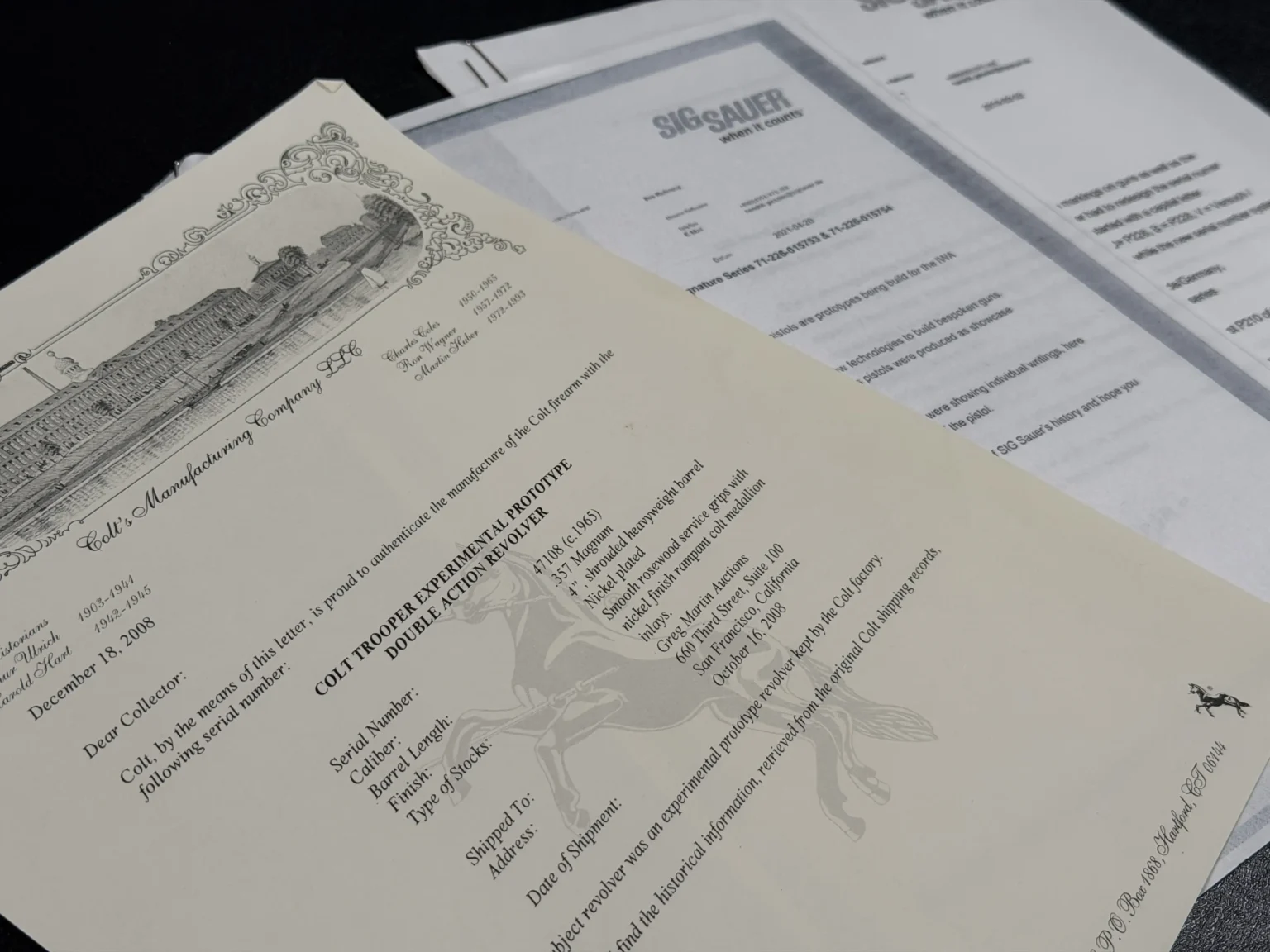
Factory letters are among the most sought-after documents in firearms collecting. A genuine Colt factory letter, for instance, can add thousands of dollars to a revolver’s value. Which means, predictably, people forge them.
Legitimate factory letters come directly from the manufacturer’s archives or from an authorized researcher who has access to those records. They’re printed on specific paper with specific formatting, and they contain details consistent with the manufacturer’s historical record-keeping practices. If you’re not familiar with what a genuine factory letter looks like for a specific manufacturer, do your homework before you evaluate one.
One common red flag is a factory letter that contains too much narrative detail. Real factory records are terse. They list dates, configurations, serial numbers, and shipping destinations in a business-like format. They don’t wax poetic about the gun’s history or its significance. If a factory letter reads more like a sales pitch than a ledger entry, be skeptical.
Another thing to watch for: letters that are photocopies or digital reproductions rather than originals. While some legitimate archives do provide copies (the Colt Archive, for example, sends researched letters rather than copies of original ledger pages), you should understand exactly what you’re looking at. A photocopy of a photocopy of a purported factory record is not strong documentation. It’s a rumor with extra steps.
Also worth noting: some smaller manufacturers didn’t keep detailed records at all. If someone offers you a factory letter for a firearm made by a company that’s known to have lost its records in a fire, a flood, or simple neglect, that’s a significant red flag. You can’t produce a document from records that don’t exist. Well, you can. But that’s called fraud.
Photographs and Visual Evidence: Trust but Verify
Period photographs showing a firearm can be compelling evidence of provenance. A Civil War tintype of a soldier holding what appears to be the same model revolver, paired with a family history linking the soldier to the firearm, makes for a powerful story. But photographs require the same scrutiny as written documents.
First, can you actually confirm that the firearm in the photograph is the same one being offered? Unless the photograph is detailed enough to show serial numbers or truly unique identifying marks, what you’re really looking at is a photograph of a similar firearm. That’s an important distinction. A picture of grandpa holding a Winchester Model 1894 doesn’t prove that the gun in the picture was grandpa’s.
Second, is the photograph genuine? Period photographic processes have specific characteristics. Tintypes, ambrotypes, CDVs (cartes de visite), and cabinet cards all look different and were popular at different times. A photograph claiming to be from the 1860s should be on a medium consistent with 1860s photography. Modern reproductions printed on aged-looking paper are surprisingly common in the collector market.
Digital manipulation adds another layer of concern. With modern software, it’s not difficult to alter photographs, add details, or composite images. If a photograph is central to a provenance claim, it’s worth having it examined by someone with expertise in photographic authentication. This might seem like overkill for a gun show purchase, but if you’re spending serious money on a piece based partly on photographic evidence, it’s a reasonable investment.
The Too-Good-to-Be-True Narrative
Collectors love a good story. We’re not just buying metal and wood; we’re buying history, connection, and sometimes a little bit of romance. Sellers know this, and the less scrupulous ones exploit it.
Be wary of firearms that come with incredible backstories and just enough documentation to make the story plausible without actually confirming it. “This revolver was carried by [famous person]” is a claim that requires extraordinary evidence. A signed letter from the famous person mentioning a specific firearm, combined with matching serial numbers, combined with a provenance chain showing how the gun passed from that person to the current seller? That’s getting somewhere. A family story and a photograph of someone who might be a famous person? That’s not evidence. That’s wishful thinking.
You know what a classic red flag is? The “attic find” story. “We found this in grandma’s attic, and we think it might have been used at Little Bighorn.” The attic find is a real thing that happens, absolutely. People do discover remarkable firearms in unexpected places. But the attic find narrative has been used so many times to explain away a lack of documentation that it should trigger immediate skepticism. Where’s the family connection to the historical event? Where are the letters, diaries, or records that place an ancestor at that event with this specific weapon?
Similarly, watch for sellers who pressure you to act quickly. “I’ve got another buyer interested” or “This won’t last through the weekend” are sales tactics, not documentation. Legitimate sellers of rare, high-value firearms understand that serious collectors need time to verify documentation. If someone is rushing you, ask yourself why they don’t want you to look too closely.
Import Marks, Proof Marks, and What They Tell You
This is an area where many collectors, even experienced ones, don’t spend enough time. Proof marks and import marks are physical evidence stamped into the firearm itself, and they need to be consistent with the firearm’s documented history.
If documentation claims a firearm was manufactured and sold domestically, but the gun bears import marks from a foreign proof house, there’s a contradiction that needs to be explained. Maybe the gun was exported and later re-imported. That happens. But the documentation should account for it. If it doesn’t, either the documentation is wrong or the gun’s history is more complicated than the seller is letting on.
Proof marks also help establish manufacturing dates and locations. British proof marks, for example, are well-documented and can be used to narrow down when and where a firearm was proofed. German proof marks follow their own system. If a firearm’s proof marks are inconsistent with its claimed date or place of manufacture, that’s a meaningful discrepancy.
Honestly, learning to read proof marks is one of the best investments a collector can make. There are excellent reference books on the subject, and once you understand the basics, you’ll catch inconsistencies that might otherwise slip past. It’s like learning a second language that guns have been speaking for centuries.
When to Call in the Experts
Let me be straightforward about something: there’s no shame in getting help. For high-value transactions involving rare firearms, professional authentication is not a luxury. It’s due diligence.
Document examiners can analyze paper composition, ink chemistry, and handwriting characteristics with a level of precision that no collector can match by eyeballing a letter at a gun show. Firearms appraisers who specialize in specific manufacturers or eras can spot inconsistencies in configuration, finish, and markings that might not be obvious to a generalist. And established auction houses like Rock Island Auction Company, James D. Julia (now part of Morphy Auctions), and others have vetting processes specifically designed to catch problematic documentation.
The cost of professional authentication is almost always a fraction of what you’d lose by purchasing a fraudulently documented firearm. If a seller objects to your desire to have documentation authenticated, treat that objection as a red flag in itself. Legitimate sellers with genuine documentation welcome verification because it protects them, too.
Networking with other collectors is also invaluable. Online forums, collector associations, and gun shows are full of people who’ve seen more documentation than you have. Someone who collects the same manufacturer or era as you might immediately recognize a document format that doesn’t look right, or a factory letter that uses the wrong typeface for its supposed date of issue. The collecting community can be your best defense against fraud if you’re willing to ask for help.
A Quick Checklist Before You Buy
I know we’ve covered a lot of ground, so let me pull together the key points you should run through before committing to a purchase involving rare firearms documentation.
Does the provenance chain have gaps, and if so, are they acknowledged or covered up? Do the physical characteristics of the documents match their claimed era, including paper, ink, printing method, and photographic medium? Do serial numbers match exactly between the firearm and all supporting documentation? Are factory letters consistent with the known record-keeping practices of the manufacturer? Do photographs actually identify the specific firearm, or just a similar model? Is the backstory supported by verifiable evidence, or is it mostly narrative? Are proof marks and import marks consistent with the firearm’s documented history? Has the seller allowed adequate time and access for independent verification?
None of these items, on its own, is necessarily a deal-breaker. Collecting rare firearms involves accepting some degree of uncertainty; that’s part of what makes it exciting. But when multiple red flags appear together, or when a seller resists your efforts to verify their claims, it’s time to walk away. There will always be another gun. There won’t always be another chance to recover your money from a bad deal.
The Bigger Picture
At the end of this, what we’re really talking about is respect. Respect for the history these firearms represent, respect for the collecting community that preserves them, and respect for your own judgment and financial well-being. Fraudulent documentation doesn’t just hurt individual buyers. It pollutes the historical record, erodes trust within the collecting community, and makes it harder for everyone to confidently assess the firearms that come to market.
So take your time. Ask questions. Bring a loupe. Call a friend who knows more about a particular manufacturer than you do. Request time to have documents examined professionally. And if something feels wrong, even if you can’t quite put your finger on why, listen to that instinct. Experienced collectors will tell you that the deals they’re most proud of aren’t always the ones they made. Sometimes, it’s the ones they walked away from.
Collecting rare firearms is a pursuit built on knowledge, patience, and a genuine love of history. The documentation that accompanies these pieces is part of that history. Treating it with the same care and attention you’d give the firearm itself isn’t just smart collecting. It’s the right thing to do.
Frequently Asked Questions
Serial numbers. If the number on the gun doesn’t match the number on the paperwork exactly, everything else is essentially irrelevant.
Not necessarily, plenty of legitimate firearms have periods where ownership records simply don’t exist, especially older pieces. The real red flag is when a seller tries to paper over those gaps with elaborate stories instead of just acknowledging them honestly.
Look at the paper, the ink, and the writing method. If someone hands you a “Civil War era” letter written in a ballpoint pen, you’ve got a serious problem since ballpoints weren’t commercially available until 1945.
They’re considered the gold standard, but forgeries do exist, and they’ve gotten more sophisticated over the years. If a factory letter reads more like a sales pitch than a terse ledger entry, that’s worth questioning.
For high-value purchases, absolutely. The cost of having documents professionally examined is almost always a fraction of what you’d lose buying a fraudulently documented firearm.