
Key Takeaways:
- It’s a genuine hybrid, not just a marketing line: The PRS marries 1911-style ergonomics and trigger compatibility with a roller-delayed, fixed-barrel system derived from HK’s roller guns. You get familiar controls and grip, but completely different internals. It’s not a clone; it’s a deliberately engineered hybrid.
- The fixed barrel reframes accuracy: Most semi-autos use tilting barrels that move during cycling, adding variables that affect precision. The PRS fixes the barrel in place and relies on a roller-delayed system for timing, so every shot leaves from the same barrel position. Adjustable sights, optional weighted front ends, and tunable springs underline that it’s built as a precision pistol, not a duty gun.
- You’re paying for mechanics, not just craftsmanship: The PRS has the usual Korth touches—hand-fitting, DLC, cold-forged barrels, walnut grips, but the real cost lies in the operating system. Roller-delayed actions are far more complex to build than standard tilting-barrel designs. You’re not just buying a nicer 1911; you’re buying a pistol that works on principles almost no one else uses in production handguns, which is either exactly what you want or an expensive solution to a problem you didn’t have.
Let’s get started…
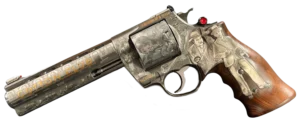
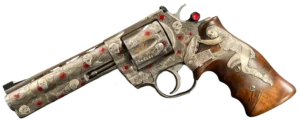
You know Korth for revolvers. Those hand-fitted, obsessively engineered German wheel guns that cost as much as a used car and shoot like a mechanical dream. The kind of thing where every surface is finished like jewelry, every part is precision-fit, and the trigger breaks like a glass rod. That’s the Korth we know.
So when Korth decided to build a semi-automatic pistol, nobody expected them to just clone a 1911 and call it a day. That’s not how Germans do things, especially not Germans who’ve spent decades building revolvers that treat the laws of physics more like gentle suggestions. What they created instead was the PRS: a pistol that looks straightforward but hides one of the most unconventional operating systems you’ll find in a modern handgun.
Here’s the thing: the PRS isn’t just Korth’s answer to the semi-auto market. It’s what happens when a company known for mechanical obsession merges two completely different handgun philosophies into a single gun. Think of it as a 1911 that went to Germany and came back speaking with a roller-gun accent.
What Exactly Is the PRS?
Let’s start with what Korth themselves say. They describe the PRS as “a merger of two of the world’s best handgun systems into a single unit.” That’s marketing speak, sure, but it’s also technically accurate in a way that becomes clear once you look under the hood.
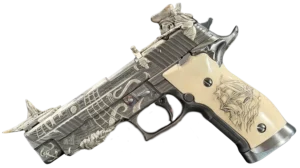
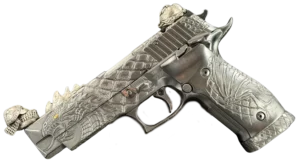
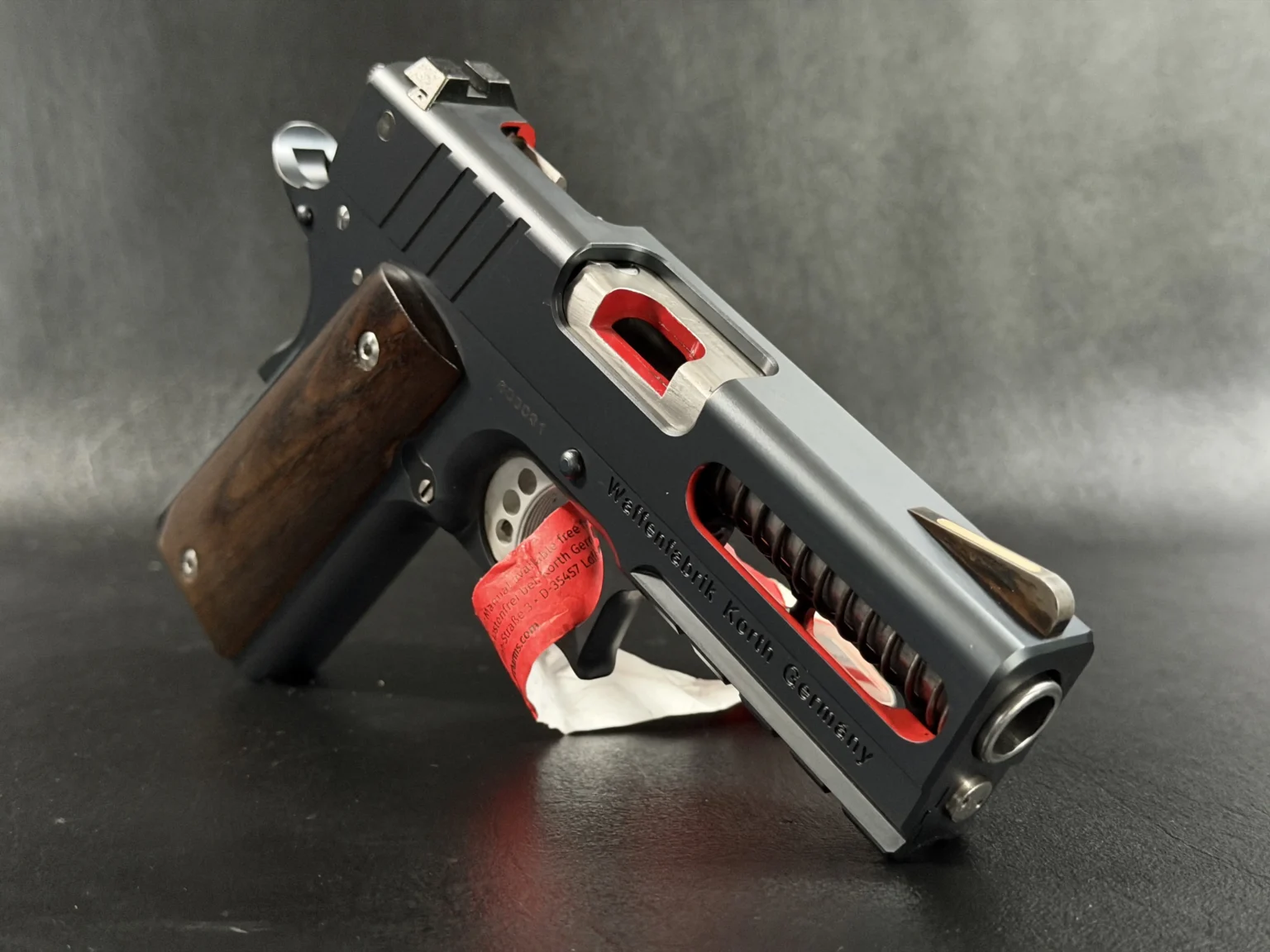
On the outside, the PRS presents a familiar face to anyone who’s spent time with a 1911. Single-action trigger. Controls that fall where your thumb expects them. Grip angle that feels like coming home. Korth even went so far as to make the trigger and function parts 1911-compatible, which is a pretty clear signal about what ergonomic baseline they were working from.
But then you get to the operating system, and that’s where things get interesting. Most premium .45s and 9mms live in predictable territory: Browning short-recoil actions with tilting barrels, or maybe something exotic like a rotating barrel or gas-delay system if the designers are feeling adventurous.
The PRS does something else entirely. It uses what Korth’s manual calls a “roller locked delayed blowback” system with a fixed barrel. While that’s the official terminology, functionally it behaves like a roller-delayed system rather than a traditional locked-breech system. If that sounds more like roller guns in the HK family, think MP5/G3 lineage, than a typical pistol, you’re picking up what they’re putting down.
The manual gets specific: it’s a “semi-rigid, roller locking action” paired with an “HK Style” bolt head, as Korth explicitly describes. That’s not pistol culture language. That’s roller-system culture, the mechanical DNA of HK’s roller guns, transplanted into a handgun frame.
Why Did Korth Build This Thing?
Korth’s answer is simple: they’ve been here before. In the early to mid-1980s, Korth built a small run of automatic pistols with a proprietary short-recoil, tilting-locking-piece system. Offered in DA/SA or SA configurations, they never went mainstream, more intriguing mechanical experiments than solutions to a problem most shooters thought they had.
In 2015, Korth took another shot, this time with a pistol tailored to modern tastes: Picatinny rails, DLC coatings, modular sights, and a roller-delayed, fixed-barrel system promising a distinct recoil feel. The PRS debuted around the 2015 SHOT Show, backed by cutaway animations and dense technical literature aimed squarely at enthusiasts.
So the question isn’t just “why another pistol?” but “why this pistol?” Korth’s reasoning becomes clear when you look at their goals.
First, recoil management. The roller-locking system is claimed to “divide the recoil impulse,” softening perceived recoil and smoothing out the cycling. Whatever you feel on the range, the mechanics check out: roller-delayed systems handle recoil timing and impulse differently than tilting-barrel designs.
Second, accuracy via a fixed barrel. A tilting barrel must unlock, drop, move rearward, then return and lock up on every shot, introducing small but real tolerances. A fixed barrel doesn’t move, reducing the potential for variation. Add Korth’s low bore axis to cut muzzle flip, and the PRS starts to look like a precision instrument more than a service sidearm.
And that’s the point: the PRS isn’t a duty gun. With 4, 5, and 6-inch barrel options, adjustable sights on longer models, and optional weighted front ends, it’s clearly configured for precision shooting, not concealed carry or defensive use.
The Engineering That Makes It Unmistakably Korth
Most modern semi-auto pistols operate on principles that John Browning would recognize, even if the materials and manufacturing have evolved. The PRS deliberately steps outside that tradition. When you read through Korth’s technical documentation, you’re not seeing normal pistol language. You’re seeing phrases like “bolt head,” “locking rollers,” and “recoil operated weapon” with “roller locked delayed blowback” action.
Let me walk you through why that matters.
In a typical 1911 or modern service pistol, the barrel and slide lock together briefly when you fire. As they recoil in unison, the barrel tilts or rotates to unlock and drop, while the slide continues rearward to eject the spent case and cycle the action. That barrel movement is essential to the design, elegant and reliable, but it adds variables to the accuracy equation.
The PRS, by contrast, keeps the barrel fixed. No tilt, no movement. In a roller-delayed system, the barrel doesn’t unlock by moving; instead, the system controls when the slide unlocks from the barrel. When you fire, the bolt head uses locking rollers engaged against the barrel extension. As pressure builds, the rollers cam inward, allowing the bolt head to unlock and the slide to move rearward. Mechanically, it’s a very different system from a 1911, even if the frame and controls feel familiar.
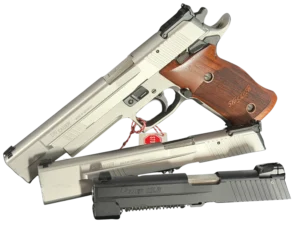
You see that difference most clearly in how it comes apart. To disassemble the PRS, you press the barrel forward against spring pressure so the breech end can pivot up and out. To remove the bolt head, you use a special tool to depress a catch until the bolt head springs forward. During reassembly, the locking rollers snap into place. That’s roller-gun procedure, not 1911 procedure, adapted to a handgun.
Then there’s the very Korth touch: different-weight slide springs, red (strong), yellow (medium), green (soft). Korth builds guns for people who want to tune the mechanical personality of their firearms, and a roller-delayed system gives you adjustment options a traditional action can’t match.
Technical Specs and Model Variants
Korth currently offers the PRS in three barrel lengths, all chambered in .45 ACP or 9mm Luger.
The 4-inch PRS is the most compact of the lineup, though “compact” is relative for an all-steel pistol. It weighs 2.51 pounds empty, is 7.87 inches long, and 5.51 inches tall. Capacity varies by caliber: seven rounds in .45 ACP and typically eight in 9mm. It uses a fixed rear sight, Korth’s quick-change front sight, a full DLC finish, and walnut grips, no plastic here.
The 5-inch PRS weighs 2.85 pounds and measures 8.86 inches overall. This is where the precision-shooting bias really shows. The rear sight is fully adjustable, the quick-change front remains, and Korth specifies a 4-inch slide with a fixed 1-inch barrel weight. That added front-end mass is there for stability and recoil control, not concealed carry.
The 6-inch PRS is a dedicated precision piece. At 3.13 pounds, it’s a heavyweight even among all-steel pistols. It shares all core PRS features, roller-delayed system with HK-style bolt head, 1911-compatible trigger parts, and a cold-forged precision barrel, but adds a 4-inch slide with a fixed 2-inch barrel weight. That’s a substantial amount of mass up front.
All three versions use the same architecture: a carbon-steel frame with a Picatinny rail, single-action trigger, DLC finish, and a fixed-barrel, roller-delayed upper. The manual confirms a recoil-operated, roller-locked delayed-blowback system fed from a magazine holding 7 rounds in .45 ACP, with 9mm models typically adding 1 round.
In the technical documentation, everything goes metric. Barrel length on the base model is 102 mm; sight radius, 145 mm; width over grip plates, 34 mm. Unloaded weight is about 1,000 grams, and a loaded magazine with seven cartridges weighs 218 grams. These are the figures Korth’s engineers care about, recorded with German precision.
What the PRS Is Not
- Not a duty pistol
- Not a concealed-carry gun
- Not a mass-market semi-auto
- Not a traditional 1911
How the PRS Differs From Everything Else
Understanding the PRS means understanding what it’s not trying to be. Let’s compare it to the two most relevant categories of semi-automatic pistols.
Versus typical 1911s: A standard 1911 uses Browning’s short-recoil system with a tilting barrel. The barrel link and locking lugs create a mechanical relationship where barrel movement is integral to the cycling process. You can feel it in how the gun shoots, how the barrel dips, how the slide comes back, how everything resets. It works beautifully and has worked beautifully for over a century.
The PRS keeps the 1911’s ergonomic soul, the grip angle, trigger feel, and control placement, but fundamentally changes the mechanical conversation. A fixed barrel means no tilting. Roller-delayed action means the timing and character of how the gun unlocks is completely different. Korth explicitly markets the recoil impulse as “divided” and reduced, which is a different shooting experience than what you get from a tilting-barrel 1911. The shared DNA is in the user interface. The divergence is in the operating system.
Versus modern striker-fired service pistols: Most duty guns optimize for reliability, ease of manufacture, and standardized performance. They work great, they’re affordable, and they’re designed to be replaced rather than rebuilt. The recoil systems are typically tilting-barrel arrangements because that’s proven, reliable, and cost-effective to produce.
The PRS goes in the opposite direction. It’s designed around mechanical distinctiveness rather than manufacturing efficiency. The roller system and fixed barrel are inherently more complex to produce. The hand-fitting and premium materials (DLC-coated standard, cold-forged barrels, carbon-steel frames) push the gun into a different price bracket entirely. And those precision-biased features, adjustable sights, weight-forward configurations, tunable spring weights, are choices that make sense for a range gun but would be excessive for a service weapon.
The Korth-ness of It All
What makes the PRS unmistakably a Korth? It isn’t just the price or German manufacturing, it’s the design philosophy behind every decision.
Korth could have built an excellent 1911. They have the machining, attention to detail, and quality control to do it. They could have designed a tilting-barrel pistol that outshot most 1911s and stopped there. Instead, they created a roller-delayed, fixed-barrel system for a handgun, choosing complexity over simplicity for real mechanical gains.
This accuracy-first layout is pure Korth revolver DNA. Their wheelguns are known for ultra-tight lockup and near-perfect barrel-to-cylinder alignment. When they designed an automatic, they didn’t want barrel movement in the accuracy equation, so they committed to a fixed barrel and accepted the added complexity of a roller-delayed system. Low bore axis, controlled recoil, and precision cold-forged barrels all show a clear preference for accuracy over simplicity.
The platform’s tunability is also very Korth. Different-weight springs, optional barrel weights, and a mechanism that responds noticeably to tuning, far more than simple blowback or tilting-barrel designs, appeal to shooters who like to understand and optimize their tools, not just run them out of the box.
There’s a hybrid philosophy at work, too. Preserving the 1911 user experience while completely reimagining the internals is classic Korth. They’re not trying to replace the 1911 or compete with mainstream service pistols. They’re targeting shooters who value mechanical sophistication and want a precision instrument that feels familiar but behaves differently.
The PRS isn’t for everyone. At Korth’s prices (check their European store and convert to dollars if you’re feeling brave), it goes up against custom 1911s and top-tier competition guns. But it offers something truly different: a semi-auto that combines beloved 1911 ergonomics with a roller-delayed, fixed-barrel system you won’t see in any other production handgun.
The Bottom Line
The PRS exists because Korth doesn’t chase trends; it engineers solutions until they feel unavoidable.
When a company obsessed with mechanical perfection decides to build an automatic pistol, you get the Korth PRS. It isn’t meant to be practical or affordable. It’s meant to be different in ways that matter to shooters who care how their guns actually operate, not just how they perform on paper.
Whether the roller-delayed, fixed-barrel system delivers on Korth’s promises about recoil management and accuracy, that’s something you’d have to decide for yourself with a box of ammunition and a good range session. But there’s no arguing that the PRS represents a genuine alternative to the standard approaches that dominate the semi-auto market.
Korth took their revolver philosophy, overbuilt, hand-fitted, mechanically distinctive, obsessively engineered, and applied it to an automatic pistol. The result is a gun that looks and feels somewhat familiar but operates on principles that are anything but mainstream. It’s a 1911 frame with a roller-gun soul, wrapped in German precision and priced accordingly.
That’s either exactly what you’ve been looking for, or it’s a solution to a problem you didn’t know existed. Either way, it’s unmistakably Korth.
Frequently Asked Questions
No. While it borrows 1911 ergonomics and trigger geometry, the operating system is completely different.
It uses a fixed barrel with a roller-delayed operating system instead of a tilting barrel. That changes how recoil is managed and how the pistol cycles.
Not exactly. Korth describes it as “roller locked delayed blowback,” but functionally it behaves like a roller-delayed system rather than a traditional locked-breech.
A fixed barrel removes movement from the accuracy equation. Fewer moving variables mean greater mechanical consistency shot to shot.
It changes the character and timing of recoil rather than eliminating it. Many shooters find it smoother than tilting-barrel pistols.
No. Its size, weight, and precision-oriented features make it better suited for range or competition use.