
Key Takeaways:
- The Sphinx 3000 followed the AT-84, AT-88, and Sphinx 2000 but was developed as a distinct successor under designer Armin Landolt.
- Factory documentation identifies Standard and Tactical models in 9×19 mm, 9×21 mm, .40 S&W, and .45 ACP.
- Model 3000 pistols used different combinations of steel, aluminum, and titanium, so surviving examples should not all be described as all-steel firearms.
The Sphinx 3000 emerged from a Swiss design lineage that began with Martin Tuma’s AT-84 and AT-88 pistols. The AT-84 was a licensed copy of the Czechoslovak CZ 75, while the AT-88 introduced changes that included a firing-pin safety and a revised slide. Sphinx subsequently developed the Sphinx 2000 series from Tuma’s work. Designer Armin Landolt later directed development of the Model 3000 as a distinct successor rather than a simple continuation of the earlier pistol.[1]
A multilingual Sphinx Systems operator’s manual, copyrighted in 2003 and printed in Switzerland, documents the Model 3000 in Standard and Tactical configurations. It lists four chamberings: 9×19 mm, 9×21 mm, .40 S&W, and .45 ACP.[2]
Operating System and Construction
The Sphinx 3000 is a short-recoil, locked-breech, hammer-fired semiautomatic pistol. Its barrel locks into the slide through the ejection port and unlocks through a camming system as the barrel and slide move rearward. The slide runs on rails inside the frame, preserving the narrow slide profile associated with the CZ 75 design family.[1][3]
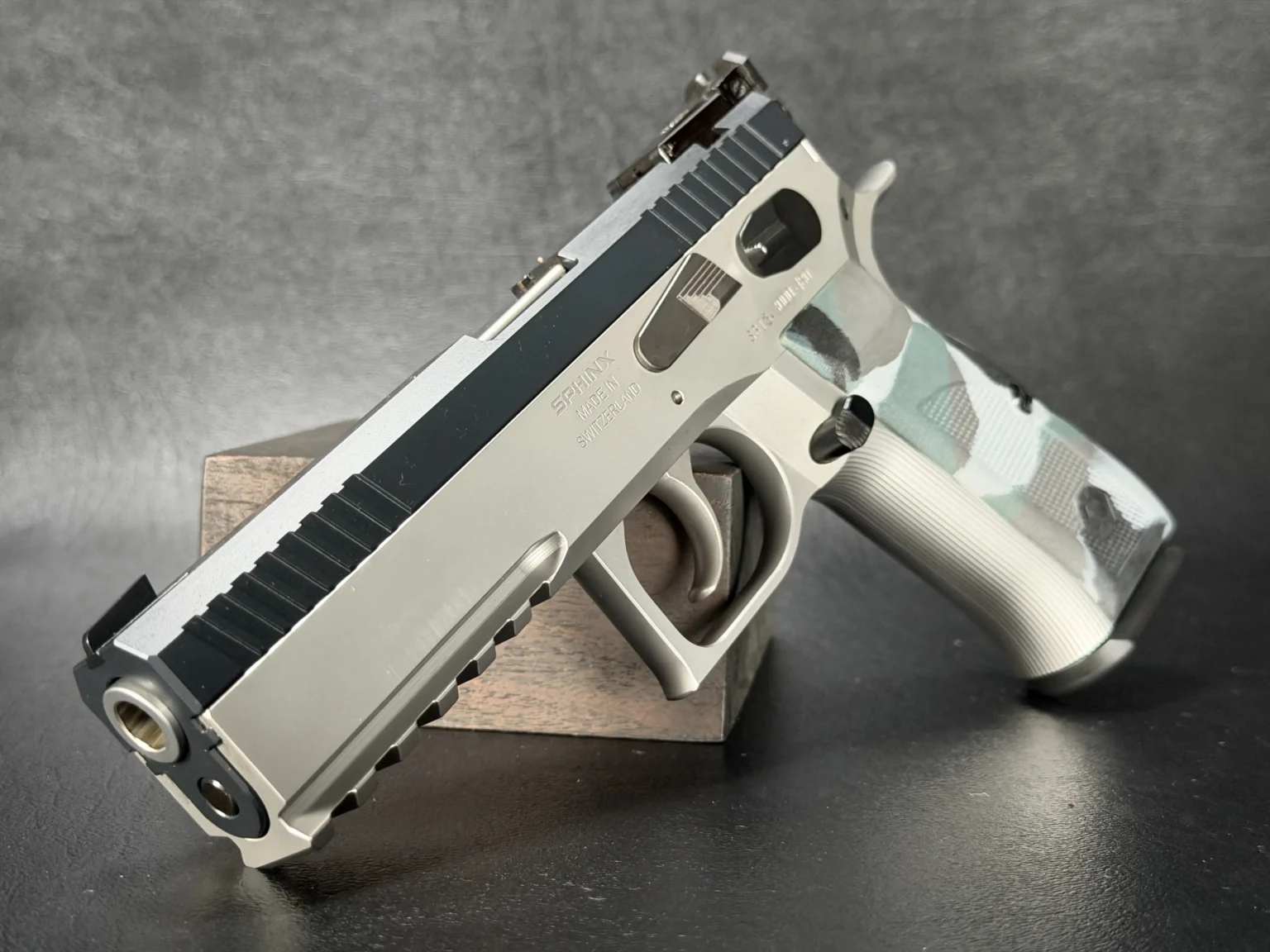
Construction varied considerably. The slide was machined from a solid steel blank, but the two-part frame system allowed Sphinx to combine steel, high-strength aluminum, and titanium components. Documented combinations included steel grip and upper-frame sections, aluminum paired with steel, all-aluminum construction, titanium paired with steel, and all-titanium construction.[1]
This variation matters when identifying surviving pistols. The Model 3000 should not be described categorically as an all-steel handgun, even though all-steel examples were produced. Frame composition directly affected weight, and factory literature consequently specified broad weight ranges rather than a single figure.[1][2]
Machining relied on CAD, CNC, and CAM processes, while manual labor remained an important part of final assembly. The construction was therefore neither wholly machine-finished nor accurately characterized as conventional mass production.[1]
Standard and Tactical Models
The Standard used a 115 mm, or 4.53-inch, barrel and measured 210 mm, or 8.27 inches, overall. The Tactical used a 95 mm, or 3.74-inch, barrel and measured 188 mm, or 7.40 inches. Both were listed at 138 mm high with a 33 mm-wide grip.[2]
Unloaded weight without a magazine depended on configuration. The Standard ranged from 830 to 1,150 grams, or 29.28 to 40.58 ounces. The Tactical ranged from 760 to 1,065 grams, or 26.79 to 37.55 ounces.[2]
Factory magazine capacities were 15 rounds for 9×19 mm and 9×21 mm pistols, 12 rounds for .40 S&W, and 10 rounds for .45 ACP. The manual expressed total loaded capacity as the magazine capacity plus one cartridge in the chamber.[2]
The Model 3000 was available with several operating arrangements. Factory documentation identifies manual-safety, decocking-lever, and double-action-only systems. The standard double-action and single-action version used an external hammer, while single-action configurations were also produced. Depending on the version, controls could include bilateral safety or decocking levers and slide-release levers.[1][2]
Sphinx specified a single-action trigger pull of 1.2 to 1.8 kilograms, or 2.64 to 3.96 pounds. The stated double-action pull was 3.7 kilograms, or 8.16 pounds. The manual also documents an automatic firing-pin safety on decocker-equipped versions.[2]
Competition Configurations
By 2007, the Model 3000 line included Standard, Tactical, and several Competition configurations. Documented competition designations included Competition Standard, Competition Production, Competition Modified, and Competition Open.[1]
The Competition Standard retained a 115 mm barrel and 210 mm overall length, with adjustable sights and a single-action trigger. The Competition Production could be supplied with a double-action trigger. The Competition Modified used an optical sight, while the Competition Open was a substantially extended pistol measuring 275 mm overall with a 135 mm barrel.[1]
These distinctions are significant for identification. “Sphinx 3000” refers to a family of pistols with different dimensions, materials, trigger systems, sights, and intended sporting configurations, not a single uniform specification.
Documented Performance
A 2005 evaluation by firearms writer Jeff Quinn examined a .40 S&W Model 3000 weighing 37.8 ounces. The test pistol had a 4.54-inch barrel, an 8.25-inch overall length, and a frame composed of separate upper and grip-frame sections. Quinn recorded no perceptible looseness at the slide-to-frame or barrel-to-slide interfaces.[3]
Most ammunition tested produced groups of two inches or less at 25 yards from a handheld rested position. One Cor-Bon 150-grain load placed four shots into one-half inch before a fifth enlarged the group to 1.25 inches. These results document the performance of that specific pistol and ammunition combination, rather than a factory guarantee for the entire Model 3000 series.[3]
For collectors, original manuals, test targets, packaging, and configuration-specific components help establish how an individual pistol left the factory. Material combinations, safety systems, sights, controls, and competition features should be evaluated on the firearm itself instead of inferred from the general Model 3000 designation.
Frequently Asked Questions
The Sphinx 3000 is a Swiss-made, hammer-fired semiautomatic pistol using a short-recoil, locked-breech operating system.
Its design lineage runs through the CZ 75-derived AT-84 and AT-88 and the subsequent Sphinx 2000. The Model 3000 was developed as a distinct successor while retaining features associated with that design family.
The factory operator’s manual lists 9×19 mm, 9×21 mm, .40 S&W, and .45 ACP.
The Standard has a 4.53-inch barrel and an overall length of 8.27 inches. The Tactical has a 3.74-inch barrel and measures 7.40 inches overall.
No. Sphinx produced configurations combining steel, high-strength aluminum, and titanium components.
Sources
[1] Kopeyko, Sergey. “Sphinx Family Pistols.” KALASHNIKOV. Weapons, Ammunition, Gear, no. 10, 2007, pp. 48–51.
[2] Sphinx Systems Ltd. Sphinx 3000: Operator’s Manual. 2003, pp. 22–33.
[3] Quinn, Jeff. “Sphinx 3000 .40 S&W Auto Pistol.” Gunblast.com, July 5, 2005.