
Key Takeaways:
- Club 30 is a gunsmithing network, not a conventional firearms manufacturer.
- The organization was formally registered in Germany in 1993.
- Documentation is essential because configurations and modifications vary among firearms and member workshops.
Club 30 is not a conventional firearms manufacturer. It is an international network of independent gunsmithing businesses specializing in the modification, refinement, and servicing of sporting pistols and revolvers.[1]
Origins
According to Club 30’s official history, engineer Peter Abe proposed bringing qualified gunsmiths together to share technical knowledge, initially with an emphasis on Smith & Wesson revolvers. A group of German gunsmiths received training at Smith & Wesson’s American factory in 1987. During the first official German training course in 1991, participants created the “Sondermodell 91” on the Smith & Wesson Model 686 platform.[1]
The idea for a permanent association developed during another Smith & Wesson course in 1992. Club 30 was formally registered in 1993 as “Smith & Wesson Club 30 Germany,” with members expected to participate in annual continuing education. Subsequent training extended to manufacturers including SIG Sauer and Heckler & Koch.[1]
The organization later adopted the shorter Club 30 name as its membership and work expanded beyond Germany and Smith & Wesson firearms. Its current network includes workshops in Germany, Austria, Switzerland, Luxembourg, and Poland.[2]
Organization and Membership
Club 30 operates through its member workshops rather than through a central factory or online firearms store. Individual businesses perform modifications, repairs, servicing, and new builds under the organization’s shared program.[3]
Membership is intended for registered gunsmithing businesses with the necessary firearms licenses, appropriate technical qualifications, and a willingness to undertake annual training.[3] Club 30’s directory currently identifies 26 participating gunsmiths across five countries.[2]
This decentralized structure is important for collectors. A Club 30 firearm may have been modified or assembled by a particular member workshop, and the scope of work can vary considerably between models and individual commissions. The Club 30 name therefore does not, by itself, identify every component, modification, or gunsmith involved.
Firearms and Services
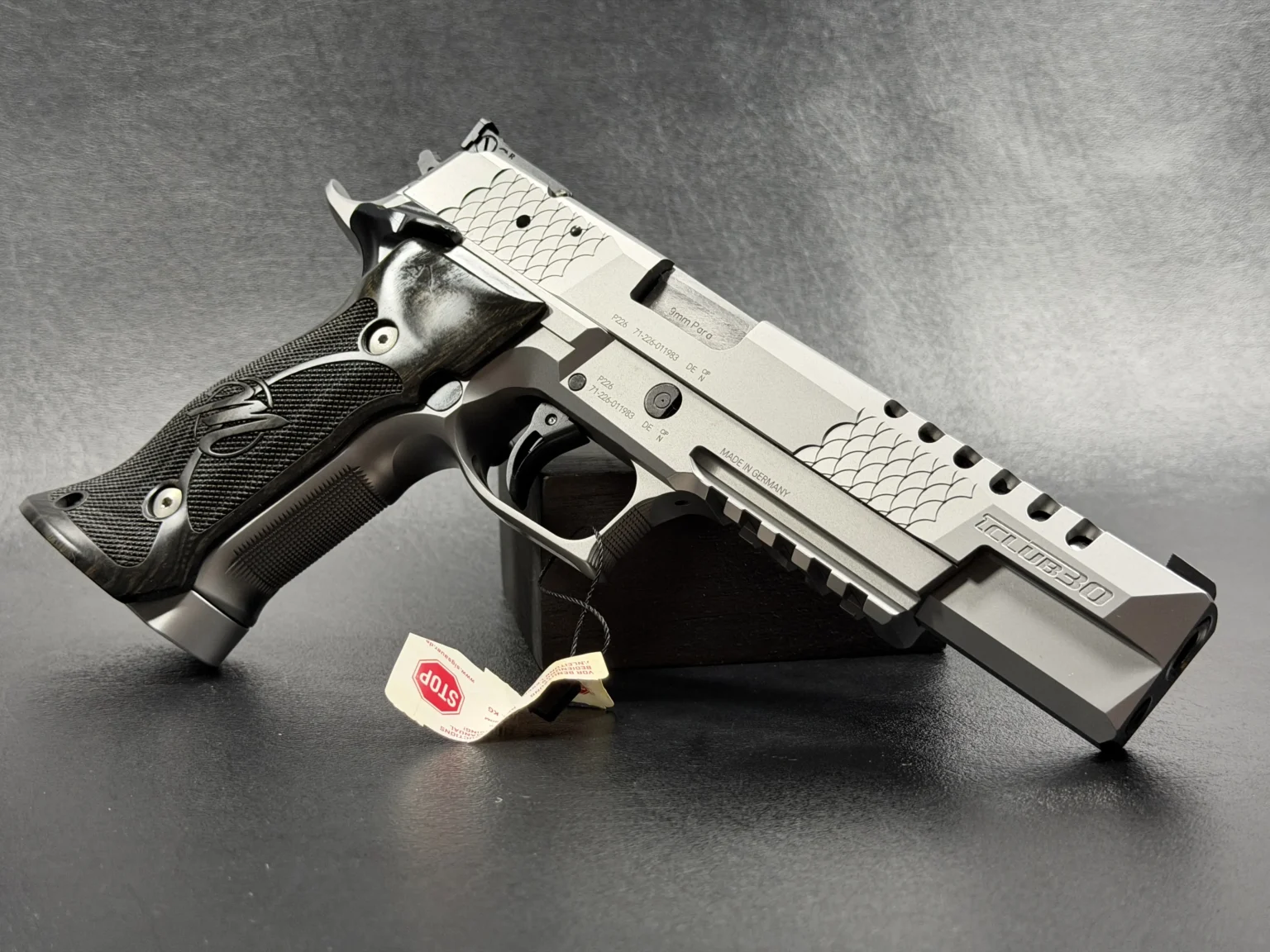
Club 30 states that its members work with established sporting-firearm platforms from manufacturers including Smith & Wesson, SIG Sauer, STP, and Spohr. Services can include action work, barrel and component fitting, sight installation, exterior finishing, repairs, and customer-specific alterations.[3]
Revolvers remain central to the organization’s identity. Its catalog includes Smith & Wesson-based conversions as well as models built on Spohr frames. The offerings range from competition-oriented Smith & Wesson Model 686 and Model 629 conversions to the configurable RL Range revolver.[4]
The RL Range is based on Spohr’s German-made L562 frame. Customers can select among different calibers, barrel lengths, cylinders, triggers, grips, sights, and finishes. The standard configuration uses a six-shot .357 Magnum cylinder, while optional cylinders allow certain configurations to use 9 mm or .38 Special ammunition through the same barrel.[4]
Club 30 also lists limited commemorative firearms. Its 30th-anniversary RL revolver was limited to 30 examples and specified with a 6-inch barrel assembly, removable cylinder, adjustable trigger stop, target sights, walnut grip, and a combination of color-case-hardened and PVD-finished components.[4]
Documentation and Collectibility
Club 30 states that each completed Club 30 firearm receives an individual certificate and 36 months of warranty coverage. The organization also offers an initial inspection between 12 and 24 months after delivery.[1]
For collectors, that certificate should be treated as part of the firearm’s provenance. Original invoices, order specifications, correspondence, and service records can further establish which workshop performed the work and what was changed. These documents should correspond with the firearm’s serial number, proof marks, import marks, and physical configuration.
Claims about rarity or limited production require model-specific evidence. A documented anniversary model limited to a stated number is materially different from an individually modified production firearm whose total number of comparable conversions is unknown.
Club 30 is best understood as a cooperative gunsmithing network rather than a single maker. Its firearms must be evaluated individually, with particular attention to the responsible workshop, the extent of the modifications, and the completeness of the accompanying documentation.
Frequently Asked Questions
Club 30 is an international network of independent gunsmithing businesses specializing in sporting pistols and revolvers.
The organization was formally registered in Germany in 1993 as Smith & Wesson Club 30 Germany.
No. Its independent member workshops modify, assemble, repair, and service firearms under the Club 30 program.
Club 30 identifies Smith & Wesson, SIG Sauer, STP, and Spohr among the platforms used by its member workshops.
Collectors should examine its Club 30 certificate, invoice, order specifications, service records, serial number, and physical configuration.
Sources
- Club 30, “Über uns”, official history, organizational description, and warranty information.
- Club 30, “Kontakt—Büchsenmacher in deiner Nähe”, official directory of member workshops.
- Club 30, “Häufige Fragen”, official description of membership requirements, services, firearm platforms, and distribution.
- Club 30, “Revolver”, official model descriptions and specifications.