
Key Takeaways:
- There are two unrelated Springfield Armories. The original was a federal factory in Massachusetts (1777 to 1968), and the modern company is a private business founded in Geneseo, Illinois, in 1974 that bought the name.
- The old armory’s reputation rests on military rifles like the 1873 trapdoor, the M1903, the M1 Garand, and the M14. For collectors, the details that drive value are serial numbers, originality, and condition, plus the low-number heat-treatment caution on early ’03 rifles.
- Many of the modern company’s popular pistols, including the XD, Hellcat, and Echelon, are made by HS Produkt in Croatia and assembled or imported through Geneseo. The 1911 line and M1A rifle are the homegrown anchors of its current lineup.
There are really two Springfield Armories, and the confusion between them is the first thing worth clearing up. One was a federal arms factory in Massachusetts that ran for nearly two centuries and closed in 1968. The other is a private company in Geneseo, Illinois, founded in 1974, that bought the name and built a business on it. They share a brand and an obsession with American military rifles, but no corporate lineage. The modern company says so itself.
For a buyer or collector, that split matters. A “Springfield” rifle could be an 1873 trapdoor pulled from a frontier-era arms rack, a wartime M1 Garand, or a polymer-framed carry pistol made in Croatia last year. Knowing which armory made what, and when, is most of what separates a smart purchase from a confused one. So let’s walk the timeline.
The first national armory
George Washington’s army stored arms at Springfield during the Revolution, and the site started life as an arsenal in 1777, chosen partly for its position above the Connecticut River and away from British naval reach. Manufacturing came later. The armory turned out its first muskets in 1795, employing 40 workers who made 245 of them that year. Modest beginnings for what became the spine of American small-arms production.
What made Springfield matter wasn’t just the guns. It was the manufacturing. The armory pioneered methods that made interchangeable parts a reality, including the Blanchard lathe for turning irregular shapes such as gunstocks. Those techniques rippled out into American industry far beyond firearms. The place was a working laboratory for mass production decades before anyone called it that.
Over 174 years of military manufacturing, the armory produced muskets, rifles, and the institutional knowledge behind them. By World War II, it employed more than 15,000 people, and about 40 percent of that wartime workforce was female. Then, in 1968, with Defense Secretary Robert McNamara pushing to contract out to private industry rather than run a government factory, the armory closed. The original arsenal reopened in 1978 as a National Historic Site, and it now holds one of the largest collections of American military firearms, with around 20,000 pieces.
The trapdoor: America’s first standard breechloader
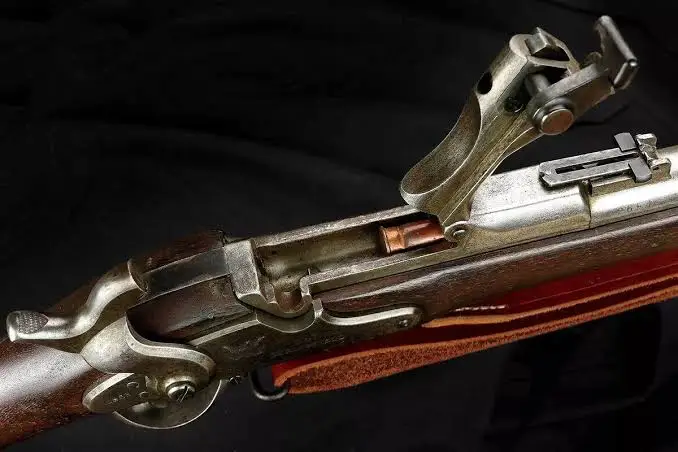
If you want a single gun that captures the old armory’s 19th-century work, it’s the Model 1873, the “trapdoor” Springfield. The name comes from the hinged breechblock that flips up and forward like a small door, designed by armory master armorer Erskine S. Allin. It was the first standard-issue breech-loading rifle adopted by the U.S. Army, chambered in the stout .45-70 Government cartridge.
The 1873 carried a 32.5-inch barrel in its infantry form and a 22-inch barrel in the cavalry carbine. Springfield built 567,882 of them between 1873 and 1884, and the design spawned a string of follow-on models (1877, 1879, 1884, 1888) that kept the basic action going for two decades. It was superseded by the bolt-action Krag-Jørgensen in the early 1890s, though trapdoors hung on in training and second-line roles into World War I.
This is the rifle of the Indian Wars and the post-Civil War frontier, for better and worse. It was the standard arm at the Battle of the Little Bighorn. For collectors, condition and configuration drive everything, and the cavalry carbines tend to draw more interest than the longer infantry rifles. Plenty of faithful reproductions exist too, from makers like Uberti, so a buyer should know whether they’re looking at an original or a modern replica before any money changes hands.
The ’03: a Mauser in American clothes
By 1900, the Army had learned a hard lesson in Cuba. Spanish troops armed with Mauser bolt-action rifles had outclassed American Krags. Springfield’s answer was the Model 1903, formally the United States Rifle, Caliber .30, Model 1903, and it borrowed heavily from Mauser’s design. So heavily that the U.S. government licensed Mauser patents and later paid royalties.
The early ’03 used the .30-03 cartridge, but in 1906 it was rechambered for the new.30-06 Springfield, the round that would arm American troops through two world wars and beyond. Production totaled roughly 3,004,079 rifles across Springfield Armory, Rock Island Arsenal, and (during World War II) Remington and Smith-Corona.
A serious collector buying an ’03 needs to know the “low number” problem. Rifles made before February 1918, below roughly serial number 800,000 at Springfield, used single heat-treated receivers that could be brittle and, in some cases, fracture when fired. The armory switched to double heat treatment at about that serial number. Shooting a low-number ’03 is a debate that’s gone on for decades, and a buyer should treat any low-number rifle as a display piece unless they’ve done their homework.
The variants are a study in themselves. The Mark I was cut for the Pedersen device, a strange and clever WWI insert that turned the bolt-action rifle into a semi-automatic pistol-caliber weapon. The M1903A3 was the simplified wartime version with stamped parts and a receiver-mounted peep sight. The M1903A4 was the sniper rifle, and it remained in service well past the point at which the rifle was otherwise obsolete. The ’03 is one of the most collected American military rifles, which means both good availability and many mixed-parts guns to watch for.
The Garand: the rifle Patton praised
John Garand worked at Springfield Armory, and the semi-automatic rifle he developed there changed infantry combat. Adopted in 1936 as the U.S. Rifle, Caliber .30, M1, the Garand gave American soldiers eight fast rounds from an en bloc clip while most of the world still used bolt actions. Patton’s line about it being the greatest battle implement ever devised gets quoted to death, but the sentiment held up in the field.
The production numbers tell the story of American industrial mobilization. Springfield Armory built around 3.5 million M1s through World War II, peaking at an astonishing 122,001 rifles in January 1944 alone, roughly 164 an hour. Winchester was the only other wartime producer, delivering about 513,880. Postwar, Springfield resumed production and was joined by Harrington & Richardson and International Harvester, pushing total Garand production past 5 million by the late 1950s.
For collectors, the M1 is a deep well. Serial number ranges tie a rifle to a maker and a rough date, and the gap between a correct, all-original WWII Springfield and a rebuilt arsenal gun (or one assembled from parts) is significant in both interest and price. The Civilian Marksmanship Program has been a major source of surplus Garands for decades, which is worth knowing if you want an honest shooter rather than a safe queen.
The M14: short tenure, long afterlife
The last rifle the federal armory designed and fielded was the M14, adopted in 1957 to replace the Garand. It kept the Garand’s gas-operated action and general feel but added a 20-round detachable magazine and select-fire capability, chambered in the new 7.62x51mm NATO round, about 10 percent lighter than the .30-06.
On paper, it was meant to replace four weapons at once: the Garand, the M1 carbine, the M3 submachine gun, and the BAR. In practice, the full-power cartridge made full-auto fire nearly uncontrollable, and most rifles were locked to semi-auto. The first Springfield-built M14s reached troops in 1959. By 1964, it was already being displaced by the M16. Total production across all makers came to about 1.3 million, and manufacturing ended in 1980. It’s one of the shortest-lived standard U.S. service rifles.
Here’s where the two Springfields connect. A businessman named Elmer Ballance set up a Texas company to build a semi-automatic, civilian-legal version of the M14 from surplus parts. He called it the M1A. In 1974, he sold that business to Bob Reese and his family in Geneseo, Illinois, who kept the Springfield Armory name. The M1A became the new company’s founding product and remains in production today, offered in 7.62 NATO, .308 Winchester, and 6.5 Creedmoor across configurations ranging from the 16-inch SOCOM to the National Match.
A name reborn in Illinois
So the modern Springfield Armory began with the M1A and later expanded. After the 1989 restrictions on imported “non-sporting” rifles, the company leaned harder into pistols. The 1911 line, built on the century-old John Browning design that the U.S. military carried as the M1911 and M1911A1, gave it a foothold in the handgun market. The 1911 remains a Springfield mainstay, from basic Mil-Spec and Garrison models up through the Prodigy and double-stack 1911 DS competition guns.
One thing buyers should understand plainly: many of the modern company’s most popular pistols are not made in Illinois. In 2001 and 2002, Springfield licensed U.S. rights to a Croatian striker-fired pistol, the HS2000, made by HS Produkt in Karlovac. Rebranded as the XD (Extreme Duty), it grew into the XD-M and XD-S lines, becoming one of America’s most popular pistol families. The newer Hellcat and Echelon are also HS Produkt designs imported from Croatia. The Geneseo facility handles assembly, quality control, distribution, and service, and builds the rifles, but the polymer pistols are made in Croatia. That’s not a knock. It’s just a fact worth knowing, and it’s stamped on the guns.
The modern pistols worth knowing
The Hellcat, launched in 2019, is the one that put Springfield back at the front of the carry market. It arrived as a micro-compact 9mm holding 11+1 in a flush magazine and 13+1 with the extended one, in a package under an inch wide. It landed in the same segment Sig Sauer opened with the P365, and it competed hard on capacity. The Hellcat Pro stretched the barrel to 3.7 inches and bumped capacity to 15, splitting the difference between deep concealment and shootability.
The Echelon, introduced in 2023, is the company’s full-size duty pistol and its most modern design. It’s built around a serialized internal chassis (the part that’s legally the firearm, removable from the polymer grip module) and a red-dot mounting system that fits many optics without separate plates. If you came up liking the XD, the Echelon is the logical next step.
The XD and XD-M Elite lines still sell, the Prodigy and 1911 DS chase the competition crowd, and the SAINT family covers the AR-15 market the company entered in 2016. There’s even a Model 2020 bolt-action line that takes Springfield somewhere the brand hadn’t gone before.
What this means for a buyer
If you’re shopping the old armory’s guns, you’re in collector territory, and the rules there are about originality, serial numbers, and condition. A trapdoor, an ’03, a Garand, or a federal M14 (which a civilian generally cannot own as a select-fire gun without navigating the National Firearms Act, so most people are really looking at semi-auto M1A rifles instead) each carries its own checklist. The low-number ’03 caution and the matching-parts question on Garands are the two that catch people most often. When something can’t be verified, like a claimed unit history with no paperwork, treat the claim as decoration, not value.
If you’re shopping the modern company, you’re buying a current production tool, and the questions are different: where it’s made, what it’s chambered in, whether it’s optics-ready, how it fits your hand and your purpose. The brand has built a reputation for delivering a lot of features for the price, and its lineup now stretches from pocket carry to precision bolt guns.
Two armories, one name, and a couple of centuries of American rifles between them. The trick is just knowing which one you’re holding.
Frequently Asked Questions
No. The original was a federal arms factory in Massachusetts that closed in 1968, and the modern Springfield Armory is a private company in Illinois founded in 1974 that bought the name. They share a brand but have no corporate connection.
The M1 Garand is probably the best-known semi-automatic rifle that armed American troops in World War II. The 1873 trapdoor and the M1903 also have strong followings among collectors.
Rifles made before about February 1918, with serial numbers below roughly 800,000 at Springfield, used single heat-treated receivers that can be brittle. Most people treat low-number ’03 rifles as display pieces rather than shooters.
The XD, Hellcat, and Echelon are made by HS Produkt in Karlovac, Croatia, and imported through Geneseo, Illinois. The 1911 line and the M1A rifle are built domestically.
Many shooters find the Hellcat and XD compact models easy to use and reliable for carry or home defense. Your best fit depends on your purpose, hand size, and budget, so handling a few in person helps.