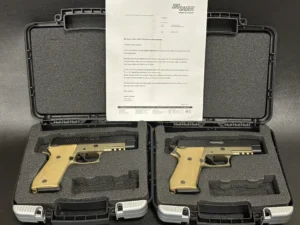

Key Takeaways:
- That “Worthless” Box Could Be Worth Thousands: Original packaging with a matching serial number can add 15 to 60 percent to a collectible firearm’s value, and in some cases even more. Certain boxes are actually rarer than the guns themselves, which means a flimsy piece of cardboard might be the most valuable thing in your safe. The lesson here is pretty straightforward: if it came with the gun, keep it with the gun. Always.
- Completeness Tells the Story, and the Story Sells: Collectors aren’t just buying a firearm. They’re buying provenance. Every manual, cleaning rod, test target, and hang tag adds another layer of authenticity and verification. A complete package confirms that the gun is exactly what it claims to be, and that kind of confidence translates directly into higher prices. Think of it this way: nobody pays top dollar for a puzzle with missing pieces.
- Protect What You’ve Got Before It’s Too Late: Owning original packaging is only half the battle. Poor storage, UV exposure, and moisture can quietly destroy the value you’re sitting on. Use climate-controlled storage, keep boxes away from direct sunlight, and never write on or modify the packaging. And while you’re at it, make sure your collection is properly insured for its actual collector value, not just the cost of a replacement firearm.
A Practical Guide for Firearms Collectors and Enthusiasts
Let’s talk about something that even experienced collectors trip up on. You find a gorgeous pre-war Colt revolver at an estate sale. The bluing is about 95 percent, the bore is bright, and the action is as crisp as the day it left Hartford. You’re already doing the math in your head. Then the seller casually mentions, “Oh, and I’ve got the original box and papers in the attic.” And just like that, the value conversation changes completely.
It sounds almost absurd when you say it out loud. A cardboard box and a few pieces of paper can add hundreds, sometimes thousands, of dollars to a firearm’s value? But that’s exactly how the collectible firearms market works. Original packaging and accessories aren’t just nice extras. They’re integral to the story of a gun, and collectors are paying premiums that would make your head spin.
Here’s the thing: this isn’t some niche concern for museum curators. Whether you’re a casual collector who picks up a piece here and there or someone building a serious investment-grade collection, understanding the packaging equation can mean the difference between a smart buy and a missed opportunity. So let’s break it down, piece by piece.
Why a Cardboard Box Can Be Worth More Than Gold
The first question most people ask is simple: why? Why would a flimsy box or a tiny screwdriver change the financial equation on a firearm worth real money?
The answer comes down to provenance and completeness. In the collector world, provenance is everything. It’s the documented history of an item, the chain of custody from the factory to your hands. An original box with a matching serial number doesn’t just look nice on a shelf. It confirms the gun’s identity. It tells you this specific firearm left the factory at a specific time, configured in a specific way. That kind of verification is hard to fake and impossible to replace.
Think of it like buying a vintage car. Sure, a 1967 Mustang is valuable on its own. But if you’ve got the original window sticker, the dealer invoice, and the owner’s manual still in the glove box? That’s a different animal entirely. It proves the car is what it claims to be, and it tells a richer story. The same principle applies to firearms.
There’s also a psychological component that we shouldn’t ignore. Collectors are, by nature, completionists. They want the whole package. There’s a deep satisfaction in owning something exactly as it was when new. It’s the same impulse that drives people to keep their sneakers in their original boxes or to save the packaging on vintage toys. It’s about preserving a moment in time, and that emotional pull translates directly into dollars.
The Numbers: What Are We Really Talking About?
Alright, let’s get specific, because the premiums here can be genuinely surprising.
For common production firearms from the mid-twentieth century, having the original box and papers typically adds 15 to 30 percent to the gun’s value. That’s on the conservative end. We’re talking about your standard Smith & Wesson revolvers, Ruger single actions, and similar pieces that were produced in large quantities.
But for rarer pieces? The premiums escalate fast. A pre-war Colt Single Action Army in excellent condition might fetch $8,000 to $12,000 on its own, depending on caliber and barrel length. Put that same gun back in its original two-piece maroon box with the factory letter, and you’re looking at $15,000 to $20,000 or more. That box alone could be worth several thousand dollars to the right buyer.
Here’s where it gets really interesting. Certain boxes are rarer than the guns themselves. Colt changed their packaging styles over the decades, and some transitional boxes were used only during short production windows. A collector might own three examples of a particular Colt model but still be hunting for the correct period box. When supply is that limited, prices get wild.
Winchester lever actions tell a similar story. A Model 94 from the 1950s in a factory box with the hang tag and instruction sheet might bring double what the same rifle would fetch without packaging. And Winchester boxes from certain eras are notoriously hard to find because, well, people threw them away. They didn’t know any better.
You know what’s funny? Your grandfather, who kept every box for everything he ever bought, the one everybody teased for being a pack rat, turns out he was sitting on a goldmine.
Not All Boxes Are Created Equal
Before you start hoarding every cardboard container you can find, there’s an important distinction to make. The box has to be correct for the gun. This is where things get nuanced, and where knowledgeable collectors separate themselves from casual buyers.
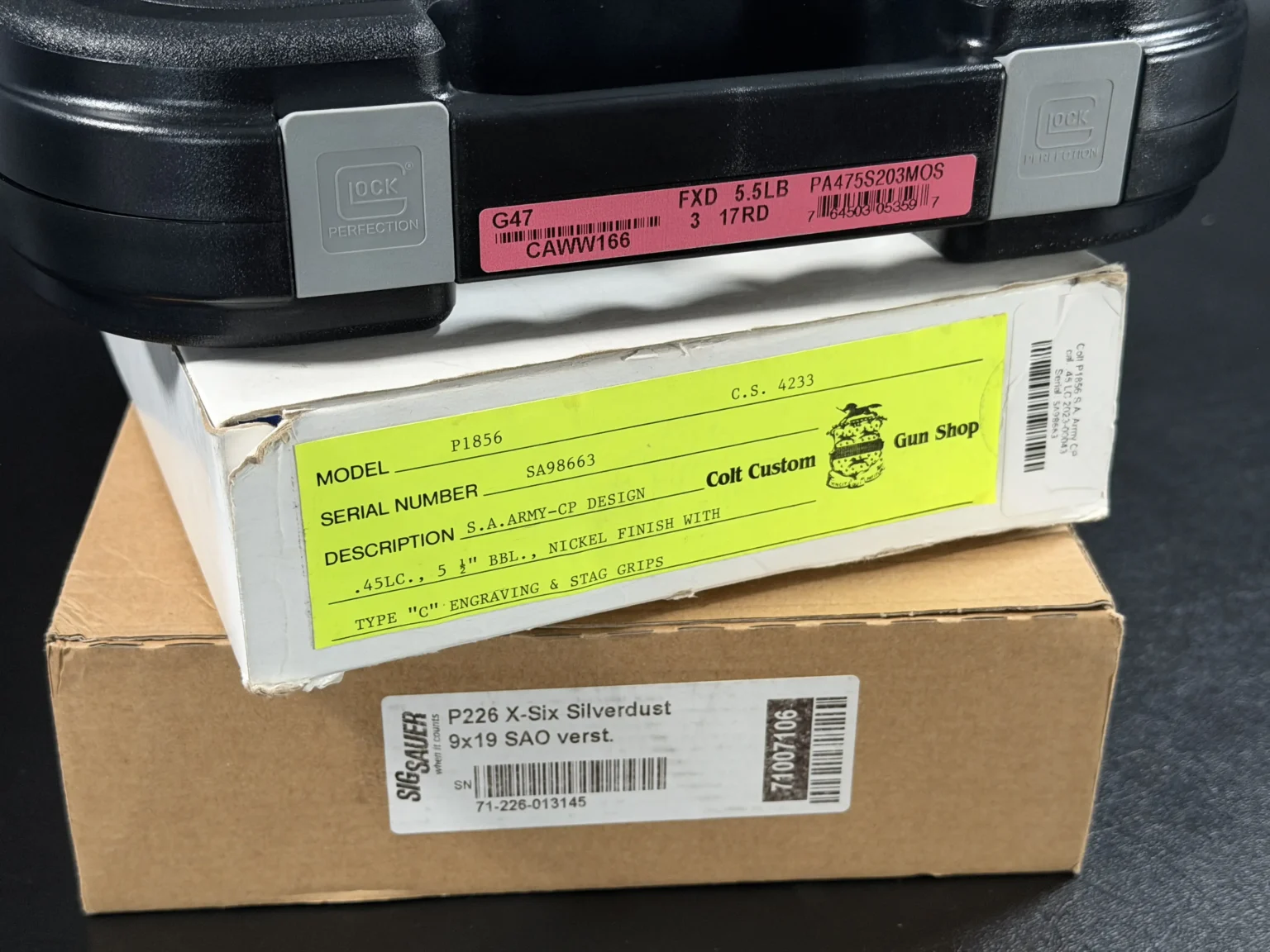
A “correct” box means the serial number on the box end label matches the gun, the box style is appropriate for the production period, and the model designation is accurate. A numbered box, one with a serial number written or stamped on it that matches the firearm, is the gold standard. A “picture box” from the right era, without a specific serial number, is still valuable, just less so. And a replacement box from the wrong era? That’s essentially worth nothing for collection purposes.
Colt collectors are particularly finicky about this. The company used different box styles throughout its history: black-and-maroon two-piece boxes, woodgrain shipping cartons, and, later, the familiar blue-and-white boxes. Each style corresponds to specific production years. Put a 1950s Python in a 1970s box and experienced collectors will spot the mismatch immediately. It won’t necessarily hurt the gun’s value on its own, but it won’t add anything either.
Smith & Wesson follows a similar pattern. Their boxes evolved from plain cardboard with paper labels to the gold-and-blue boxes of the postwar era, and later to the maroon boxes of the 1960s and beyond. Matching the box generation to the gun’s shipping date matters. A lot.
And honestly, this is where the hobby gets kind of fun. Learning to identify box styles, date production runs, and verify authenticity is a skill set all its own. It’s detective work, and there’s a real community of collectors who specialize in packaging alone.
Beyond the Box: Accessories That Move the Needle
The box gets most of the attention, but it’s not the only accessory that affects value. The full package, what collectors sometimes call “LNIB” (like new in box) or “complete,” includes several components that each carry their own weight.
Factory instruction sheets and owner’s manuals are big ones. These are often the first things to get lost because people either read them and toss them, or never read them and toss them. Either way, they’re gone. A complete Colt manual from the 1950s, the ones with the little Colt logo on the front, can be worth $50 to $200 on its own. For rarer models, considerably more.
Cleaning rods, tools, and extra grips are also significant. Many firearms were shipped with bore brushes, screwdrivers, or specialized tools. Luger pistols, for instance, are famous for this. A complete Luger rig with the original holster, magazine tool, and cleaning rod in the correct leather holster can be worth three or four times what the pistol alone would bring. That’s not an exaggeration.
Test targets are another collectible accessory that surprises people. Some manufacturers included a test-fire target with each gun to prove accuracy at the factory. These little paper targets, often with the serial number hand-written on them, are incredibly desirable. Finding one is like finding a tiny piece of factory floor history.
Hang tags, warranty cards, and dealer receipts round out the picture. Each piece adds to the story. Each piece confirms authenticity. And each piece adds value. A complete package with every accessory can command premiums of 40 to 60 percent over a gun-only example. For high-end collectibles, that premium can push even higher.
The Factory Letter: A Special Case
While we’re talking about paper accessories, we need to spend a minute on factory letters. These are a bit different from the other documentation because they can be obtained after the fact, but they’re still enormously important.
A factory letter is a document from the manufacturer (or its official historian) detailing a specific firearm’s configuration when it left the factory. Colt, Smith & Wesson, and Winchester all offer this service through their archives or through organizations like the Colt Archive Properties LLC and the Buffalo Bill Center of the West.
These letters confirm barrel length, caliber, finish, grip style, and shipping destination. For a collectible firearm, this information is gold. A gun that can be documented as shipped to a famous dealer, a military contract, or a notable historical figure jumps into an entirely different price category.
Now, a factory letter obtained today doesn’t carry quite the same weight as original paperwork that’s been with the gun since day one. But it’s close. And for guns where the original box and papers are long gone, a factory letter can recover some of that lost provenance. It’s the next best thing.
The cost of obtaining a factory letter varies. Colt letters typically run $75 to $200, depending on the era of the gun. Winchester letters are similar. Compared to the value they can add, it’s one of the smartest investments a collector can make. If you own a collectible firearm and you haven’t gotten the factory letter yet, honestly, what are you waiting for?
Condition of the Packaging: Yes, That Matters Too
So you’ve got the original box. Great. But before you celebrate, take a close look at it. The condition of the packaging itself plays a significant role in the value it adds.
A box that’s been stored in a dry attic for sixty years and still has sharp corners, clear labels, and intact graphics is going to add far more value than a water-stained, crushed box with torn flaps. Collectors grade boxes similarly to how they grade firearms, and the condition scale runs from about 60 percent (rough but identifiable) to 98-plus percent (essentially as shipped).
Labels are particularly important. The end label on a Colt or Smith & Wesson box contains critical information: model number, serial number, barrel length, finish, and sometimes caliber. If that label is faded, torn, or missing, the box loses much of its verification value. A box without a readable label is like a book without a title page. It’s still something, but it’s missing the most important part.
Interior condition counts too. Many boxes had cardboard inserts, foam linings, or shaped cradles to hold the gun securely. These internals should be present and reasonably intact. A box that’s just an empty shell isn’t nearly as desirable as one with all its original interior components.
Here’s a practical tip: if you’re storing collectible firearms in their original boxes, keep them in a climate-controlled space. Basements and garages are box killers. Temperature swings cause condensation, which in turn leads to mildew and deterioration. A closet in a temperature-stable room is a much better option. Some collectors even store their boxes in archival-quality plastic containers for extra protection.
The Counterargument: When Packaging Doesn’t Matter (Much)
Now, I’d be misleading you if I said packaging always makes a huge difference. There are situations where the box and accessories are secondary concerns.
Military firearms are the most obvious example. Nobody expects a World War II bring-back to come in a factory box. These guns were carried through combat zones, shoved into duffel bags, and shipped home in whatever container was available. For military collectibles, provenance typically focuses on unit markings, arsenal stamps, capture papers, and personal histories rather than on retail packaging.
Antique firearms, generally those manufactured before 1899, are another category where packaging is less critical. For guns that are 125 years old or more, the survival of the firearm itself is remarkable enough. Original boxes from this era are so rare that the market doesn’t penalize their absence. When they do exist, though, they’re museum-quality items and priced accordingly.
Modern production firearms are on the opposite end of the spectrum. A Glock 19 or a Smith & Wesson M&P in its factory case isn’t exactly rare. These guns ship in plastic cases by the millions, and the packaging adds minimal collector value. The calculus changes significantly once a model is discontinued or has been out of production for a couple of decades, but for current-production firearms, hang onto the box mostly for practical reasons, not financial ones.
That said, and this is important, you never know what will become collectible. Thirty years ago, nobody was paying premiums for original boxes on Ruger Blackhawks. Now they do. The lesson? Keep everything. Just in case.
The Forgery Problem: Keeping It Honest
With packaging premiums climbing, it was only a matter of time before the fakers got involved. Reproduction boxes, relabeled packaging, and forged paperwork are real problems in the collectible firearms market, and they’re getting more sophisticated.
The most common forgery is a relabeled box. Someone takes a correct-era box from a common model and creates a new end label for a rarer variant. The box itself is genuine; the label isn’t. This can be tough to spot without experience. The paper stock, ink color, font style, and printing method all need to match the period. Experienced collectors develop an eye for these details over years of handling originals.
Completely fabricated boxes exist, too, though they’re less common because reproducing the cardboard, printing, and construction methods of a specific era is surprisingly difficult. The weight of the cardboard, the type of glue used, the printing technique (letterpress versus offset), and even the way the box was assembled all provide clues to its authenticity.
So how do you protect yourself? Education is your best defense. Study reference books like the “Standard Catalog of Smith & Wesson” or Larry Wilson’s books on Colt. Join collector organizations like the Colt Collectors Association or the Smith & Wesson Collectors Association. These groups have members who’ve been studying packaging details for decades, and they’re usually happy to help authenticate pieces.
When buying, ask questions. Where did the box come from? Has it always been with the gun? Is the serial number on the label consistent with the gun’s features? Does the wear pattern on the box match what you’d expect from genuine storage? A box that looks brand new for a gun from 1955 should raise an eyebrow.
Reputable auction houses like Rock Island Auction, James D. Julia (now part of Morphy’s), and Amoskeag Auction Company employ specialists who vet the authenticity of packaging. Buying through these channels provides an extra layer of confidence, even if you pay a buyer’s premium for the privilege.
Practical Advice for Collectors: Protecting What You’ve Got
If you’re already sitting on collectible firearms with their original packaging, congratulations. Now let’s make sure you don’t accidentally destroy your investment.
First, never store firearms in their original boxes long-term without some precautions. Old cardboard can absorb moisture and even contain chemicals that promote rust. Use a silicone-treated gun sock or VCI (vapor corrosion inhibitor) paper as a barrier between the gun and the box. Check your pieces at least twice a year for any signs of corrosion.
Second, don’t write on the boxes. Don’t put stickers on them. Don’t rubber-band the flaps shut. And for heaven’s sake, don’t store anything else inside the box that wasn’t originally there. Every mark, sticker, and modification reduces value.
Third, document everything. Photograph the gun, its box, and accessories from multiple angles. Record the serial numbers, note the box condition, and keep these records in a separate location from the collection itself. If the worst happens, whether that’s fire, theft, or a natural disaster, documentation is essential for insurance claims and potential recovery.
Fourth, consider how you display your collection. UV light fades box labels and graphics over time. If you’re displaying boxed firearms, keep them out of direct sunlight. Some collectors use UV-filtering display cases, which is a smart move if you plan on having pieces on permanent display.
And fifth, ensure your collection is properly. Standard homeowners policies typically have low limits on firearms and almost never account for collector premiums for packaging and accessories. A dedicated firearms collection policy from a company that understands the market is worth the cost. Companies like Collectibles Insurance Services and the NRA’s endorsed programs offer policies that cover the actual collector value, not just the replacement cost of a used gun.
Where the Market Is Heading
Let me offer some observations about trends, because where the market has been isn’t necessarily where it’s going.
The premium for original packaging has been climbing steadily for the past two decades, and there’s no sign of slowing. As more collectors enter the market and the supply of properly boxed firearms shrinks (because boxes get damaged, lost, or separated), the basic economics of supply and demand keep pushing prices up.
There’s also a generational shift happening. Younger collectors who grew up in the era of mint-in-box collecting for toys, video games, and sneakers bring that same mentality to firearms. They expect a complete package, and they’re willing to pay for it. This trend is especially visible in the collecting of firearms from the 1970s, 1980s, and 1990s, pieces that older collectors might not have considered “collectible” yet.
Online auction platforms have also changed the game. Sites like GunBroker and the major auction houses’ online platforms have created a national (and international) market that rewards rarity. A boxed example that might have sat unsold at a local gun show for months can now reach thousands of motivated buyers with a few clicks. That increased exposure tends to drive prices upward, particularly for the most desirable configurations.
One more thing worth mentioning: the information age has made everybody smarter. Collectors today have access to production records, serial number databases, and online forums full of experts. That means the market is more efficient than it used to be, and correctly identified, properly boxed firearms are being valued more accurately. The days of finding a boxed pre-war Colt at a yard sale for $200 are mostly over. Mostly.
The Bottom Line: Save the Box
If there’s one takeaway from all of this, it’s simple. Save everything. Every box, every manual, every cleaning rod, every test target, every hang tag, every warranty card. If it came with the gun, keep it with the gun.
The collectible firearms market has spoken clearly on this point: completeness matters. A firearm with its original packaging and accessories isn’t just a gun; it’s a time capsule. It’s a complete artifact from a specific moment in manufacturing history, and collectors value that completeness in very tangible ways.
Whether you’re buying, selling, or just maintaining a collection you plan to pass down, understanding the role of packaging and accessories gives you an edge. It helps you spot value that others miss, avoid overpaying for incomplete examples, and protect the investments you’ve already made.
So the next time someone tells you it’s “just a box,” you’ll know better. That box is part of the story. And in the world of collectible firearms, the story is worth real money.
Frequently Asked Questions
For common mid-century production guns, expect a 15 to 30 percent bump. Rarer pieces with matching serial-numbered boxes can see premiums of 40 to 60 percent or even higher.
A serial-numbered box that matches the firearm is the gold standard and adds the most value. A period-correct box without a specific serial number still helps, but it won’t carry nearly the same weight with serious collectors.
Factory manuals, cleaning rods, test targets, hang tags, warranty cards, and original tools all contribute to the overall package. A fully complete example can command significantly more than a gun sold on its own.
It’s an official document from the manufacturer confirming a firearm’s original configuration and shipping details. At $75 to $200, it’s one of the smartest investments a collector can make, especially when the original box and papers are gone.
Study reference books, join collector organizations, and pay close attention to paper stock, ink color, font style, and printing methods. Buying through reputable auction houses that employ packaging specialists also adds a solid layer of protection.