
Key Takeaways:
- Same concept, completely different purpose. The Colt Peacemaker and modern revolvers share the same basic DNA, rotating cylinder, hammer, six rounds, but they were built for entirely different worlds. The SAA is a deliberate, single-action experience rooted in history. Modern revolvers like the Ruger GP100 or S&W 686 are engineered tools optimized for speed, versatility, and real-world performance. Comparing them directly is a bit like comparing a hand-forged chef’s knife to a modern surgical scalpel. Both cut; that’s where the similarity ends.
- The Peacemaker’s “weaknesses” are features, not flaws, depending on who you ask. Gate-loading, fixed sights, single-action only: on paper, these look like limitations. And functionally, they are. But for cowboy action shooters, collectors, and anyone who appreciates the ritual of slow, precise shooting, these same characteristics are exactly the point. The SAA demands engagement. That’s not a bug.
- Modern metallurgy changed everything, even if the silhouette didn’t. A first-generation Peacemaker and a Ruger Redhawk may look vaguely similar from across a room. Under the surface, though, they’re separated by over a century of materials science, CNC machining, and pressure-tolerance engineering. Original SAAs weren’t built to handle the loads modern revolvers routinely handle, and that gap, more than anything else, defines what “modern” actually means in this conversation.
Let’s get started…
There’s something almost reverent about holding a Colt Single Action Army. The weight of it, the click of the hammer as you draw it back, it feels like history folded into cold steel. It should. The Peacemaker helped shape an entire era, and its design has barely flinched in 150 years. But here’s the thing: that legendary design, the one that made the Peacemaker an icon, is also the reason it can’t compete with what’s sitting in your local gun shop today.
So what’s actually different? If you’ve ever stood at a range with a Ruger GP100 in one hand and an original SAA (or one of the reproductions from Uberti or Taylor’s & Co.) in the other, you already have a gut sense of the answer. One feels like holding a relic; the other feels like a tool. Both are revolvers, yes, both use a rotating cylinder to chamber cartridges, both have a hammer, and both are mechanically elegant in their own right. But the gap between them spans more than just time.
Let’s get into it.
A Brief Word About Where the Peacemaker Came From
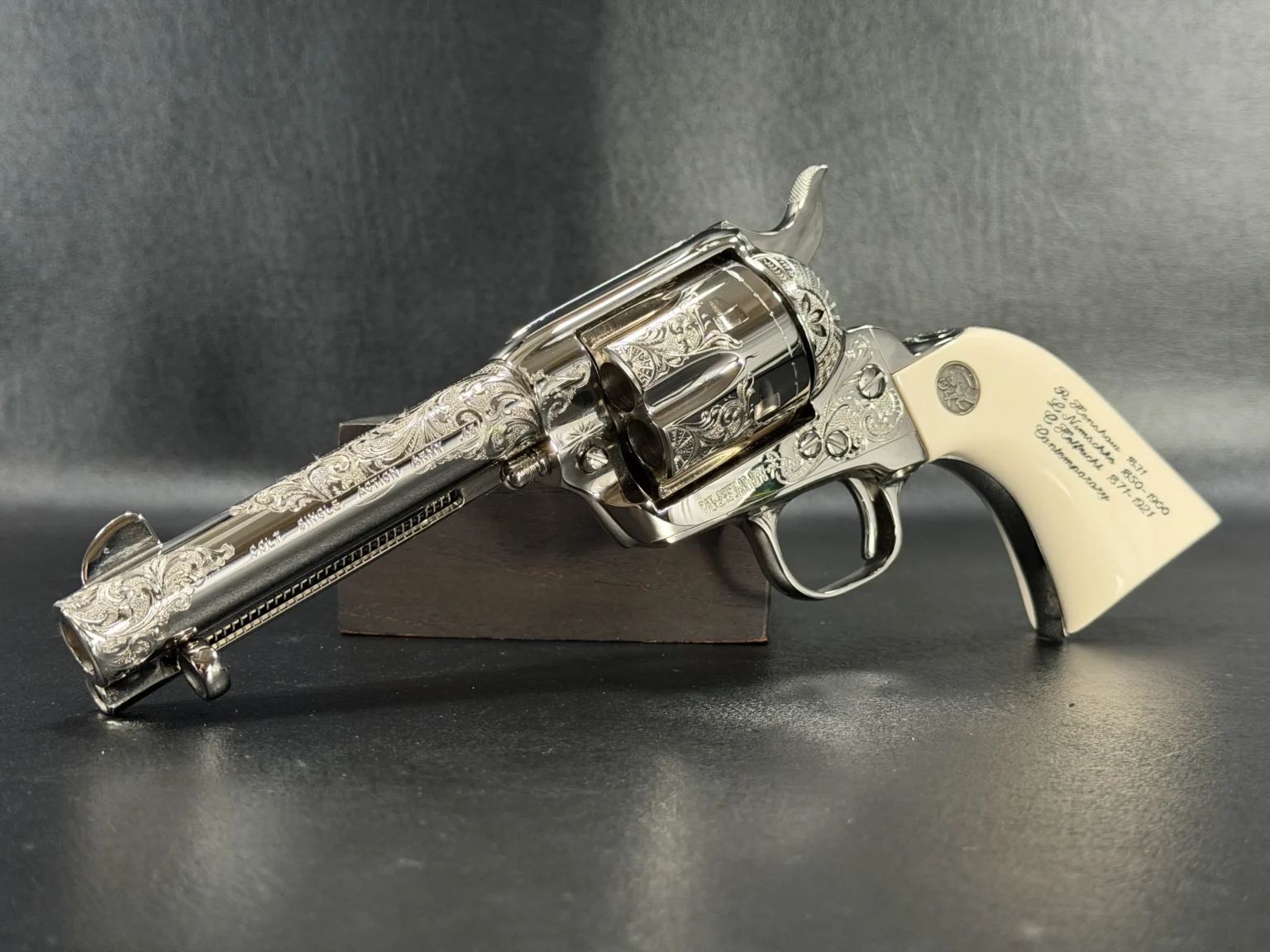
Colt’s Single Action Army was introduced in 1873, and the U.S. Army adopted it the same year. It was initially chambered in .45 Colt, a round specifically developed for it, and went on to serve in cavalry engagements, frontier towns, and, eventually, Hollywood. Wyatt Earp. Doc Holliday. The gunfighters of the American West, real and imagined, carried some version of this pistol.
The genius of the design was its simplicity. Samuel Colt’s engineers created a revolver with relatively few parts, each serving an obvious mechanical purpose. The cylinder rotates as you manually cock the hammer. The cartridges load one by one through a gate on the right side of the frame. And to unload, you open that same gate and use a rod mounted below the barrel to punch spent cases out, one at a time.
That loading and unloading process matters a lot when you start comparing it to modern designs. More on that in a moment.
Single-Action vs. Double-Action: The Biggest Functional Divide
If there’s one mechanical difference that separates the Peacemaker from virtually every modern revolver, it’s the action type.
The SAA is, as the name suggests, a single-action revolver. To fire it, you must manually cock the hammer with your thumb before each shot. That backward stroke of the hammer simultaneously rotates the cylinder to the next cartridge. You pull the trigger only to drop the hammer. Simple, yes, but slow if you’re trying to get rounds downrange quickly.
Modern revolvers like the Smith & Wesson 686, the Ruger GP100, or the Taurus Raging Hunter operate in double-action. That means you can either cock the hammer for a precise, lighter single-action pull, or simply press the trigger for a longer, heavier double-action pull that cocks and fires in one motion. In a defensive scenario, that difference is enormous. Six rounds downrange in double-action takes a fraction of the time it would take to shoot six from a Peacemaker.
Some people argue that single-action shooting is more accurate for precision work. There’s truth to that; the trigger pull on a properly tuned SAA is genuinely crisp, often around 3 to 4 pounds, and the deliberate cocking motion forces a certain mindfulness. Cowboy action shooting competitors, who use the SAA and its replicas in SASS (Single Action Shooting Society) competitions, will tell you there’s real technique in thumb-cocking under pressure. But for defensive use or modern law enforcement? The SAA is a non-starter. It was retired from U.S. military service in 1892, replaced by the Colt Model 1892 double-action revolver.
Loading and Unloading: Night and Day
Here’s where the Peacemaker’s age really shows, and honestly, it’s what trips up new shooters who try one for the first time.
The SAA uses what’s called a gate-loading system. There’s a spring-loaded loading gate on the right side of the frame. You open it, half-cock the hammer (which frees the cylinder to rotate), and then load cartridges one at a time. To unload, you cycle through each chamber with the ejector rod, one case at a time.
Now compare that to a modern revolver, which uses a swing-out cylinder. You press a release latch, the cylinder swings left out of the frame, you push the ejector rod to kick out all cases simultaneously, and you reload, potentially with a speedloader like the HKS or Safariland Comp III, in a matter of seconds. The whole empty-to-loaded process on a modern revolver can take under three seconds with practice.
This isn’t a small difference. In the context of self-defense, it’s almost disqualifying for the SAA. In the context of a competitive shooting sport or a historical collection, it’s part of the experience. Different tools for completely different jobs.
Materials and Metallurgy: Old World Craft vs. Modern Engineering
The original Colt SAAs were built when steel metallurgy was a far less precise science than it is today. First-generation Peacemakers (roughly 1873 to 1940) were made of steel with limited tensile strength and pressure tolerance by modern standards. This is a critical point if you’re handling an original: many first-generation SAAs should be used only with period-appropriate black powder loads or specific reduced-pressure smokeless loads. Running modern +P ammunition through an original is not something any responsible collector does.
Second-generation (1956 to 1975) and third-generation (1976 to present) Colts use better steel and tighter manufacturing tolerances. The contemporary Colt SAA is rated for standard .45 Colt loads. Uberti and Cimarron reproductions, which are popular in the cowboy action shooting community, are made with modern Italian steel and generally handle the pressures of factory .45 Colt without issue.
Modern revolvers, though? They’re engineered on a different planet entirely. The Smith & Wesson 686 is made from 400-series stainless steel, machined to tolerances that would’ve been science fiction in 1873. The Ruger GP100’s cylinder and frame are built to handle .357 Magnum +P loads indefinitely, pressures that would be unthinkable in an original SAA. Ruger’s triple-locking cylinder design (locked at the front, rear, and crane) provides a level of cylinder alignment that the original gate-load design simply can’t match.
This matters for accuracy and longevity. The tighter the cylinder gap (the space between the front of the cylinder and the forcing cone), the less gas blowback and the better the accuracy. Modern CNC-machined revolvers maintain gaps measured in thousandths of an inch across thousands of rounds. The manufacturing variation in 19th-century revolvers was, by necessity, wider.
Ergonomics: The Plow Handle vs. Modern Grip Design
Pick up a Peacemaker, and you immediately notice the grip. It’s narrow, the backstrap is curved, and the grip angle is fairly upright. It’s often called a “plow handle” grip, and it was designed around a specific shooting style, cavalry-style shooting from horseback, where a pinned wrist and vertical gun orientation made sense.
On foot, at a modern range, that plow handle grip is something of an acquired taste. Most experienced shooters will tell you it’s comfortable for slow-paced shooting, but it can transmit recoil harshly during rapid fire.
Modern revolvers have evolved dramatically in grip design. The Ruger GP100’s Hogue Monogrip, for instance, wraps around the back of the frame with a finger-groove rubber design that distributes recoil across the entire hand. Smith & Wesson’s L-frame revolvers come with ergonomically contoured wood or rubber grips. Some models, like the Taurus Raging Hunter, have compensators built into the barrel to redirect muzzle blast and reduce felt recoil. These aren’t cosmetic choices; they reflect decades of biomechanical research into how humans actually manage recoil.
That said, a lot of shooters, especially those who spend time in historical shooting disciplines, develop a genuine affection for the SAA grip. It points naturally for some people, and the grip profile makes it exceptionally fast for a single-action draw. You know what? Personal preference plays a real role here, and anyone who says otherwise is oversimplifying.
Sights: Fixed vs. Adjustable, and Why It Matters
The Colt SAA has a fixed front blade sight and a groove milled into the top of the frame as the rear sight. That’s it. It’s a rudimentary aiming system by modern standards, but it was considered adequate for the ranges at which the SAA was designed to be used, typically under 50 yards in practical terms.
Modern revolvers offer considerably more. The Smith & Wesson 686 Plus comes with a fully adjustable rear sight and a replaceable front sight. The Ruger GP100 Match Champion features a fiber optic front sight. High-end options like the Smith & Wesson Performance Center revolvers can come with precision-adjustable sights, tritium night sights, or even red dot optic mounts.
For hunters using revolvers, this matters enormously. Cartridges like the .357 Magnum, .44 Magnum, and the .460 or .500 S&W Magnum, chamberings found in modern wheelguns, require precise sighting systems to be used effectively at hunting distances. A fixed groove rear sight isn’t going to cut it at 100 yards on a whitetail.
The SAA’s fixed sights are, in many ways, a reflection of its era’s tactical thinking. In a cavalry charge or a close-range confrontation, long-range precision was secondary to a reliable, robust system that could operate in dust and mud. Modern revolvers reflect a different set of priorities.
Cylinder Capacity: Six is the Number, but That’s Where the Similarity Ends
Both the Peacemaker and most modern revolvers hold six rounds, and interestingly, this hasn’t changed as much as you might expect. The six-shot format persists in many revolvers today, though modern options like the Smith & Wesson 686 Plus hold seven rounds, and some .22 LR revolvers hold eight or even nine.
The capacity similarity, though, masks the massive difference in how quickly you can reload. As noted earlier, a swing-out cylinder with a speedloader turns a six-shot revolver into something genuinely competitive for rapid-fire scenarios. The SAA’s gate-loading system keeps it in the historical category regardless of the round count.
For cowboy action shooting, of course, the historical loading method is the whole point. SASS rules require period-correct firearms, and the deliberate gate-loading ritual is part of what separates the sport from general handgun competition.
The Trigger: Thin Pulls and Heavy Ones
We touched on single vs. double action, but the trigger feel itself deserves its own conversation.
A properly tuned SAA trigger is, genuinely, one of the great pleasures of the revolver world. The pull is short, crisp, and predictably light. Gunsmiths like those at Doug Turnbull Restorations (who do extraordinary case-hardening and restoration work) can bring an SAA’s trigger to a level that makes modern production guns seem somewhat clunky by comparison. There’s a mechanical simplicity to the SAA’s lockwork, fewer components, fewer variables, and for many shooters, a more tactilely satisfying experience.
Double-action triggers on modern revolvers are genuinely good, far better than they were even 30 years ago, but they’re operating a more complex mechanism. The Smith & Wesson Performance Center versions are exceptional, and with cylinder timing and action smoothing from a qualified revolver smith, a modern DA revolver can achieve a long, smooth pull that’s very shootable. But it won’t feel like the SAA’s single-action pull. Nothing does.
The trade-off is the versatility: a double-action revolver gives you the choice. Slow shooting? Cock it and enjoy that single-action pull. Rapid fire? Work the trigger in double-action. The SAA gives you one option, and it’s a good one, but still just one.
What About Reliability and Maintenance?
The Peacemaker’s simplicity is arguably its greatest advantage in maintenance. There are very few parts to lose, break, or confuse. Field-stripping an SAA requires no tools and only moderate familiarity, and the design’s tolerance for dust, grit, and rough handling is well documented in history. Cowboys didn’t exactly have gun cleaning kits in their saddlebags.
Modern revolvers are more complex but are engineered to demanding tolerance standards. A Ruger or Smith & Wesson made in the last decade will run for tens of thousands of rounds with proper maintenance and almost certainly outlast the shooter. The leaf spring on an older SAA, however, is a known weak point, they can break, and replacement requires some knowledge of the mechanism.
One maintenance area where the SAA clearly loses: timing. Over time and with heavy use, the hand (the part that rotates the cylinder) can wear out, causing the cylinder to stop rotating and become slightly misaligned with the barrel. This is a known issue with original SAAs and some lower-quality reproductions. Modern revolvers with their multi-locking cylinders are considerably more resistant to timing issues.
The Collector and Cultural Dimension
Here’s where things get interesting for the collector community specifically. The Peacemaker isn’t just a firearm; it’s a cultural artifact. First-generation Colt SAAs in original condition command extraordinary prices; a pristine, documented first-gen SAA can fetch $15,000 to well over $50,000 at auction, depending on provenance and condition. Second and third-generation guns occupy a different market, but even contemporary Colt SAAs have a collectibility premium that no modern production revolver from Ruger or Smith & Wesson currently matches.
That said, modern revolvers have their own collector interest, particularly in limited editions, Performance Center models, and discontinued configurations. The Smith & Wesson Model 27, the original .357 Magnum revolver from 1935, has a devoted collector following. Pre-lock Smith & Wessons (those made before the internal lock was introduced around 2001) are actively sought after by collectors who feel the lock changed the guns’ feel and reliability.
The Peacemaker, though, occupies a category of its own. It’s the intersection of American history, frontier mythology, and genuine mechanical elegance. Reproductions from Uberti, Cimarron, Taylor’s & Co., and Standard Manufacturing make the experience accessible without sacrificing a first-generation example to range use, and cowboy action shooting has created a genuinely vibrant community around these guns.
Different Tools, Different Conversations
It might seem like an unfair comparison in some ways, pitting a 150-year-old design against a gun engineered with CNC machining, modern alloys, and ergonomic research. In functional terms, modern revolvers win in almost every measurable category: reloading speed, ergonomics, adjustable sights, metallurgical strength, and versatility.
But that framing misses the point for most people who are drawn to the Peacemaker. The SAA isn’t competing with the GP100. It never was, really. The Peacemaker exists in a different conversation, one about American history, mechanical artistry, and the satisfying ritual of a single-action revolver. You cock the hammer, you acquire the target, you press the trigger. There’s a deliberateness to it that modern double-action shooting simply doesn’t replicate.
Modern revolvers, by contrast, are serious working tools. The .44 Magnum Smith & Wesson Model 629 is a legitimate hunting handgun for deer and black bear at reasonable distances. The .357 Magnum Ruger SP101 is a serious concealed-carry option for those who prefer revolvers over semi-automatics. The Ruger Redhawk in .45 Colt can be loaded with Ruger-only handloads pushing well beyond what the SAA could handle.
For the firearms enthusiast and collector, the best answer is almost always to own both. Use the modern revolver for range work, hunting, or home defense. Bring out the SAA, or a high-quality reproduction, for cowboy action shooting, historical appreciation, and the pure pleasure of a design that’s outlasted the civilization it was built for.
A Few Notes Before You Buy
If you’re considering an original first-generation Colt SAA, have it inspected by a qualified gunsmith before you fire it, and absolutely research appropriate loads for the specific gun. These are antiques in the truest sense, and they deserve careful handling.
For practical Peacemaker shooting, look at Uberti’s 1873 Cattleman series, Cimarron’s wide range of SAA reproductions, or Taylor & Co.’s various offerings, all made in Italy with modern steel and excellent fit and finish. Standard Manufacturing also produces American-made SAA reproductions worth considering.
For modern revolvers, the Smith & Wesson L-frame (586/686) and the Ruger GP100 are the workhorses of the category, deservedly beloved by generations of shooters. If you want something with a bit more fire-breathing capability, the Ruger Redhawk or S&W Model 629 in .44 Magnum won’t disappoint.
The comparison between the Peacemaker and modern revolvers ultimately tells a story about how much, and how little, firearms design has needed to change. The revolver format remains viable, practical, and deeply appealing well into the 21st century. The Colt Peacemaker simply stands as proof that some ideas are good enough to become permanent.
Frequently Asked Questions
First-generation SAAs were built for black powder pressures, so running modern smokeless loads through one is genuinely risky, and running +P loads is asking for trouble. Stick to period-appropriate or specifically reduced loads, and always have an original inspected by a qualified gunsmith before firing it.
For its intended purpose and era, absolutely, the SAA’s crisp single-action trigger pull actually encourages precise shooting at practical distances. Beyond 50 yards, though, the fixed, rudimentary sights become a real limiting factor compared to the adjustable systems on modern revolvers.
Honestly, the cylindrical geometry of a revolver frame puts natural limits on capacity, especially in larger calibers where chamber walls need to be thick enough to handle pressure. Some modern revolvers do push past six; the S&W 686 Plus holds seven, for instance, but the format itself hasn’t dramatically changed because the engineering constraints haven’t either.
Uberti’s 1873 Cattleman and Cimarron’s SAA reproductions are the go-to choices in the SASS community, built with modern Italian steel and solid fit and finish at a reasonable price. Taylor’s & Co. and Standard Manufacturing are also worth a serious look, particularly if you want American-made options.