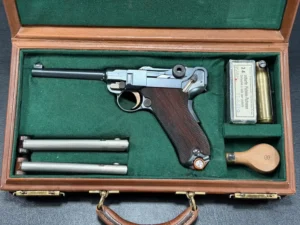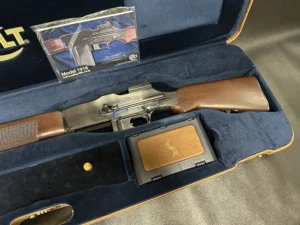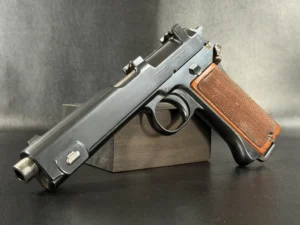

Key takeaways:
- Provenance and condition speak different languages depending on what you’re collecting. With historic guns, a documented paper trail can outweigh physical condition entirely. A well-worn piece with a clear ownership history will almost always command more than a cleaner gun that surfaced from nowhere. Flip that thinking for contemporary customs, where authenticity is assumed, and originality of configuration matters far more than age or patina.
- Conservation and maintenance aren’t interchangeable, so don’t treat them that way. Historic pieces demand restraint. Refinishing, polishing, or even aggressive cleaning can permanently erase value that no amount of money can recover. Contemporary custom guns, by contrast, are often built to be used, serviced, and kept in working order. Applying museum-level hands-off reverence to a modern 1911 isn’t preservation; it’s just neglect wearing a careful face.
- Neither category is a reliable short-term investment, but only one of them has a fixed supply. Historic custom firearms exist in a finite pool. Every authentic, well-documented piece that disappears or gets damaged makes the rest slightly rarer. Contemporary customs are luxury objects first; any future appreciation is speculative at best. Buy the contemporary piece because you love the craft. Buy the historic piece because you understand what you’re stewarding. Both are valid reasons. Neither “I’ll flip this in two years” is.
Let’s get started…
There’s a moment most firearms collectors remember with uncomfortable clarity. You’re at a gun show, or maybe browsing a specialized auction catalog, and you spot something that makes your pulse tick a little faster. It could be a Colt Single Action Army with provenance going back to a 19th-century lawman, or it could be a modern custom 1911 built to exacting tolerances by a present-day master like Ted Yost or Les Baer. Both are extraordinary objects. Both have devoted followings. But the way you should think about acquiring, caring for, and eventually valuing them couldn’t be more different.
That distinction matters more than newcomers typically expect. And honestly, a lot of experienced collectors still blur the lines in ways that cost them money, lead to preservation mistakes, and occasionally break their hearts.
So let’s get into it.
The Weight of History (Literally and Figuratively)
When you pick up a historic custom gun, you’re holding a conversation between the past and the present. A single-action revolver engraved by someone like L.D. Nimschke in the 1870s, or a Winchester Model 1873 bearing the ornamental scrollwork of a long-dead master craftsman, carries a kind of gravity that no modern piece can replicate. That gravity isn’t just sentimental. It directly shapes the market, the scholarship around the piece, and the decisions you’ll need to make as its caretaker.
Historic custom firearms, generally speaking, are pieces made before roughly the 1950s, though collectors constantly argue about exactly where the line falls. What defines the category isn’t just age, though. It’s the combination of period craftsmanship, original finish integrity, documented provenance, and that impossibly elusive quality: authenticity of context. A Colt engraved by Cuno Helfricht doesn’t just represent metalworking excellence; it represents the social and commercial world of late 19th-century American firearms culture. That context is part of what you’re buying.
Contemporary custom guns, on the other hand, are built by living craftspeople using modern techniques, materials, and equipment. A pistol from Wilson Combat or a custom long gun from an individual maker like Jason Baney or Rinaldo D’Amelio represents the cutting edge of what human hands and modern metallurgy can achieve together. These aren’t inferior objects. They’re often technically superior to their historical counterparts. But they exist in a completely different collecting framework, and treating them as if they’re the same kind of investment or the same kind of stewardship challenge is where collectors get into trouble.
Provenance: The Currency of Historic Collecting
Here’s the thing about historical pieces that takes time to truly internalize: condition matters enormously, but provenance can matter even more.
Let’s say you come across two nearly identical Colt Single Action Army revolvers from the 1880s, both engraved to roughly the same level, both retaining perhaps 60% of their original case-hardened finish. One has a clear, documented chain of ownership tracing it to a well-known figure. The other surfaced at an estate sale with no paper trail at all. Same metal, same craftsmanship, same age. The difference in auction prices can be 300% or more.
Provenance documentation for historic pieces typically includes factory letters from the original manufacturer, which you can still obtain from sources such as the Colt Archive, the Winchester Museum, or the National Firearms Museum. Dealer invoices, estate records, photographs showing the gun in a specific owner’s possession, military inspection marks, export stamps, and period advertisements showing identical pieces. All of it adds up.
The frustrating reality is that provenance can also be fabricated. This is where the collector community, and specifically organizations such as the American Society of Arms Collectors, provides genuine value. Expert authentication isn’t just about knowing what a real 19th-century finish looks like. It’s about recognizing the tells that distinguish authentic documentation from manufactured history. A beginner learns to examine metal. An expert learns to examine paper.
Contemporary custom guns have their own provenance considerations, but they operate differently. When you buy directly from the maker, you have provenance by default. The builder knows the gun; they made it. Some contemporary craftspeople keep detailed records and will provide documentation on request. The collector challenge here isn’t so much establishing authenticity as establishing significance. Who made it? What’s their standing in the community? Has their work been recognized in publications such as Guns & Ammo, American Rifleman, or the specialized catalogs published by major auction houses, such as Rock Island Auction Company?
Condition Grading: Two Different Languages
If you’ve spent time with historic gun collecting, you’re probably familiar with the NRA condition standards: Perfect, Excellent, Very Good, Good, Fair, Poor. These grades, applied to antique and vintage firearms, carry a specific meaning tied to the percentage of original finish remaining, the sharpness of markings, and the mechanical function of the piece.
Contemporary custom guns use similar language but require a completely different interpretive lens. A modern 1911 built to competition specifications by Nighthawk Custom is, by definition, in “new” condition when it leaves the shop. The grading questions for these pieces are less about the original finish and more about whether any modifications have been made to the original builder’s specifications, whether the gun has been fired (and how extensively), and whether any components have been replaced.
This creates a mild paradox that trips people up. With a historic piece, a gun that was used and shows honest wear can actually tell a more compelling story than one that was stored unfired for a century. A Winchester repeating rifle with a worn stock and a dented buttplate might have a human history worth preserving. With a contemporary custom piece, use typically diminishes value unless the gun has some kind of competitive or documentary history.
There are exceptions in both directions. A historic gun that was incorrectly refinished, even decades ago, suffers a permanent loss of value that no amount of skill or story can fully restore. And a contemporary custom gun carried by a competitive shooter with notable wins might actually appreciate with use, because now you’re looking at a different kind of provenance. But these are the nuances, not the baseline.
The Conservation Problem
Let’s talk about what you do with these things once you own them, because this is where the two categories diverge most dramatically.
With historic firearms, the overriding principle is conservation, not restoration. This is not a subtle distinction. Restoration means returning something to how it looked or functioned when new. Conservation means preserving what exists and preventing further deterioration. The conservation community, borrowing heavily from museum practice, is emphatic that amateur restoration almost always does more harm than good.
Think about it this way: if a Colt Dragoon from 1851 has 35% of its original patina and a stock showing 170 years of honest handling, and you send it to a polisher who returns it looking like new, you have destroyed irreplaceable evidence of that gun’s history. You’ve also probably destroyed a significant portion of its market value, but that’s almost secondary to what you’ve lost in terms of material culture.
This means historic gun collectors need a very specific set of skills. You need to know how to store pieces properly, which means controlling humidity, using appropriate cases, and avoiding contact with materials like some synthetic foams that off-gas chemicals that damage period finishes. You need to know how to clean without stripping. And you need to know when to stop touching a piece entirely and just let it be.
Contemporary custom guns are almost the opposite. These are frequently precision instruments built for use, and using them appropriately, maintaining them, and even having the builder perform periodic service are entirely consistent with both their function and their value. A custom 1911 that’s never been fired isn’t a preservation challenge; it’s just a paperweight. These guns are alive in a way that museum pieces aren’t, and treating them with the fearful restraint appropriate for a 19th-century relic is actually a disservice.
That said, contemporary custom collectors face their own questions about maintenance philosophy. The metalwork on a high-end custom pistol often involves proprietary finishes, specialized coatings like Cerakote or DuraCoat, or hand-fitted components that require service from the original maker or someone with equivalent expertise. Sending a Cabot Guns pistol to a general gunsmith for a trigger job is not the same as sending a factory Glock. The tolerances are different. The intent is different. The risk is different.
Market Dynamics: Scarcity Versus Selection
The economics of historic versus contemporary custom guns diverge in ways that should fundamentally shape how you think about building a collection.
Historic custom firearms exist in a finite supply. Every significant piece that’s destroyed, every important gun that disappears into a private collection without catalog documentation, every major piece that’s incorrectly refinished or modified, makes the remaining pool of authentic material slightly rarer and, usually, slightly more valuable. The market for these pieces tends to be slow-moving yet directional over the long term. You’re rarely making a quick profit on antique guns, and you shouldn’t try to. But a carefully assembled collection of well-documented historic customs, acquired at fair prices over years of patient hunting, typically holds value through economic disruptions in ways that general antique markets don’t always manage.
You know what drives that stability? The fact that collectors of historic American firearms are a global community. Japanese collectors, European collections, and Australian enthusiasts. The market for a documented Colt from the frontier era isn’t limited by American economic conditions. It’s limited primarily by the supply of authentic pieces, which is, by definition, fixed.
Contemporary custom guns operate in a living market. New pieces are being made. Makers rise and fall in reputation. Aesthetic preferences shift. What seems like a landmark custom build today might look dated in fifteen years. It might also become a historically significant piece in thirty years if the maker achieves genuine legacy status.
Here’s the honest truth: most contemporary custom guns, even very good ones from recognized makers, do not appreciate significantly in the near term. They’re luxury objects, not financial instruments. The premiums you pay for handfit tolerances and custom metalwork reflect the craftsmanship, not a future market premium. Buying a contemporary custom gun purely as an investment is almost always a mistake. Buying it because it represents something you love about gunmaking, shooting, or a particular maker’s vision, and recognizing that it might be valuable to someone else in twenty or thirty years, is a much sounder relationship with the purchase.
The Gatekeeping Problem (And How to Work Around It)
Both categories of collecting have learning curves, but the steepness differs.
Historic firearms collecting has an established scholarship. There are definitive references. Charles Clawson’s work on Colt Single Action Army revolvers. Herbert Houze’s scholarship on Winchester. The detailed work done by various pattern books and period catalogs that serious collectors rely on. The American Society of Arms Collectors brings together people who have spent decades developing expertise, and that community has real gates. It’s not impossible to break in, but it requires demonstrated knowledge and respect for the field’s standards.
This can feel intimidating. It can also protect you. If you’re buying a historic piece and you can get it in front of recognized experts before purchase, you’re much less likely to pay tens of thousands of dollars for something that’s been incorrectly represented. The gatekeeping, frustrating as it sometimes feels, exists because there are real stakes.
Contemporary custom collecting has a more open community. Forums like 1911Forum, The High Road, and specialist communities on various social platforms host active conversations about makers, builds, and values. Attending events like the Shooting, Hunting, and Outdoor Trade Show, or the National Rifle Association Annual Meetings, lets you see contemporary custom work in person and meet the people building it. Many contemporary builders are accessible and willing to talk about their work in ways that 19th-century engravers, being dead, are unable to be.
The risk in the contemporary space is different. Not fraudulent historical documentation, but misplaced enthusiasm. A maker who was highly regarded five years ago might have changed their practices, brought on staff that changed the character of their work, or simply fallen out of fashion. The scholarship around contemporary custom guns is being written in real time, which is exciting but means there are fewer established authorities to consult.
Documentation Practices for Each Category
How you document your collection should reflect what you’re actually collecting.
For historic pieces, documentation is almost a scholarly exercise. You want to capture the existing condition meticulously, which means taking photographs under consistent lighting, close-up detail shots of markings and finishes, written condition notes, and secure storage of any supporting documents, such as factory letters or previous owner records. This documentation protects you legally, supports insurance claims, and contributes to the historical record in a way that genuinely matters to the collector community.
Some collectors contribute to larger databases. The Colt Collectors Association, for instance, maintains records that help the community track pieces and authenticate them. Contributing to these records isn’t just good citizenship. It adds a layer of documentation to your own holdings that independent buyers may find valuable.
Contemporary custom guns need different documentation. Original invoices, build sheets if the maker provides them, records of any modifications, and photographs at purchase showing original configuration. If you have the gun serviced, keep records of what was done and by whom. Some buyers of contemporary custom pieces will want to know the gun’s history, including whether it’s been fired extensively or modified from the maker’s original specification.
The Aesthetic Question No One Talks About Enough
There’s something worth acknowledging directly that collector discourse sometimes dances around.
Historic custom guns and contemporary custom guns represent different artistic traditions, and your emotional connection to each category probably reflects something real about what you love about firearms.
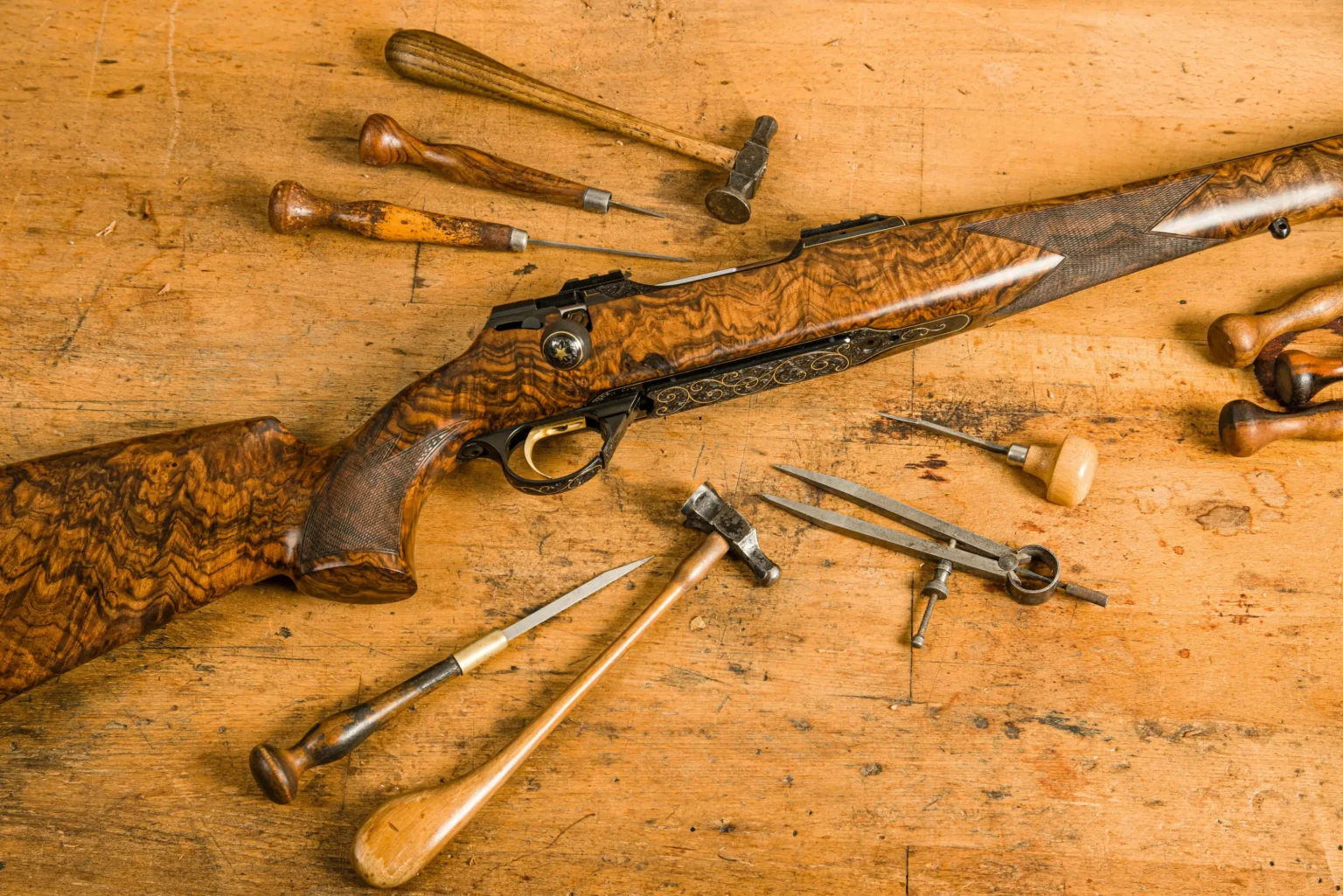
The engraving traditions of the 19th century, the Germanic scroll patterns, the American-style floral coverage, and the game scenes that appear on presentation pieces were commercial art forms practiced by craftspeople who often worked anonymously. The best of them were genuinely great artists by any standard. Their work on metal represents a visual language of a particular historical moment. When you look at an Ulrich-engraved Winchester or a Tiffany-gripped Colt, you’re seeing an aesthetic conversation that was happening in American material culture in the 1870s and 1880s. It’s inseparable from its historical context.
Contemporary custom guns operate in a different tradition. Some makers are working in revivalist styles, deliberately echoing historical patterns while bringing modern precision to the execution. Others are doing something genuinely new, using computer-aided machining, modern finishing technologies, and contemporary aesthetic sensibilities to build pieces that couldn’t have existed before. These objects aren’t lesser because they’re new. They’re part of an ongoing tradition.
The collector who can genuinely love both traditions is probably the most intellectually honest about what custom firearms actually are: human objects, made with skill and intention, that reflect their moment in time. A Ruger No. 1 built out by a skilled contemporary craftsman might be as beautiful as anything made in the 19th century. It’s just a beauty of a different kind, and appreciating both requires a certain flexibility of eye that the best collectors develop over time.
A Few Practical Notes Before You Spend Anything
If you’re building a collection that spans both categories, or trying to decide which direction to focus first, some practical considerations are worth keeping in mind.
Budget shapes strategy more toward historic collecting than toward contemporary collecting. The threshold for acquiring meaningful historic pieces has risen sharply in recent years. Documented, condition-worthy examples from the major 19th-century American makers increasingly clear five figures at auction without breaking a sweat. If you’re working with limited capital, contemporary custom guns can offer a genuinely excellent collecting experience at lower entry points, especially if you focus on emerging makers or less-celebrated yet highly skilled craftspeople.
That said, there’s a middle tier of historic collecting, post-WWII custom work, competition custom guns from the mid-20th century, regional makers who haven’t yet attracted serious collector attention, where educated buyers with modest budgets can still find value. This is exactly the kind of opportunity that requires scholarship, not just money. It rewards collectors who do the reading.
For contemporary guns, the relationship with the maker is often more valuable than people initially expect. Knowing a craftsperson’s work from its early years, being able to speak knowledgeably about their evolution, and having pieces that represent different phases of their career, creates a collection with narrative coherence that goes well beyond simple accumulation.
At the end of it all, both categories of collecting are really about the same thing: recognizing excellence, honoring craft, and building a connection between yourself and the human skill that these objects represent. The historic pieces show that skilled people did this extraordinary thing with metal and wood a century ago, and, with care and attention, we can hold on to that evidence. The contemporary pieces say that people are still doing this extraordinary thing right now, in living workshops with living hands.
Both are worth your time. Both deserve your seriousness. Just make sure you understand which one you’re dealing with before you spend a dollar.
Frequently Asked Questions
Provenance documentation almost always matters more than condition alone; a factory letter, estate record, or verified ownership history can multiply a piece’s value several times over. Before you spend anything significant, have the paperwork examined by a recognized expert or an organization such as the American Society of Arms Collectors.
Most don’t, at least not in any timeframe that makes them a smart financial play. Buy them because you love the craftsmanship; treat any future appreciation as a pleasant surprise rather than a plan.
You can do basic, careful preservation, but the operative word is restraint. Incorrect cleaning strips the original finish, and once that’s gone, it’s gone permanently.
Look for consistent recognition in established publications, a dedicated following in serious collector communities, and a body of work that holds up over time. A reputation built over years matters far more than a single impressive build.
Honestly, yes, in almost every case. Refinishing destroys original material evidence and typically significantly reduces resale value, regardless of how well the work is done.