
Key Takeaways:
- JTL means Janz Technik und Labor, not “Janz Target Luxury.”
- Selected Janz models accept interchangeable barrels and cylinders in calibers ranging from .22 Long Rifle to .454 Casull.
- Collectors should verify serial numbers, proof marks, fitted components, factory documentation, and overall condition before assigning rarity or value.
The Janz revolver is best understood as a precision firearm built around an unusually adaptable mechanical system. Its distinguishing feature is not decorative extravagance or an invented luxury designation, but the ability, on selected models, to combine interchangeable cylinders and barrels with a single serialized frame.
From Precision Instruments to Revolvers
Janz-Präzisionstechnik traces its origins to a precision-mechanics workshop established in Kiel, Germany, in 1935. The business later became JTL, an abbreviation of Janz Technik und Labor, and relocated to Malente, where it manufactured laboratory equipment, industrial components, and other precision instruments.[1] Contrary to descriptions sometimes repeated online, “JTL” does not stand for “Janz Target Luxury.”
The company’s route into revolver production began through its work as a parts supplier to Korth. After Korth experienced successive financial difficulties during the 1990s, Janz retained manufacturing knowledge, unfinished components, and experience with the Korth system. In 1997, the company decided to develop a revolver under its own name and hired René Ganz, a former apprentice of Willi Korth, to assist with the project.[2]
Janz completed its first prototype, serial number 0001V, in 1998. It was chambered in .44 Magnum. A larger-frame .454 Casull prototype, serial number 0002V, followed in 1999. The company then incorporated CNC production methods and, in 2000, introduced a system that permitted barrels and cylinders of different calibers to be fitted to the same frame.[2]
Understanding the Model Names
“Janz EMS JTL” is not the clearest description of a single factory model. JTL identifies the broader company heritage, while Janz’s published model structure distinguishes among EM, E, and MA frame sizes. Versions equipped with the caliber-conversion system have been identified as Type S, EM/S, EM-S, or E-S, depending on the market and period.[3][4]
The compact EM frame accommodates chamberings from .22 Long Rifle through .44 Magnum. The larger E frame extends the range through .454 Casull. Both have been offered with barrels from 2½ to 12 inches and may be configured with the quick-change system. The substantially larger MA frame is intended for .460 S&W Magnum or .500 S&W Magnum and uses fixed-caliber construction with barrels from 4 to 12 inches.[5]
These distinctions matter to collectors. A fixed-caliber Janz and a factory multi-caliber system may resemble one another, but they are not mechanically or commercially identical. The frame designation, caliber markings, proof marks, serial number, and accompanying conversion components should therefore be recorded individually.
The Quick-Change System
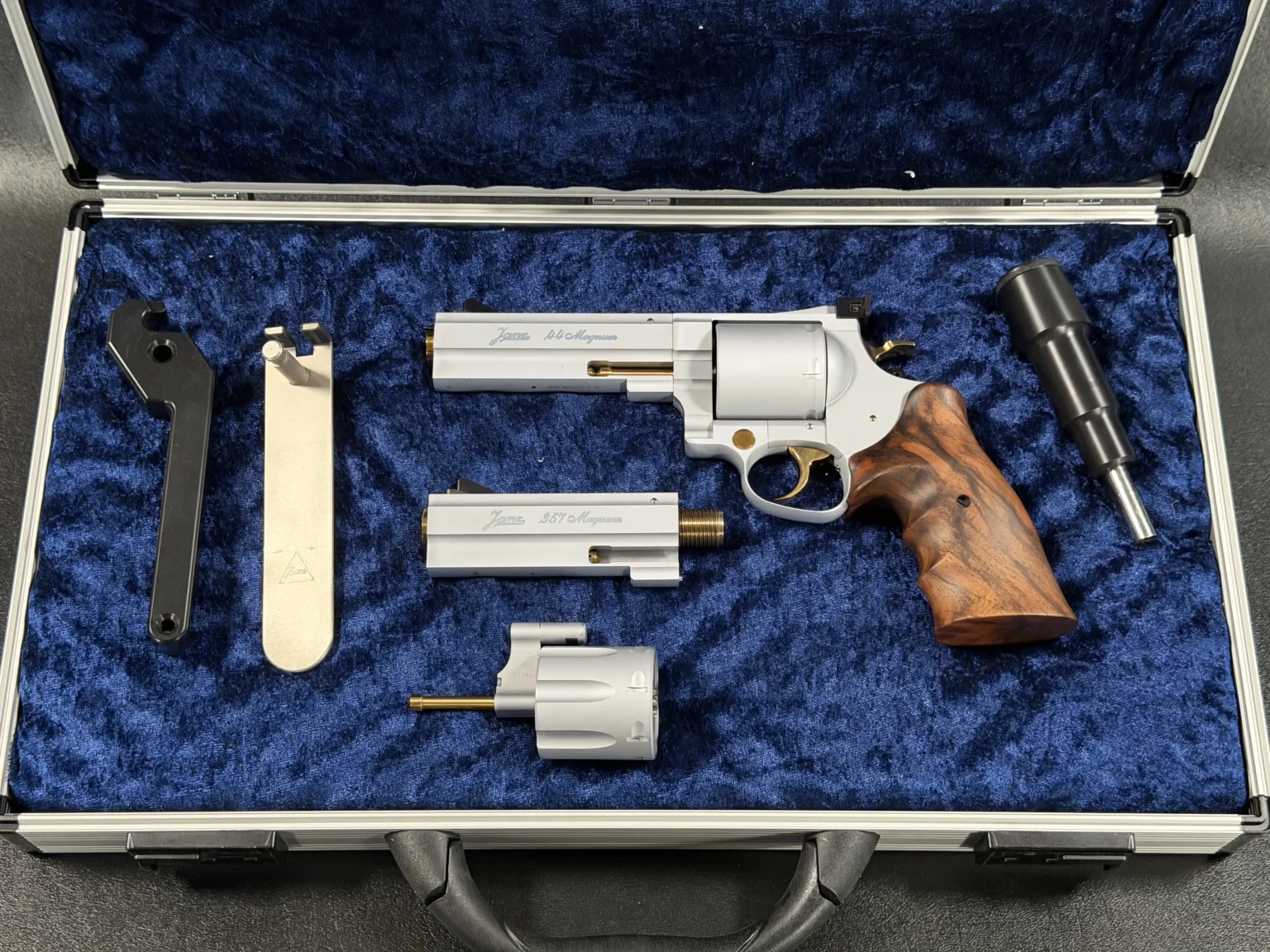
On a convertible Janz, changing calibers requires replacing both the barrel and the cylinder assembly. The cylinder and yoke detach from the frame after the cylinder is opened and its release is operated. The barrel is loosened with the supplied mounting fixture and wrench, unscrewed, and replaced with the corresponding barrel. The matching cylinder assembly is then installed.[6]
Janz describes the process as taking only seconds and requiring no loss of precision.[3] An independent, illustrated examination reported that a complete barrel-and-cylinder change took slightly more than a minute and used dedicated tools supplied for the task.[6] The practical point is that the conversion is designed to be performed by the owner without conventional gunsmith fitting during each change, not that the barrel can literally be removed with bare hands alone.
Published configurations have included .22 Long Rifle, .38 Special, .357 Magnum, .44 Magnum, .45 Colt, .45 Winchester Magnum, and .454 Casull. Cylinder capacity depends on the chambering and frame: published examples range from eight rounds in .22 Long Rifle to five rounds in .454 Casull.[4] Available combinations may vary by production date, market, and the configuration originally ordered.
The system also incorporates a safeguard against mismatched components. According to a detailed technical examination, the relevant cylinder is machined so that it cannot close when paired with an incompatible barrel.[6] This feature is particularly important on a platform capable of accepting cartridges with substantially different bullet diameters and operating pressures.
Construction and Adjustment
Janz states that its convertible frames are CNC-machined from chrome-molybdenum steel and surface-hardened. The company describes its cylinders as heat-treated steel components that are normally supplied without fluting, although fluted cylinders may be ordered.[3]
The revolvers operate in both single- and double-action modes. External controls permit adjustment of trigger-pull weight and trigger overtravel, while interchangeable rollers alter the character of the trigger break. The rear sight is adjustable for windage and elevation and can be exchanged as a complete sight block. Certain front sights are also interchangeable or height-adjustable.[3][6]
Factory-published specifications identify Nill wooden grips as standard equipment on the convertible system, with other grips available. Janz also designed portions of its grip geometry around established Smith & Wesson grip patterns, making some aftermarket alternatives possible.[2][3]
Finish and ornamentation vary widely. Factory-listed treatments include polished and matte surfaces, stainless-steel configurations, traditional dark finishes, and plasma coatings. Janz has also offered deep or relief engraving, animal motifs, and gold-wire inlay.[3][7] These options explain why two revolvers sharing the same basic frame and chambering may differ materially in appearance and collector appeal.
Evaluating a Janz for a Collection
A Janz should be assessed as an individual firearm rather than valued solely by its model name. Important evidence includes the serial number, German proof marks, frame designation, original chambering, barrel lengths, cylinder markings, finish, engraving, and the completeness of any conversion set.
The relationship between the hand and each cylinder’s ratchet is also significant. Technical reporting indicates that cylinders supplied in a multi-caliber set were individually fitted to the revolver’s action.[6] A loose cylinder or barrel acquired separately should not automatically be treated as an original, properly fitted component.
Original cases, tools, test targets, manuals, invoices, and factory correspondence can help establish how a revolver was delivered. Documentation is especially important when an example has an unusual finish, extensive engraving, or numerous caliber assemblies. Absent factory records or persuasive physical evidence, claims of one-off production, special ownership, exceptional rarity, or investment-grade status should be treated cautiously.
No dependable public production ledger or comprehensive series-by-series total has been identified. Janz stated that production was running at approximately ten revolvers per month when series manufacturing began around 2000, but that contemporary rate does not establish total production or the number of surviving examples.[2] Likewise, available evidence does not support a general prediction that every Janz revolver will appreciate in value.
What can be established is more concrete. Janz developed its revolver program from the company’s earlier precision-manufacturing work and experience supplying Korth. Its interchangeable system spans unusually diverse revolver chamberings, while its adjustable action, replaceable sights, varied barrel lengths, and extensive finishing options permit substantial individual configuration. For collectors, that combination of documented history and mechanical adaptability, not unsupported investment language, is the Janz revolver’s principal
Frequently Asked Questions
JTL stands for Janz Technik und Labor. It identifies the company’s broader precision-manufacturing heritage.
Janz decided to develop its own revolver in 1997. Its first documented prototype was completed in 1998.
No. The quick-change feature applies to selected S, EM/S, EM-S, and E-S configurations, while models such as the MA use fixed-caliber construction.
Published configurations range from .22 Long Rifle through .454 Casull, depending on the frame and conversion components. Not every caliber is compatible with every Janz frame.
Collectors should inspect the serial number, proof marks, frame designation, barrel and cylinder markings, condition, tools, and documentation. Claims of rarity, originality, or special provenance require supporting records or persuasive physical evidence.
Sources
- Janz-Präzisionstechnik GmbH, “The Company.”
- Janz-Präzisionstechnik GmbH, “Development Stages of the Janz Revolver,” Malente, June 2012.
- Janz-Präzisionstechnik GmbH, “Quick Change System Revolver Type S and EM/S.”
- TheGunMag, “New Gear from SHOT Likely to Be Seen at May NRA Show.”
- Janz-Präzisionstechnik GmbH, “Frame EM/E/MA.”
- Mike Wood, “The Janz Revolver: The Best Gun You’ve Never Heard Of,” RevolverGuy, March 2, 2019.
- Janz-Präzisionstechnik GmbH, “Engraving and Surface Finishing.”