
Key Takeaways:
- The P210 connects collectors with Switzerland’s postwar service-pistol history, but Swiss, German, and American examples belong to different production periods.
- The P226 was a technically acceptable XM9 finalist; Beretta secured the contract based on the overall evaluated procurement cost.
- Military and commercial SG 550-family rifles may look similar, but their configurations, histories, and legal classifications can differ substantially.
SIG’s firearms history began with an industrial company rather than a traditional gunmaker. Friedrich Peyer im Hof, Heinrich Moser, and Johann Conrad Neher established a railway-carriage factory in Neuhausen am Rheinfall, Switzerland, in 1853. The company began manufacturing firearms in 1860 and adopted the name Schweizerische Industrie-Gesellschaft, or SIG, in 1863.[1]
For collectors, SIG’s subsequent changes in ownership, manufacturing location, and product configuration make precise identification essential. Pistols carrying similar model names may come from different countries, factories, and production periods. The name on the slide is only the beginning; serial numbers, proof marks, mechanical features, and documentary records determine what a firearm actually is.
The P210
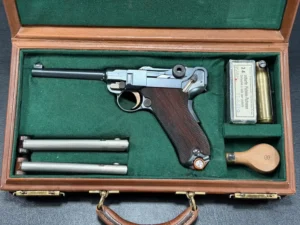
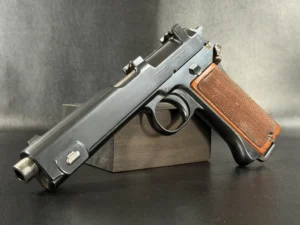
The P210 is a logical foundation for a historically focused SIG collection. Developed as Switzerland’s postwar service pistol, it entered military service as the Pistole 49. The original design was a recoil-operated, single-action pistol whose slide traveled inside the frame rails. It also used removable, plate-mounted lockwork derived from features associated with Swiss designer Charles Petter’s French Model 1935A pistol.[2]
The Swiss Army replaced the Pistole 49 with the Pistole 75, its designation for the P220, beginning in 1975.[3] Commercial P210s were produced alongside the military pattern, and later P210 versions were manufactured in Germany and the United States. Modern American examples retain the design’s internal slide rails and general appearance but incorporate significant mechanical, ergonomic, and manufacturing changes.[2]
Collectors should therefore separate Swiss military Pistole 49 examples from Swiss commercial P210s and later German or American production. Military-pattern markings may identify the intended configuration, but they do not establish that a particular pistol was issued to a named soldier or unit. Such provenance requires records connected directly to the firearm.
The P226 and the XM9 Competition
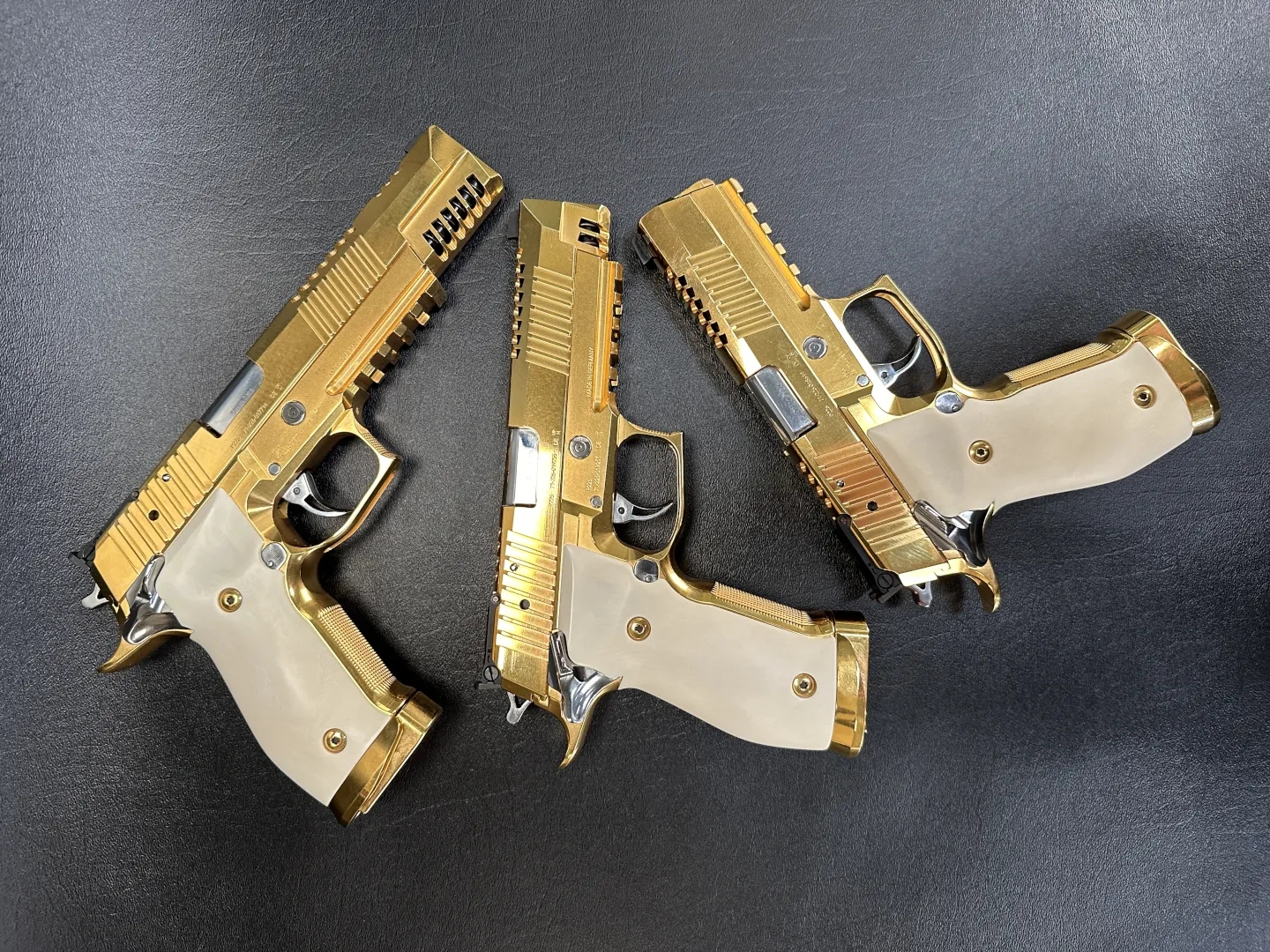
SIG developed the P226 for the U.S. military’s 1984 XM9 service-pistol competition. The official procurement record contradicts the common claim that the P226 failed the military tests. The P226 and Beretta 92SB-F were the competition’s two technically acceptable finalists.[4]
The final selection also depended on price. After the Army requested best-and-final offers, Beretta received the contract based on the overall evaluated cost of pistols, magazines, and spare parts. The Government Accountability Office concluded that Beretta’s lower magazine price contributed more than any other factor to its lower evaluated price.[4]
The P226’s documented importance rests on its position as an XM9 finalist and on the broader development of high-capacity, double-action service pistols during the 1980s. Collectors should distinguish early production from later configurations by examining manufacturing marks, slide construction, frame features, controls, caliber, and factory packaging.
Claims that an individual P226 was carried by a military operator or law-enforcement officer require item-specific evidence. Model designation, finish, engraving, or resemblance to a service configuration does not prove government ownership or operational use.
The SG 550 and Sturmgewehr 90
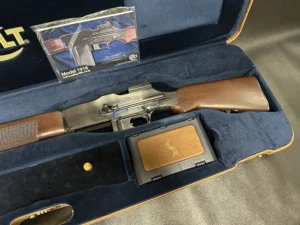
The SG 550 family represents SIG’s modern Swiss service-rifle lineage. The Swiss Army introduced the Sturmgewehr 90 in 1990 as the successor to the Sturmgewehr 57.[3]
The Swiss military manual describes the Sturmgewehr 90 as a gas-operated automatic rifle with a rotating bolt. It has a 528 mm barrel, measures 1,000 mm with the stock extended and 772 mm with the stock folded, and weighs 4.1 kilograms with an empty magazine. The manual identifies semiautomatic, rapid-fire, short-burst, and automatic firing modes.[5]
Collectors must distinguish the selective-fire military rifle from semiautomatic commercial firearms belonging to the broader SG 550 family. External resemblance does not establish identical internal configuration, service status, or legal classification.
That distinction is especially important in the United States. Federal law generally prohibits civilian transfer or possession of machine guns manufactured after May 19, 1986, except for specified government transactions and firearms lawfully possessed before that date.[6] The legal status of a particular SG 550-family firearm depends on its receiver, operating configuration, registration or import history, and applicable federal, state, and local law.
A Disciplined Collecting Approach
The P210, P226, and SG 550 represent three distinct areas of SIG history: Swiss service-pistol development, the American XM9 procurement era, and Switzerland’s modern service rifle.
Before acquiring an example, a collector should document:
- The exact model and configuration
- The serial number and all visible proof or acceptance marks
- The country and period of manufacture
- Whether major numbered components match
- The apparent originality of the finish, grips, sights, and controls
- Any factory packaging, manuals, test targets, magazines, or issued accessories
- The documentary basis for claimed military, police, or personal provenance
Oral history, dealer assertions, and internet serial-number tables should not be treated as substitutes for factory records, government documentation, period literature, or a traceable chain of ownership.
Nor should appreciation be assumed. Collectible firearms do not rise in value according to a predictable schedule. Historical importance, verified rarity, originality, condition, provenance, legal status, and current demand all affect the market. The strongest collection is built around correctly identified firearms and defensible documentation—not speculative promises about future prices.
Frequently Asked Questions
The P210 entered Swiss military service as the Pistole 49. Its internal slide rails and plate-mounted lockwork distinguish it from most conventional service pistols.
No. The P226 and Beretta 92SB-F were the two technically acceptable finalists, with Beretta ultimately winning on overall evaluated cost.
The Swiss Army introduced the rifle as the Sturmgewehr 90 in 1990. It replaced the earlier Sturmgewehr 57.
No. Military selective-fire rifles and semiautomatic commercial versions can fall into different legal categories depending on their configuration and history.
Collectors should examine the exact model, serial number, proof marks, manufacturing origin, matching components, originality, and accompanying records. Military or police provenance should be accepted only when supported by documentation tied to the firearm.
Sources
- Adrian Knoepfli, “Schweizerische Industrie-Gesellschaft (SIG),” Historical Dictionary of Switzerland, October 27, 2011.
- Wiley Clapp, “Tested: SIG Sauer’s Made-In-America P210 Pistol,” American Rifleman, December 21, 2018.
- Swiss Federal Department of Defense, Civil Protection and Sport, “Handfeuerwaffen der Schweizer Armee feiern Jubiläum”, October 21, 2025.
- U.S. Government Accountability Office, Pistol Procurement: Allegations on Army Selection of Beretta 9-mm. as DOD Standard Sidearm, GAO/NSIAD-86-122, June 1986.
- Swiss Armed Forces, 5.6 mm Sturmgewehr 1990, Regulation 53.096.
- Bureau of Alcohol, Tobacco, Firearms and Explosives, “National Firearms Act”.