
How Do Limited-Run, Boutique Pistol Makers Compare to Major Manufacturers for Collectors?

Table of Contents

Key Takeaways:

  • Boutique guns hold value differently than production guns. Limited-run pistols from makers like Nighthawk and Cabot tend to retain their price on the secondary market almost immediately, thanks to built-in scarcity and passionate buyer communities. Production guns are more of a long game; they depreciate at first, but the right discontinued models can appreciate dramatically over decades if you know what to look for.
  • Craftsmanship still separates the two, but the gap is shrinking. Hand-fitted slides, hand-lapped surfaces, and factory-level customization give boutique pistols a tactile quality that’s hard to replicate on an assembly line. That said, premium-tier offerings from major manufacturers, think SIG’s Legion series or CZ’s Shadow 2, have closed a lot of ground. The difference is real, but it’s not the canyon it used to be.
  • The smartest collectors don’t pick sides. A well-rounded collection includes both. Boutique pieces bring artistry and exclusivity. Production guns bring historical weight, proven durability, and accessibility. Together, they tell a richer story than either could alone, and that story is ultimately what makes a collection worth building.

Let’s get started…

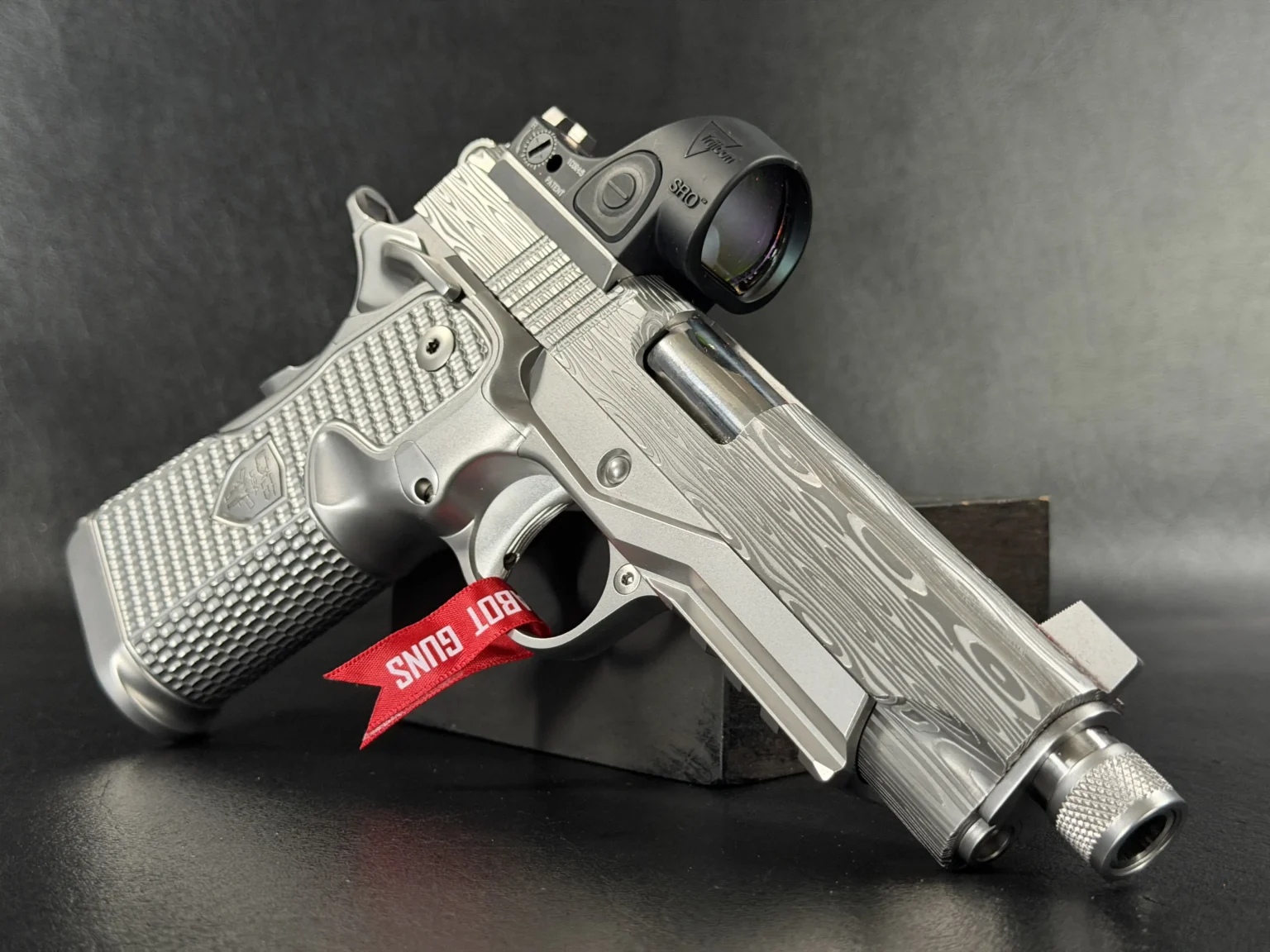
There’s a moment every firearms collector knows. You’re at a gun show, scrolling through an auction catalog, or just browsing your favorite dealer’s new arrivals, and something stops you cold. Maybe it’s a Cabot Guns 1911 with mirror-polished flats that catch the overhead light like jewelry. Maybe it’s a Nighthawk Custom with hand-fitted internals you can feel the second you work the slide. Whatever it is, you realize: this isn’t just another pistol. It’s something different.

And that “something different” is exactly where the conversation between boutique pistol makers and major manufacturers gets interesting for collectors. It’s not as simple as “expensive equals better.” Honestly, it’s more complicated than most people think, and the answer depends on what you’re actually collecting it for.

So let’s break it all down.

What Exactly Makes a Maker “Boutique”?

Before we get too far, it helps to define what we’re talking about. The term “boutique” gets thrown around a lot, and sometimes it’s more marketing than substance. But there are real differences.

A boutique pistol maker typically produces firearms in limited quantities. We’re talking hundreds or maybe a few thousand units per year, not hundreds of thousands. Companies like Cabot Guns, Nighthawk Custom, Wilson Combat, Korth, and Les Baer fall into this space. Some are even smaller, like Ed Brown or Guncrafter Industries, where a single pistol might take weeks of hand labor from start to finish.

These shops usually emphasize hand-fitting, hand-finishing, and tight tolerances that go beyond what’s necessary for function. They’re building for a different standard. Think of it like the difference between a solid daily-driver watch and a hand-assembled Swiss timepiece. Both tell time. Both work. But the experience of owning them? Completely different worlds.

Major manufacturers, on the other hand, are the Glocks, Smith & Wessons, SIG Sauers, Berettas, and Springfields of the world. They produce pistols at scale. CNC machines, MIM parts (metal injection molding, for those not familiar), and assembly-line processes keep costs down and volume up. And here’s the thing: that’s not a knock against them. There’s genuine engineering brilliance in producing a reliable, affordable handgun that works for millions of people.

But collectors aren’t always looking for what works for millions of people.

The Craftsmanship Question (And Why It’s Not Black and White)

Let’s talk about fit and finish, because this is usually the first thing that comes up. Pick up a standard production 1911 from a major manufacturer. Run your thumb along the frame-to-slide fit. You’ll probably feel a little play, maybe a tiny bit of wobble. It’s within spec. It’ll function just fine. Thousands of rounds, no issues.

Now pick up a Nighthawk Custom or a Cabot. That slide-to-frame fit will feel like it was machined from a single block of steel. Because in a sense, it kind of was. Boutique makers hand-lap and hand-fit those surfaces. The result is a tactile experience that’s hard to describe until you’ve felt it. It’s that “bank vault” lockup people talk about.

But here’s where it gets nuanced. Not every boutique maker is equal, and not every production gun is rough. SIG Sauer’s Legion series, for example, has a level of refinement that surprises people. Staccato (formerly STI) sits in an interesting middle ground, producing at a higher volume but with a level of fit that rivals some custom shops. And CZ’s Shadow 2 has a factory trigger that makes some hand-tuned guns jealous.

So the craftsmanship gap isn’t as wide as it used to be. It still exists, absolutely. But major manufacturers have closed ground, especially in their premium tiers.

For collectors, though, the question isn’t just “does it feel nice?” It’s “Does the level of craft translate into collectible value?” And that’s where things get really interesting.

Investment Value: Where the Money Actually Goes

You know what surprises a lot of new collectors? Production guns from major manufacturers can be incredible investments, too. A first-generation Colt Python, a pre-agreement Smith & Wesson, a West German SIG P226. These aren’t boutique guns. They were made on production lines. But they’ve appreciated enormously because of historical significance, discontinuity, and collector demand.

Boutique pistols play a different investment game. Their value proposition rests on scarcity, craftsmanship, and brand cachet. A Cabot Guns “Big Bang” 1911, made from a meteorite (yes, seriously, a 4.5-billion-year-old Gibeon meteorite), sold for over $4.5 million at auction. That’s an extreme example, but it illustrates the ceiling.

More realistically, a standard Nighthawk Custom 1911 that retails for $3,000 to $4,500 tends to hold its value remarkably well on the secondary market. Limited-edition and collaboration pistols, like the Nighthawk/Agency Arms partnership pistols, often sell above retail price almost immediately. The demand is there, and the supply is inherently constrained.

Major manufacturers’ standard models, by contrast, depreciate the moment they leave the dealer’s case. A brand-new Glock 19 loses value like a new car driving off the lot. That $550 pistol is probably worth $400 to $450 used, even in great condition. There are just too many of them.

But, and this is a big but, certain production runs become collectible over time. Discontinuation is the great equalizer. When SIG stopped importing the German-made P210 years ago, prices on existing ones climbed steadily. When Colt went through its various corporate upheavals, guns from specific eras became sought after purely because of the uncertainty around future production.

There’s another angle here, too. Condition matters more with production guns than with boutique pieces. A used Nighthawk in 95% condition still commands strong money because the base value is so high and the buyer pool understands what they’re getting. A production gun’s value is far more sensitive to wear marks, box condition, included accessories, and matching serial numbers on components. Collectors in the production space spend enormous energy tracking down original boxes, manuals, and even the little cable locks that came with the gun. It’s a whole sub-hobby within the hobby.

So if you’re collecting strictly as an investment, the picture is mixed. Boutique guns offer more predictable short-term value retention. Production guns are a longer game, requiring you to identify which models, generations, or production windows will matter to future collectors. That takes knowledge, patience, and, honestly, a bit of luck.

The Thrill of the Hunt: Availability and Exclusivity

Let’s be real for a second. Part of collecting is the chase. Finding the thing that’s hard to find. And boutique makers have this built into their DNA.

Try ordering a Korth Ranger. You might wait months. A custom-spec Nighthawk? Plan on 12 to 18 months if you’re going through their build queue. Some of Cabot’s limited editions sell out before most people even know they exist. This scarcity creates an emotional gravity that mass-produced firearms simply can’t replicate.

There’s also the “I have something you can’t easily get” factor, which, let’s be honest, is a real part of collecting culture. It’s not about snobbery (well, usually not). It’s about the satisfaction of owning something rare. Walk into any collector gathering with a Korth NXS and watch heads turn. It’s a different energy than showing up with a factory Glock, no matter how tricked out.

Major manufacturers create their own version of this through special editions, anniversary models, and distributor exclusives. Ruger does a nice job with their Shopkeeper and Distributor Exclusive lines. Smith & Wesson’s Performance Center puts out limited runs that generate genuine collector interest. And don’t sleep on the foreign military contract variations, like the Beretta 92FS models made specifically for certain NATO countries. Those have a niche following that’s surprisingly passionate.

But the exclusivity of a boutique gun is structural. It’s not a marketing decision; it’s a production constraint. And collectors tend to value that distinction.

Customization: Starting from Scratch vs. Making It Yours

Here’s something that doesn’t get discussed enough. When you buy from a boutique maker, customization is often part of the deal. You’re not buying off a shelf. You’re specifying options, choosing finishes, selecting grips, maybe even picking your serial number range.

Nighthawk Custom’s build sheets read like a restaurant menu. Slide serrations? Pick your style. Front strap checkering? Choose the lines per inch. Trigger? Solid, skeletonized, medium, short. You’re building your gun, piece by piece, with a team of smiths who will put it together by hand.

Wilson Combat offers a similar experience. Their Beretta 92/96 partnership opened up a whole new tier of semi-custom guns that blend a familiar platform with Wilson’s hand-fitting and finishing. It’s a clever bridge between production and full custom.

With major manufacturers, customization happens after purchase. You buy the gun, then send it to a shop, swap parts, and add accessories. The aftermarket for platforms like the Glock, 1911, and P320 is enormous. You can turn a $500 Glock into a $2,000 custom carry gun with the right parts and labor.

But for collectors, aftermarket modification can actually hurt value. A bone-stock Glock 17 Gen 1 is worth more than a modified one. A factory-original Python beats a refinished one every time. Modifications, even good ones, raise questions about who did the work, whether it was done correctly, and how they affect originality.

Boutique customization, on the other hand, comes from the factory. It’s documented. It’s part of the gun’s provenance. And that matters enormously in the collector market.

Reliability and Shooting: The Practical Side of Collecting

Some collectors never fire their acquisitions. They’re investment pieces, display items, or preservation projects. But most collectors I know actually shoot their guns. And this is where a fair comparison gets complicated.

Major manufacturers have one undeniable advantage: battle-tested reliability at scale. Glock’s reputation didn’t come from marketing. It came from millions of pistols running in military, law enforcement, and civilian hands across every climate and condition imaginable. SIG, Beretta, Smith & Wesson: same deal. Their designs have been proven through sheer volume of use.

Boutique pistols are reliable, too, but the sample size is smaller, and the tight tolerances that make them feel amazing can sometimes make them pickier. A hand-lapped 1911 with a bushing barrel might prefer certain bullet profiles or need a specific break-in period. A Korth revolver with its precision timing is magnificent but requires quality ammunition to perform at its best.

This isn’t a flaw, exactly. It’s a trade-off. Tighter tolerances mean less margin for deviation. It’s why race cars need premium fuel. The performance is higher, but the requirements are higher too.

For collectors who shoot, this matters. If you’re putting rounds through a $5,000 boutique 1911, you want to know what it likes to eat. You’ll develop a relationship with that gun in a way you probably won’t with a box-stock production pistol. Some people love that. Others just want to load whatever’s on the shelf and go.

I’ll share something from personal observation. Collectors who own both types often develop a rotation. The boutique pieces come out for special range sessions, maybe when friends visit or when they want to really enjoy an afternoon of shooting. The production guns come out for regular practice, training classes, or just casual plinking. It’s not that one is more valued than the other. They serve different emotional and practical needs.

And here’s a point that might ruffle some feathers: a well-maintained production pistol from a major manufacturer, run hard and put away clean, can outlast some boutique pieces in terms of round count. Glock, for instance, routinely documents torture tests exceeding 100,000 rounds. The Austrian design was built for hard use by people who aren’t firearms enthusiasts. They’re tools made for rough conditions. That kind of durability has its own appeal, even in a collector context. A Glock that was actually carried in combat, with documented provenance, is an entirely different collectible than one sitting in a display case.

Brand Stories and the Culture Factor

Collecting isn’t purely rational. Let’s just admit that. Part of what we’re buying is story.

Colt has the story of the American West, the military sidearm, the Single Action Army. Smith & Wesson has the law enforcement heritage, the Model 29 and Dirty Harry, the Bodyguard revolver your grandfather carried. These narratives run deep and shape collector demand in ways unrelated to metallurgy.

Boutique makers are building newer stories, but they’re compelling ones. Cabot Guns’ origin tale, a precision-machining company that decides to build the most precise 1911 in the world, has a certain romantic quality. Nighthawk Custom started as a group of gunsmiths who wanted to do things their way, without compromise. Korth carries the mystique of German engineering, where a single revolver takes dozens of hours to assemble by hand.

These stories create communities. Nighthawk owners form a tribe. Korth collectors have their own circles. And these communities support resale value by creating consistent, passionate demand.

Major manufacturers have broader but shallower communities. Everyone owns a Glock; there’s no exclusivity in the ownership experience. But within that broad base, sub-communities form around specific models, generations, and configurations. The Glock collector community, for example, is surprisingly sophisticated, with deep knowledge about frame dates, proof marks, and country-specific variations.

Both types of community enhance the collecting experience. They just do it differently.

There’s also a generational shift happening that’s worth mentioning. Younger collectors, folks in their 20s and 30s, are entering the market with different reference points. They didn’t grow up with the same reverence for blue steel revolvers that Baby Boomers carry. They might be more drawn to modern designs, to the aesthetics of a Staccato or an Agency Arms Glock build. Some gravitate toward boutique makers because of social media exposure; seeing a Cabot Guns post on Instagram creates desire in a way that a traditional gun magazine ad never could.

This generational shift affects both markets. It creates new collector niches and can accelerate the appreciation of certain models while cooling demand for others. Keeping an eye on these cultural currents is a smart collecting strategy, whether you’re buying boutique or production.

The Middle Ground Nobody Talks About Enough

One thing I think gets overlooked is the growing middle tier. Companies are emerging (and established ones are pivoting) that sit between full-scale production and true boutique.

Staccato is probably the best current example. They’re producing thousands of 2011-style pistols per year, far more than a traditional boutique shop. But the quality and pricing put them firmly above standard production. They’ve created their own lane.

Dan Wesson, owned by CZ, makes semi-custom 1911s that punch way above their price point. The Specialist and Bruin models compete against guns that cost twice as much. For collectors watching their budget, this space offers real value.

Springfield Armory’s Custom Shop and Kimber’s higher-tier offerings also blur the line. Are they boutique? Not really. But they’re not straight production either.

For newer collectors, especially, this middle tier can be a smart entry point. You get elevated craftsmanship, some level of exclusivity, and more manageable price points. And some of these guns will absolutely become collectible as models rotate in and out of production.

I think the middle tier also serves as a gateway. Someone buys a Dan Wesson, falls in love with the quality jump over their production guns, and starts looking at full-custom options. Or they buy a Staccato, discover the 2011 platform, and start exploring the high-end offerings from Atlas Gunworks or Infinity Firearms. It’s a natural progression that grows the collector market overall.

Resale Markets and Where to Buy

This is worth touching on because where you buy affects what you pay and what you find. For production guns, the secondary market is enormous. GunBroker, Armslist, local shops, pawn shops, gun shows, estate sales. You have options. And with volume comes price competition, which generally benefits buyers.

Boutique guns have a tighter secondary market. You’ll occasionally find them on GunBroker, and some high-end dealers specialize in pre-owned custom pistols. But the pool of buyers and sellers is smaller, which can work in your favor or against it. Selling a Nighthawk Custom on a forum frequented by Nighthawk enthusiasts will get you a better price than putting it in a general-purpose gun shop’s consignment case, where the staff might not even know what they’re looking at.

For either category, documentation matters enormously. Original receipts, factory letters, custom order confirmations, original boxes, and packaging. Keep everything. File it. Store it with the gun. Future buyers will thank you (or more accurately, they’ll pay you a premium for it).

What Actually Matters When You’re Building a Collection

Let me get a little philosophical here. The “boutique vs. major manufacturer” debate assumes these are competing categories. For serious collectors, they’re not. They’re complementary.

A well-rounded collection tells a story. It might be chronological, tracing the evolution of the semi-automatic pistol from the Colt 1900 to today’s polymer-framed designs. It might be thematic, focusing on every notable 1911 variant, from government-issue models to custom competition guns. Or it might be personal: the guns that mattered to you at different points in your life.

In any of these frameworks, both production and boutique guns have roles to play. A collection of only Nighthawk Customs would be impressive but one-dimensional. A collection of only Glocks would be thorough but might lack the artistry that makes a display case truly special.

The smartest collectors I’ve met think about balance. They have their grail guns, the boutique pieces they saved and waited for. They have their historical anchors, the production guns with provenance and significance. And they have their shooters, the guns they take to the range without worrying about holster wear on a $4,000 finish.

The Practical Stuff: Maintenance, Parts, and Long-Term Care

One more thing worth mentioning that doesn’t come up in most comparison articles. If something breaks on your Glock, you can have a replacement part by tomorrow. Aftermarket support for major manufacturers is staggering. Parts, holsters, sights, magazines: everything is available, often from dozens of competing suppliers.

Boutique guns are a different story. Need a part for your Korth? You might be dealing with the factory in Germany. A replacement component for your Nighthawk might need to go back to Berryville, Arkansas, for hand-fitting. This isn’t a dealbreaker, but it’s something to factor into ownership.

For collectors who keep guns in safe storage, this matters less. But if you’re shooting your collection (and you should shoot at least some of it), knowing the support infrastructure behind each piece is important.

Also worth noting: some boutique makers have exceptional customer service precisely because they’re small. Call Nighthawk, and you might talk to the same person who built your gun. That’s a level of relationship you just don’t get from a major manufacturer’s customer service line.

So, Which Is Better for Collectors?

If you’ve read this far, you probably already know the answer: it depends.

If you’re collecting for investment, boutique guns generally provide more predictable short-term value retention, whereas carefully selected production guns can deliver outstanding long-term returns. For craftsmanship-focused collectors, boutique makers tend to excel in fit, finish, and exclusivity, though top-tier production models are narrowing the gap. If you’re collecting purely for enjoyment, the right choice is simply to have both.

Here’s what I’d tell someone just getting into collecting. Start with what excites you. Handle as many guns as you can. Go to shows, visit shops, and join forums. The Firing Line, 1911Forum, GlockTalk, the various Reddit communities: they’re all gold mines of collector knowledge.

Pay attention to what makes your pulse quicken. If it’s the precision of a hand-fitted boutique pistol, chase that feeling. If it’s the historical weight of holding the same model that was issued to soldiers or carried by detectives, honor that.

And don’t let anyone tell you your collection is wrong. The guy with twenty Colts from different eras is a collector. The woman with a curated set of Nighthawk Customs is a collector. The person who mixes both, picking up whatever speaks to them regardless of maker size, is also a collector.

Final Thoughts

The firearms collecting world is broad enough for everyone. Boutique makers and major manufacturers aren’t competitors in the collector space. They’re different instruments in the same orchestra.

Boutique pistols bring artistry, scarcity, and a level of personal connection that mass production can’t match. Major manufacturers bring history, proven reliability, and an accessibility that keeps the collecting community growing.

The best collections I’ve ever seen include both. They tell a story that’s bigger than any single gun, any single maker, or any single price point. They reflect the person who built them, their taste, their curiosity, their passion.

And that, really, is what collecting is about.

Whether you’re saving up for your first Nighthawk or hunting down an early-production P226 with a West German rollmark, you’re participating in something that connects craftsmanship to history to personal meaning. Boutique or production, limited-run or mass-market, every gun in a collection has a reason it’s there. And that reason is worth more than any price tag.


Frequently Asked Questions

What makes a pistol maker “boutique”?

Boutique makers produce firearms in limited quantities, usually hundreds to a few thousand per year, with an emphasis on hand-fitting and hand-finishing. Think companies like Nighthawk Custom, Cabot Guns, and Korth, where a single pistol might take weeks of dedicated hand labor.

Are boutique pistols a good investment?

They tend to hold their value well on the secondary market, and limited editions often sell above retail almost immediately. That said, carefully chosen production guns from major manufacturers can deliver surprising long-term returns too, especially after discontinuation.

Do major manufacturers make anything worth collecting?

Absolutely. First-generation Colt Pythons, pre-agreement Smith & Wessons, and West German SIG P226s are just a few examples of production guns that have appreciated enormously over time.

Is the craftsmanship gap between boutique and production guns still significant?

It exists, but it’s narrower than it used to be. Premium lines like SIG’s Legion series and CZ’s Shadow 2 have raised the bar for what factory guns can feel like out of the box.

Can I modify a production gun to match boutique quality?

You can get close with aftermarket parts and a skilled gunsmith, but here’s the catch: modifications can actually hurt collector value on production guns. Boutique customization comes documented from the factory, which matters enormously for provenance.

Love this article? Why not share it...

Michael Graczyk

As a firearms enthusiast with a background in website design, SEO, and information technology, I bring a unique blend of technical expertise and passion for firearms to the articles I write. With experience in computer networking and online marketing, I focus on delivering insightful content that helps fellow enthusiasts and collectors navigate the world of firearms.

Leave a Reply

Your email address will not be published. Required fields are marked *

Related News

How Do Limited-Run, Boutique Pistol Makers Compare to Major Manufacturers for Collectors?

Boutique pistol makers like Nighthawk Custom and Cabot Guns offer collectors hand-fitted craftsmanship, built-in scarcity, and predictable value retention that mass-produced firearms rarely match out of the box. But major manufacturers bring their own collector appeal through historical significance, proven reliability, and the potential for extraordinary long-term appreciation when the right models get discontinued.

Read More »

How to Prepare a High-Value Firearms Collection for Sale (Without Leaving Money on the Table)

Selling a high-value firearms collection is part business, part art, and part emotional journey that demands patience, proper documentation, and the right professionals in your corner. From protecting that irreplaceable original patina to choosing between auction houses, consignment, and private sales, every decision you make shapes whether you walk away with full value or leave thousands on the table.

Read More »

Factory Engraved Colts: Art, Provenance, and What Makes Them Truly Valuable

A factory engraved Colt isn’t just a firearm with decoration added to it; it’s functional art tied directly to Colt’s production legacy, often backed by archival records that trace its story back to the day it left Hartford. Whether it’s the bold scrollwork of Gustave Young or a fully cased presentation revolver with gold inlay, these pieces sit at a rare intersection of mechanical precision, artistic expression, and American history that collectors don’t just admire but actively pursue.

Read More »

Availability Notification

Some pieces never make it to public listing. Join our private notification list to be the first to know when exceptional firearms become available.

Name