
Key Takeaways:
- Not all “rare” firearms are rare for the same reason: The Colt BOA is scarce because it was intentionally limited to 1,200 revolvers, built once, then gone. Early Ratzeburg Korths are rare because they couldn’t be produced in large quantities. They came out of a tiny workshop where time, cost, and efficiency were secondary to absolute mechanical perfection. That difference matters, especially to seasoned collectors.
- The line between the BOA and a Ratzeburg Korth is craftsmanship, not prestige: The BOA represents Colt doing excellent work within a factory system. The Ratzeburg Korth represents an almost stubborn refusal to behave like a factory at all. One is a refined product of industrial excellence; the other is closer to a mechanical art object that happens to be a revolver.
- Market value reflects philosophy as much as condition: BOA prices are driven by known production numbers, Colt loyalty, and repeatable demand. Ratzeburg Korth values are driven by something less predictable: reverence. When collectors talk about them, the language changes. They don’t compare specs; they talk about feel, silence, and restraint. That’s usually a sign you’ve crossed from “collectible” into “legend.”
Among serious handgun collectors, “rarity” isn’t just about production numbers; it’s about mythology, provenance, craftsmanship, and the degree to which a piece represents the peak of its maker’s capabilities. In this landscape, early Korth Ratzeburg revolvers sit in a category almost no other production wheelgun can touch.
The Colt BOA, while itself a scarce and desirable piece of 1980s Colt history, occupies a very different tier of rarity and prestige.
This article draws a clear line between the two: one is a boutique, almost experimental-level craft revolver hand-built in tiny numbers, while the other is a limited special run by a major U.S. manufacturer that has since become collectible.
Early Korth Ratzeburg: The Apex of Ultra-Low-Volume Precision
Production Numbers
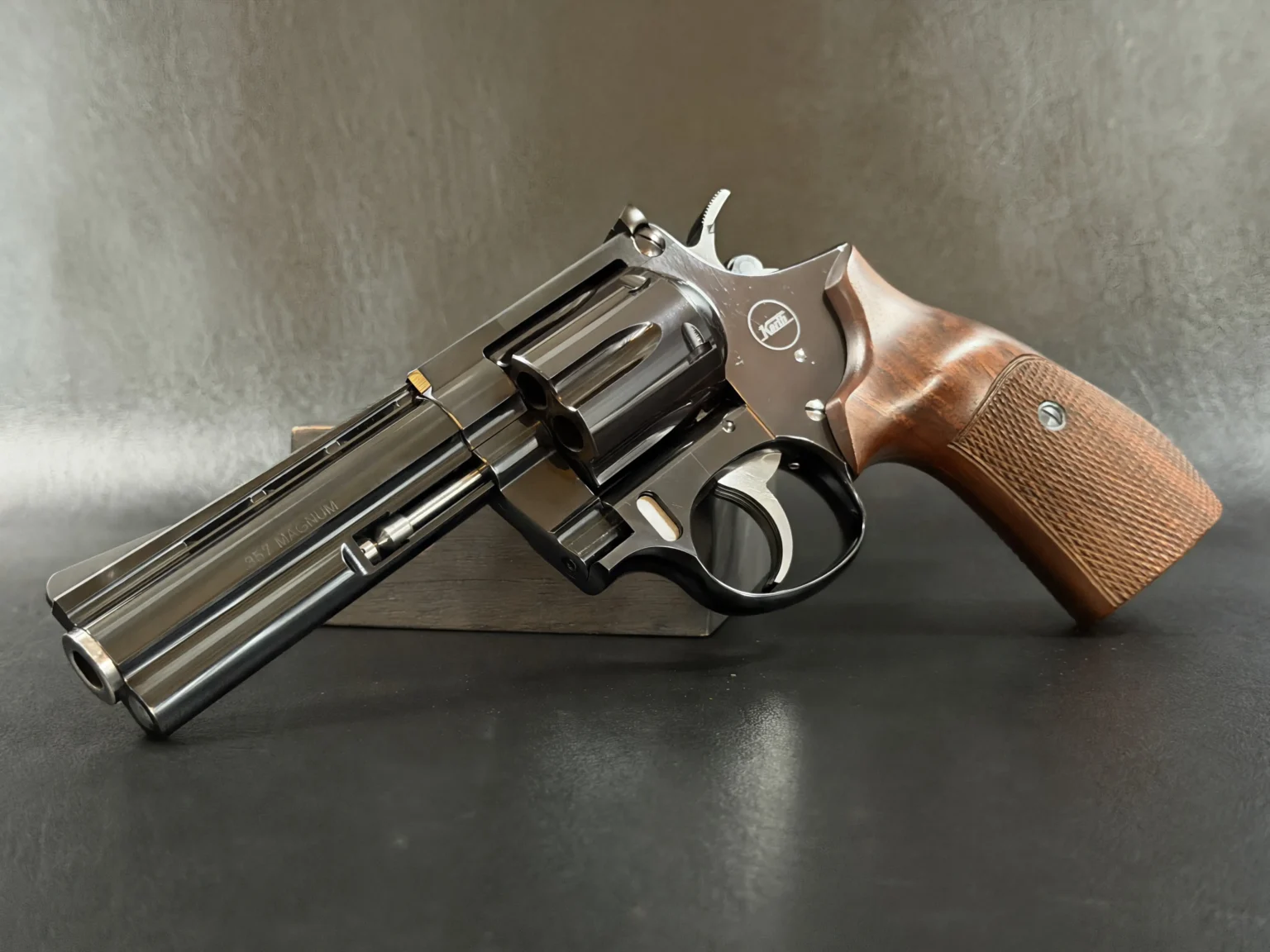
Early Ratzeburg Korths, particularly the 1960s–early 1970s models with the classic blue finish, were produced in very small numbers. Annual output for the entire company was sometimes under 200 units, and individual configurations were produced in double-digit quantities or fewer.
Characteristics That Define Their Rarity
- Hand-built by a micro-team.
Willi Korth’s shop was essentially an atelier, not a factory. Korth himself literally finished certain guns. - No two early examples are truly identical.
Tolerances and fitting were adjusted by hand. Disassembly and reassembly today still feel like dealing with a Swiss timepiece. - Ratzeburg’s provenance itself is a rarity marker.
These guns represent the company’s original period, before production shifted and before the design language changed in the later Lollar era. - Small German civilian market + export restrictions
Many never left Germany, limiting global circulation. - High survival rate but extremely low circulation
Korth owners tend to be long-term holders; estates rarely release them. When one surfaces, it often sells privately before ever hitting the open market.
Market Dynamics
Prices for top Ratzeburg examples, especially early-serial, mint, boxed, target-included guns, can exceed €12,000–€20,000 depending on configuration. Unique finishes or special-order guns climb even higher.
In collector psychology, a Ratzeburg Korth sits in the same conceptual tier as a Jeffery Best Best shotgun, early Patek Philippe, or pre-war Mauser Special Order: the intersection of rarity, craftsmanship, and cultural legend.
Colt BOA: Limited, Scarce, but Not Micro-Artisanal
Production Numbers
The Colt BOA was produced in 1985 as a 1,200-unit limited run, evenly split between 4″ and 6″ barrels.
These were built for the Lew Horton Special Distributor program, combining a Python barrel and a Trooper Mk V frame, effectively a hybrid, and an extremely attractive one.
Why the BOA Is Collectible
- Limited run, never catalogued
- Python-level polish and visual appeal
- Built during Colt’s “last gasp” of true quality
- Strong demand from Python collectors
Quality Comparison
The BOA is absolutely a high-quality Colt wheelgun, better polished than most Troopers, mechanically sound, and strikingly attractive. But it is not hand-built in the Ratzeburg sense. It is a mass-production revolver made in a special batch, not a micro-atelier product.
Market Dynamics
Mint or NIB BOAs fall in the $8,000–$14,000 range, depending on barrel length, condition, and whether the matched pairs are preserved.
Drawing the Line: Korth Ratzeburg vs. Colt BOA
Below is the cleanest way to articulate the difference:
| Attribute | Korth Early Ratzeburg | Colt BOA |
|---|---|---|
| Production Scale | Dozens per year; extremely low | 1,200-unit defined run |
| Craftsmanship | Hand-built, watchmaker-level tolerances | Factory-built limited run |
| Provenance | Original Korth atelier (Ratzeburg era) | Lew Horton distributor special |
| Variability | Micro-batch or one-off variations | All BOAs are nearly identical |
| Market Circulation | Very low; rarely sold publicly | Moderate; BOAs trade regularly |
| Desirability Tier | Ultra-elite boutique collectible | High-end mainstream collectible |
| Comparable To | Korriphila HSP 701 | Python variants, S&W PC exclusives |
The Line That Separates Them
- The BOA is a rare Colt.
- The early Ratzeburg Korth is a rare artifact.
One represents exceptional work within a prominent manufacturer.
The other represents the output of a tiny workshop that believed no mechanical or financial compromise was acceptable.
Why Collectors Conclude: Korth Ratzeburg Is a Different Universe
Collectors who have handled both routinely describe Ratzeburg Korths as:
- “The best double-action revolvers ever built.”
- “Not comparable to anything Colt or Smith ever made.”
- “As close to a luxury watch as a firearm can get.”
Meanwhile, the BOA’s value derives from:
- Scarcity
- Colt mythology
- Python lineage
- Investment and nostalgia appeal
Both are rare; only one is singular.
5. Conclusion
The Colt BOA is a highly desirable, historically interesting, and financially attractive revolver that sits at the top end of mainstream U.S. collectibles. It commands premium pricing, has an active collector base, and represents an important moment in Colt’s 1980s output.
But the early Korth Ratzeburg revolver occupies the realm of micro-legendary objects: scarce not only because of numbers, but because of craftsmanship that cannot be replicated at scale.
One is a rare gun.
The other is a rare creation.
Frequently Asked Questions
Yes, just for different reasons. BOAs benefit from predictable demand, Colt nostalgia, and clearly defined scarcity. They’re liquid, recognizable, and widely respected. That makes them easier to price, sell, and explain.
They can be, not because demand is weak, but because the buyer pool is narrower. You’re not selling to someone chasing a rollmark. You’re selling to someone who already understands what the gun is, or is ready to learn why it matters.
BOAs tend to follow steady, understandable market curves. Ratzeburg Korths move differently. When one surfaces, the price is often set by desire rather than precedent. That unpredictability is a risk, and a draw.
If you value clarity, history, and resale confidence, the BOA makes sense. If you value obsessive craftsmanship, mechanical purity, and owning something that almost shouldn’t exist in modern manufacturing, the early Ratzeburg Korth stands alone.
Yes, but only if you understand the line between them. The BOA shows how good a factory revolver can be. The Ratzeburg Korth shows what happens when someone ignores the factory mindset entirely.